|
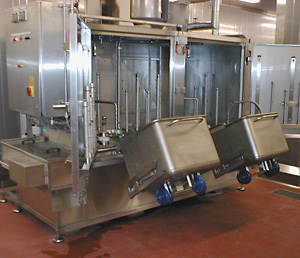
| Laura Chenel’s Chèvre, a goat cheese processor, recently installed a customized washer from CM Process Solutions to clean and sanitize its process buggies. Source: CM Process Solutions. |
In Northern California, Laura Chenel’s Chèvre, an award-winning goat cheese processor, recently installed a customized washer from CM Process Solutions to clean and sanitize its process buggies used to transfer cheese from the mixer to the packaging department at its newly expanded Sonoma County plant.
“These buggies handle millions of pounds of cheese annually,” explains Charles Willard, senior project engineer. “This is still done in small batches, 400 lbs. at a time, so these buggies are an integral part of the process stream. Once the cheese has been processed, the buggies must be cleaned and made ready for the next cycle.”
Prior to opening the new facility, workers used to clean the buggies with spray hoses in an open area of the plant that didn’t have much floor space.
“Before, this was a full-time job,” Willard explains. “But since we got the automated washing system, we simply line up the carts and push them in and start the system. Because it is automated, the worker in charge of cleaning the buggies can do other things while the washer is working. It saves on labor for spray washing and does a much better cleaning job.”
According to Willard, the construction standards used to manufacture the washing equipment were critical as well. “We evaluated the system by the type of construction, such as the stainless steel, the quality of the welds and the use of metal parts instead of plastic parts, as well as overall engineering and durability.”
He was impressed specifically with the level of detail in the design of the machine’s sanitation system. “One important design element is that the buggies are front-loaded into the washer upside down to ensure that even the wheels are completely cleaned,” says Willard. “Other washing systems load the buggy in on its side with the wheels facing the front door where there are no spray nozzles. This means the wheels are not cleaned well, and we didn’t want to risk tracking contaminants from the back end of the process to the front, where the cheese is loaded.”
In addition to system configuration, other parameters must be customized to provide the right washing system solution for a specific application, according to Willard. This includes water temperature, cleaning agents and water recovery systems, all of which can be vital to meeting both food safety and productivity goals.
For example, the choice of heating options—whether gas, steam coils, live steam injection or electric—could be vital to an application. The optimal washing system design also must take into consideration of the quantity of items to be washed and the level of soiling, rinsing and drying requirements. Even speed of throughput should match the application, whether the requirement is a batch cleaning process with individual containers or a more advanced, continuous, multi-lane system.
For more information: CM Process Solutions, 1269 Pomona Road, Corona, CA 92882; 951-808-4376; sales@cmpsolutions.net.