HMI/SCADA system promotes consistent, traceable burgers

Ever wondered how McDonald's Corp. ensures that its trademark Big Macs taste the same the world over? The answer is consistency of product and a delivery program that allows the company to trace any individual beef patty back to the supplier's specific batch. In fact, McDonalds evaluates potential suppliers on the basis of cleanliness, consistency and, yes, traceability.
Hence, when Swedish supplier Farlo was founded a decade ago for the purpose of making McDonald's hamburgers, the company required a means of satisfying those criteria while meeting a production load of 1 million hamburgers per day. While Farlo's overall goal was to improve production quality and capacity by streamlining and integrating plant monitoring and business systems, it also needed to document the quality and traceability of each item produced -- practices that proved costly and inefficient when performed manually.
Selection criteria
To meet these objectives, Farlo selected an HMI/SCADA system from Citect that features MES capabilities. The automation system -- Citect 5.20 -- integrates a Jeeves MES with data from a Mitsubishi PLC controlling the production process. One reason Citect was chosen was its ability to update to the latest version without risk to production or quality. Another was that everything Farlo needed could be integrated into the Citect package. Citect and the MES work together on the in the same networking domain, and run side by side in several workstations on the client side.Data acquisition rates from the controllers are less than one second, as are data transfers to the MES, effectively delivering real-time data to the enterprise. Citect communicates using stored procedures -- a fast and secure process that ensures the integrity of the MES database. The Citect server enables other applications to trigger events in Citect through standardized interfaces. When an event is triggered, Citect takes a snapshot of the process data and logs it to the MES database.
By using Citect to link production processes to the administration system, Farlo has achieved traceability.
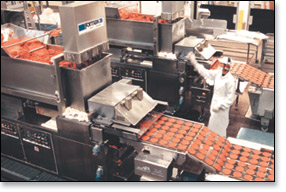
While the MES is responsible for stock overview, traceability, fat content registration and the recipe for the pre-blend, Citect monitors the production machines and plant temperatures. The production machine monitoring includes the mixing of beef, forming of hamburger patties, supervision of final mixture's recipe, and sending batch information back to the MES for traceability.
Farlo places its orders for beef via the MES. This information is entered automatically into the MES and then transferred to Citect to give the grinding operator a complete overview of raw materials available. McDonald's requires that the fat content only deviate by less than one percent. Citect automatically allocates the amount of different minced beef, and the correct blend ration is then calculated to produce a mix with the required fat content. This mix is then formed into 45-gram and 113-gram hamburger patties. Citect supervises the mixing process for each batch and transfers the batch results, including fat content and quantity, to the MES.
Citect optimizes, executes and reports these results for each individual batch. Fat data is sent from the MES to Citect for analysis using the product's Historical Trend System. The operator performs random size and weight checks on the patties, and enters the data into Citect. Citect updates the MES with batch start and stop times, batch number and production time. Each box of patties is uniquely marked with the time and date of the batch. This identification is used to track each patty until it lands on a bun.
Looking for a reprint of this article?
From high-res PDFs to custom plaques, order your copy today!