A brand new whey of packaging food

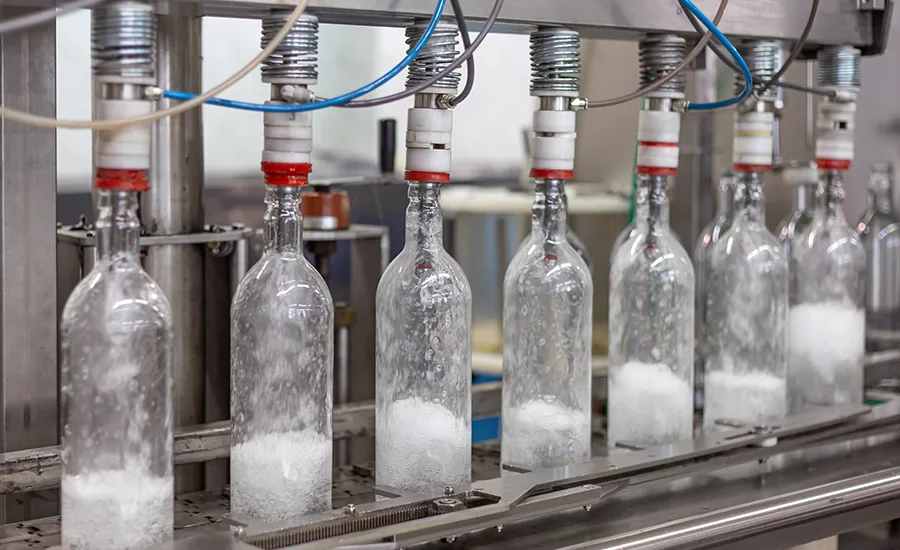
This machine is part of the coating application in the lacquering/laminating plant used to process WheyLayer films. Inset shows sample foods packaged in WheyLayer material. Source: Fraunhofer IVV.
Begun three years ago as an industry-driven, research and development project sponsored by the European Commission, WheyLayer is ending on a successful note. The purpose of the project is to develop a suitable whey protein-based packaging replacement barrier film layer for non-recyclable, synthetic-based film products. The WheyLayer film, developed by Fraunhofer Institute for Process Engineering and Packaging (Fraunhofer IVV), had to provide both an oxygen barrier and water vapor barrier similar to its synthetic counterpart; it also had to be biodegradable.
IRIS (Innovació i Recerca Industrial i Sostenible), a Spanish engineering group and partner in the project, is tasked with scaling up Fraunhofer IVV’s lab-based process to an industrial level and integrating the material in an industrial coating system. The WheyLayer material is laminated with a polymer substrate such as PET, OPP or PLA. In terms of recycling, the WheyLayer barrier coating can be dissolved completely without harming the substrate, making it easy for recyclers to reclaim the substrate.
A barrier-layer film is important in food packaging to prevent the oxidation of fats, oils and other food components from off-flavors, change in color and loss of nutrients. Common synthetic films such as PE and PP are excellent moisture barriers, but must be coated or laminated with synthetic polymers including EVOH and PVDC copolymers to provide an oxygen barrier, according to the WheyLayer Project. The resulting polymeric structures are effective in minimizing oxygen permeation, water vapor and odors, but are not very reusable for recycling because of the difficulty in separating the layers.
Recent research found that whey, the milk protein byproduct of cheese production, acts as a good moisture barrier with acceptable mechanical integrity. In addition, the use of the whey-layer coating on plastic films improves the recyclability and reuse of the plastic layer because the whey protein can easily be removed chemically or by using enzymes.
IRIS exhibited results from the ongoing project at Interpack in May. The first demonstration session for the WheyLayer project was held at IRIS on September 22. Various packaging items and samples based on WheyLayer were exhibited as well as the recycling process at lab scale. The WheyLayer project prototype machine built at IRIS was demonstrated to coat PET films at semi-industrial speed.
In addition, a WheyLayer demonstration was held in October at the TUBA(supplier of packaging materials) facility in Ljubljana, Slovenia. Fraunhofer IVV will show its new packaging film at the November 2011 Munich “Sustainability in Packaging: Process and Materials” conference.
According to WheyLayer’s Executive Summary 2.1, research activities led by Frauhofer IVV were to develop and select WheyLayer formulations best suited for achieving barrier property specifications of less than 20 cm3/m2 d bar for oxygen (23°C, 50 percent RH) and less than 50g/m3 d for water vapor permeation (23°C, 85 to 0 percent RH) for protein on polymer film substrates like PET, OPP or PLA.
Since whey proteins as raw materials for coatings show a wide spectrum of properties, extensive chemical, physical and functional characteristics tests were performed on carefully selected, commercially available whey protein concentrates (WPCs) and isolates (WPIs). Processing properties of the whey protein products were, in general, improved with increasing protein pureness and maintained protein nativity, according to the summary.
WPIs from both sweet whey and sour whey were produced in a pilot scale using a combined ultra- and micro-filtration process. The aim was to produce products with better adapted properties and to produce not-commercially available WPI from sour whey. The adapted process was suitable to process both types of whey and to produce WPIs with protein contents of 95.9 percent d.m. for sweet whey and 92.9 percent d.m. for sour whey respectively.
Missing protein properties for an excellent WheyLayer coating were introduced by elaborating formulations with additives like plasticizers (glycerol, sorbitol, PEG [polyethylene glycol] and PG). After further research and testing for rheological behavior, film-forming properties and water resistance, two formulations achieved the required specified properties, and were selected as first-coating materials on polymer substrates like PET, OPP and PLA.
For more information, visit www.wheylayer.eu.
Looking for a reprint of this article?
From high-res PDFs to custom plaques, order your copy today!