Lifestyle-specific containers
Canada’s Eska water touches all the material bases in its sweeping array of bottled still and carbonated waters.

 Most bottlers are content to offer a few different sizes of their conventional containers. Not so for Eaux Vives Water Inc., a Toronto firm that continues to expand a package lineup almost as varied and interesting as its own history.
A wholly owned subsidiary of Morgan Stanley Principal Investments, Eaux Vives embellished an already diverse packaging range last year with lightweight aluminum bottles made with coil-to-can (C2C) technology, a high-speed process for light-weighted containers. Instead of extruding the bottle from slugs, C2C fabricates the bottles from sheets, according to Ed Martin, business development manager at Youngstown, OH-based Exal Corp. Both the bottle and the cap are made from aluminum, Martin says, and faster line speeds and less raw material produce a container that’s about 30 percent lighter and less expensive than conventional containers. Eaux Vives’ bottles also use up to 60 percent recycled content, helping the bottler support a low-GHG, eco-friendly claim.
Aluminum gives Eaux Vives a clean sweep of material options for its Eska brand. Its still and carbonated water also is available in 750 ml glass bottles, four sizes of single-serve PET, three PET bottles with a Spill-Guard cap for on-the-go consumption, and 14 different multi-pack combinations. The diversity is a conscious effort to build the brand through convenience stores and other channels where single-unit sales predominate, explains Simon Lester, president & CEO.
“We’re not trying to enter the commodity market, where water is sold cheaply by the case, often used as a loss leader by the retailer,” says Lester. Only four of the Eska multi-packs contain 24 bottles.
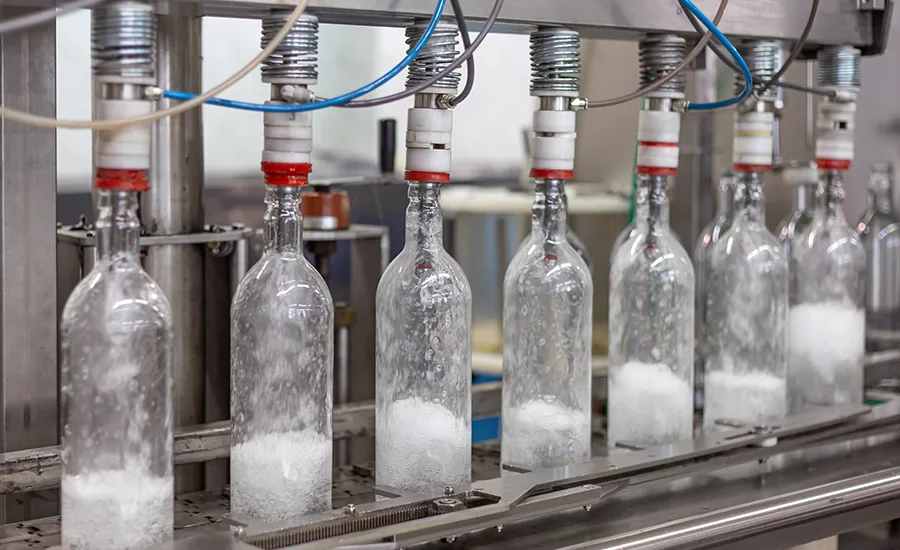
Product and process also distinguish the brand, and Lester hopes to build repeat sales on those dimensions. Instead of multiple filtration and purification steps, the water is pumped directly from underground esker formations in the remote Abitibi-Temiscaming region of Western Quebec and filled directly in a Sidel combi machine, which also caps and, in the case of PET preforms, blows the bottles. Positive pressure is maintained in the filling room, and the water arrives at 5
“The challenge is to do as little as we can to the water and allow nothing to get to it,” Lester says, adding exposure to ambient air can be measured in “nanoseconds.”
Eska debuted in Canadian stores in late 2006, with glass bottles added in December 2008. Crown-capped aluminum followed, though the screw-cap did not debut until June 2009. State approval is needed to export bottled spring water to the US, Lester says, a process that will delay US sales until at least the fall.
For more information:
Ed Martin, Exal Corp., 203-852-1962, ed.martin@exal.com
Single bottles are a more common presentation for Eska aluminum containers, voted the innovation of the year in 2009 by the Canadian Convenience Stores Association.
A carrying strap helps transport six bundled 1.5-L bottles of Eska. Most multipacks have 12 or fewer bottles, part of the company’s brand-building strategy. Source: Eaux Vives Water Inc.
A wholly owned subsidiary of Morgan Stanley Principal Investments, Eaux Vives embellished an already diverse packaging range last year with lightweight aluminum bottles made with coil-to-can (C2C) technology, a high-speed process for light-weighted containers. Instead of extruding the bottle from slugs, C2C fabricates the bottles from sheets, according to Ed Martin, business development manager at Youngstown, OH-based Exal Corp. Both the bottle and the cap are made from aluminum, Martin says, and faster line speeds and less raw material produce a container that’s about 30 percent lighter and less expensive than conventional containers. Eaux Vives’ bottles also use up to 60 percent recycled content, helping the bottler support a low-GHG, eco-friendly claim.
Aluminum gives Eaux Vives a clean sweep of material options for its Eska brand. Its still and carbonated water also is available in 750 ml glass bottles, four sizes of single-serve PET, three PET bottles with a Spill-Guard cap for on-the-go consumption, and 14 different multi-pack combinations. The diversity is a conscious effort to build the brand through convenience stores and other channels where single-unit sales predominate, explains Simon Lester, president & CEO.
“We’re not trying to enter the commodity market, where water is sold cheaply by the case, often used as a loss leader by the retailer,” says Lester. Only four of the Eska multi-packs contain 24 bottles.
Product and process also distinguish the brand, and Lester hopes to build repeat sales on those dimensions. Instead of multiple filtration and purification steps, the water is pumped directly from underground esker formations in the remote Abitibi-Temiscaming region of Western Quebec and filled directly in a Sidel combi machine, which also caps and, in the case of PET preforms, blows the bottles. Positive pressure is maintained in the filling room, and the water arrives at 5
“The challenge is to do as little as we can to the water and allow nothing to get to it,” Lester says, adding exposure to ambient air can be measured in “nanoseconds.”
Eska debuted in Canadian stores in late 2006, with glass bottles added in December 2008. Crown-capped aluminum followed, though the screw-cap did not debut until June 2009. State approval is needed to export bottled spring water to the US, Lester says, a process that will delay US sales until at least the fall.
For more information:
Ed Martin, Exal Corp., 203-852-1962, ed.martin@exal.com
Looking for a reprint of this article?
From high-res PDFs to custom plaques, order your copy today!