Active packaging gets a boost
The promise of packaging that senses change in food and reacts to it has been more tease than reality, but recent FDA clearance for Microsphere brings commercialization of at least one solution closer to market.
In June, the FDA issued a letter of no objection for Microsphere, an antimicrobial packaging system that releases chlorine dioxide gas to kill bacteria and spoilage organisms. Release rates are dictated by temperature and humidity levels. As humidity rises, gas release increases; if humidity drops, release slows and eventually stops. The biocide also acts as a deodorizer, eliminating unpleasant odors.
The technology, which relies on hydrolysis of an acid anhydride to release the chlorine dioxide, was patented in 1994 by researchers at San Antonio's Southwest Research Institute. Chicago-based Bernard Technologies Inc. funded the work and is the exclusive licensee.
The FDA's green light created a buzz among food scientists at the recent IFT conference, though many were quick to note chlorine dioxide's limitations. It can oxidize meat, for instance, turning red meat an unappetizing green. "Post-harvest fruits and vegetables will probably be our biggest application," allows Bernard's Nick DeVito, though cheese and other foods have potential. "We're partnering with a number of companies, and we think Maxwell Chase Technologies is going to be a core partner."
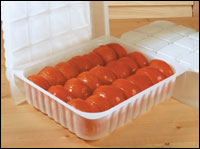
Atlanta-based Maxwell Chase is focused on controlling purge from meats and produce with its Fresh-R-Pax trays. The trays absorb up to a pint of blood and other fluids in packaged foods, and isolate the purge away from the food. "Control of purge has not been taken very seriously, but this broth encourages and sustains the organisms we are so desperately trying to control," says Tom Gautreaux, the firm's sales director. Incorporating low-cost sachets of chlorine dioxide would allow the tray to actively kill pathogens and spoilage organisms and extend shelf life, he suggests.
By releasing a gas, Microsphere also overcomes a limitation of biocides that require direct contact with pathogens. Bernard Technologies is working with film companies to incorporate chlorine dioxide in polyethylene, though one major supplier said film would have to be extruded with the compound rather than be coated with it if it is to be cost-effective.
Another active solution to purge contamination is being developed by Paper-Pak Products, a La Verne, Calif., supplier that has licensed a silver ion antimicrobial compound from AgION Technologies. Paper-Pak is developing Ultra Zap absorbent pads, which could replace paper purge pads. Paper-Pak also makes Attends, an adult incontinence care product.
Cost could be a barrier for silver ion, though. A more likely application is in food-preparation contact points. AK Steel is working with equipment manufacturers to apply silver ion coating on their machines' contact points, a safeguard that would add an estimated 5 to 10 percent to the equipment's total cost.
Looking for a reprint of this article?
From high-res PDFs to custom plaques, order your copy today!