Food Safety
Ignorance ain't bliss:
the lesson of mad cow in the US
Of course, the immediate result of the announcement was a ban on US beef exports by many nations, a product recall, and a frantic investigation by various US agencies. Consumer groups and various experts resumed their litany of how our government has again failed to protect the consumer and called for more regulation and testing.
But has the industry, regulatory agencies or public learned anything? The investigations into the history of the sick animal revealed that it was not a four-year-old dairy cow as originally thought. Born in Canada, the cow was six-years-old and may have been fed nervous system tissue when it was young. (The use of such tissue in animal feeds has been banned since 1997.)
Yet, despite the first US appearance of mad cow, good news exists. The animal was older, it entered the US before 1997 and the ranch owner was able to trace its history. The bad news was that the animal was slaughtered for meat and distributed to the public- consumers that, until this point, knew little about BSE.
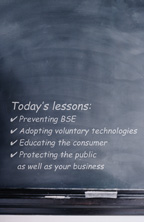
Further, the programs that have been imposed to control the disease in the US are effective. But are our systems as effective as they could be? Hopefully, the industry and government will look at this event as a lesson for all. Systems to monitor and control any potential hazard need to be constantly evaluated. This is a basic principle of HACCP and of ISO 9000 and one that we as an industry need to be sure to follow.
With new and improved technology, the ability to monitor individual animals and track them throughout the food chain becomes easier and less expensive. Voluntary adoption of any technology that enhances safety and quality is always viewed as favorable. Plus the adoption of such systems allows them to be evaluated effectively and without regulatory interference. The bottom line is that industry, and business in general, cannot afford to accept the status quo.
Unfortunately, though, the food industry neglected to be proactive in educating consumers on BSE. The industry waited until the problem occurred in the US before starting educational programs. The National Cattleman's Beef Association upgraded its website to inform consumers about the beef industry in general as well as programs that have been implemented to assure safety. The association has also held regular briefings since the sick cow was discovered and has started a site (www.bseinfo.org) that addresses issues related to mad cow disease.
I commend these approaches, but they come too late. They should have been implemented prior to the incident. It comes down to education and understanding. If people understand an illness or problem, they are less likely to be frightened and perhaps fewer people and businesses will suffer needlessly. It is the responsibility of industry, government and the educational systems at all levels to eliminate ignorance and to do so proactively.
Looking for a reprint of this article?
From high-res PDFs to custom plaques, order your copy today!