Managing Software:

With annual revenue reaching $7 billion, 32 percent market share and 13,000 implementations of its ERP product R/3 worldwide, SAP has established itself as the 800-pound gorilla in the enterprise application software market. Food company executives have taken notice and are wondering about the potential of SAP in the food industry, especially in plant applications.
SAP Vice President of Consumer Products E.J. Kenney, responsible for the company's food industry business, says that the food industry makes up approximately 16 percent of all SAP customers in the US and 10 percent worldwide. That translates into approximately 1,800 food companies worldwide and includes Nestle, Kraft, Kellogg, Hershey, Coca-Cola, Pepperidge Farm as well as a number of mid-sized companies.
SAP's software suite in the food industry includes solutions for financials, human resources and supply chain management. Many of SAP's food industry customers have invested extensively in these areas, but have not invested as much in SAP applications for manufacturing operations.
According to Kenney, about one third of the company's food industry customers have implemented SAP for manufacturing management in the plant. "Our consumer goods customers, including food customers, have chosen to implement the solutions that impact customers first, for example, order-to-cash applications. Then they move into manufacturing and supply chain planning."
Last fall Kara Romanow, a research analyst with AMR Research, wrote a report that addressed SAP in process plants. According to Romanow, approximately 4 percent of SAP process customers have installed SAP at the plant level. "Although my analysis dealt with the process industries, reviewing my information reveals that the food industry's numbers would not be different. Roughly 4 percent of SAP's food customers have installed in the plants." Even though the report was conducted a year ago, Romanow believes the number is now higher that 4 percent but not significantly so.
The AMR report showed that missing functionality was cited by 94 percent of SAP's process customers as the reason they have not adopted SAP in the plant. Despite the functionality included in SAP's manufacturing offerings, these customers claimed that the function did not go deep enough or did not exist at all. The functions cited as missing include adequate modeling of the process itself (byproducts and coproducts, disassembly, etc.) costing of complex processes and products, catch weight, management of material characteristics (brix, viscosity, fat percentage, etc.) and the inability to react to inconsistencies in the production process itself. These customers are using legacy or homegrown systems to manage their plants with integration to their SAP systems. The legacy and homegrown systems are highly customized to fit the specific nature of the plant and, in most cases, the cost and effort of replacing these systems outweigh any perceived benefit.
When asked about functionality, Kenney states, "SAP has a broad solution for the food plant that includes inventory management, recipe management, quality management, maintenance, accounting and human resources. SAP has been and continues to invest in more functionality for the plant including catch-weight, quality based available-to-promise to better utilize on-hand ingredients and finished goods, portal technology to simplify the user interface, event management to issue and react to alert conditions and more."
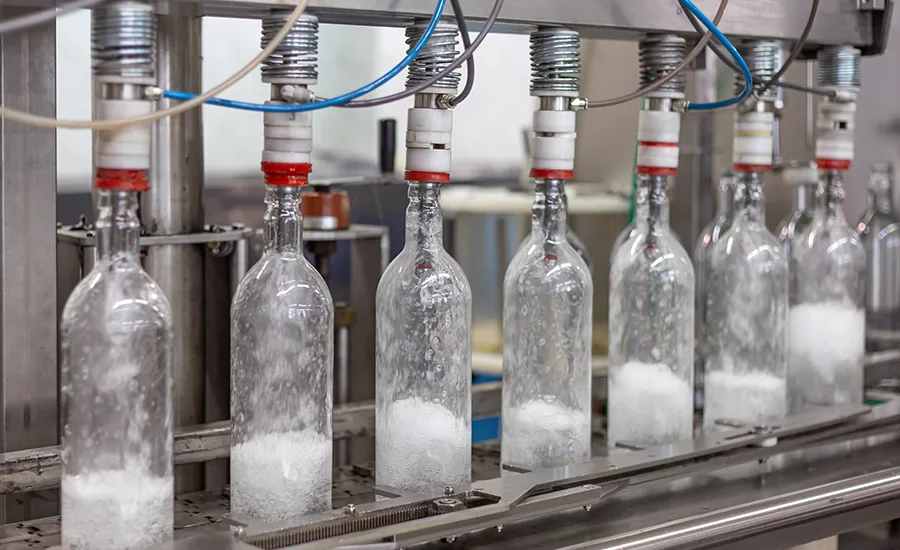
The AMR report looked at the impact on systems of different levels of complexity and variability in the plant. Within the food industry, a bottling plant is relatively simple and a meat processor (kill and further processing) is relatively complex. Romanow states that the level of process complexity and variability was the major determinant of the applications implemented in the process plant. The fill and pack operations have had success with SAP's R/3. More complicated operations like mix and pack, process reactions and disassemble use plant centric ERP and packaged or customer MES systems, she says. "SAP is more widely installed in simple operations and less so in more complex operations. Those companies with SAP corporate infrastructures are typically using other systems for the plant and feeding normalized data into R/3," according to Romanow.
SAP has had success in the beverage industry and its customers include Coca-Cola, Anheuser-Busch, Cadbury-Schweppes, Guinness, and the Boston Beer Company. The company has recently introduced SAP-Beverage which, in addition to managing the beverage plant, includes telephone sales, route accounting, route management, empties, excise duties, contract management, and rebates/bonus agreements.
Romanow found that SAP's success in the plant is primarily driven by the objectives of the enterprise. In those enterprises where integration and standardization are the primary drivers, plant level SAP systems are more prevalent. According to the AMR Report, "SAP implementations in these industries have been successful when standardization is ruthlessly enforced and integration is the business driver."
Is SAP a key vendor to the food industry? Absolutely. Is SAP right for a food plant? Maybe. As SAP continues to expand its functionality, it will be appropriate for more food plants as they move from simple to complex processes.
Looking for a reprint of this article?
From high-res PDFs to custom plaques, order your copy today!