Cold storage warehouse cools energy costs by 35 percent

|
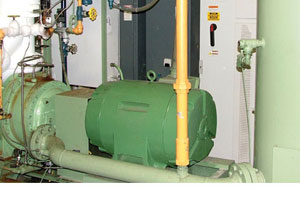
| An ABB drive unit is mounted directly behind the motor, which is coupled to one of the ammonia compressors. Source: ABB. |
“American Electric Power, our electricity provider, informed us of pending rate increases due to the end of a 15-year moratorium,” says Jerry Tippmann, ICS refrigeration operations manager. “Cold storage facilities’ largest expenses are energy and manpower, so improving energy efficiency is an obvious area for operational improvement.”
ICS is owned by Tippmann Affiliated Group, which owns over a dozen companies, including Tippmann Refrigeration, a company that specializes in design/build services for refrigerated warehouses and distribution facilities. Tippmann Refrigeration, led by Project Engineer Phil Black, conducted the warehouse modernization project for ICS. Prior to joining Tippmann Refrigeration, Black had been with an independent rep firm that handled, among other products, ABB variable frequency drives (VFDs).
“My awareness of the recent leaps in VFD technology, and their value-price offer, made VFDs a focal point of our analysis,” says Black. “That, coupled with the large number of rotating loads in a public cold storage facility, made the prospect of adding VFDs a high-potential means to achieve improved efficiency.”
Black decided to add 26 ABB VFDs to the motors powering the compressors, evaporators and condensers. Most striking was the savings in energy costs, as the Fort Wayne West facility realized an electrical energy consumption savings of 35 percent, providing a six-month return on investment. The major sources of the energy savings include:
• Compressor capacity control—The only way to control the capacity of the compressor used to be through opening and closing the slide valve, which wasted energy. With the drives, the capacity can be set at any point between 0 to 100 percent, matching energy to the load with no waste.
• Condenser and evaporator fan control—Previously, the only setting on the condenser and evaporator fans was “on” or “off.” With the drives, the control of the condensers can be far more precise.
Based on these benefits alone, ICS added drives to the refrigeration system in its remaining four locations, facilities that range in age from 10 to 35 years, and in refrigerated storage capacity from 1.75 to 7.25 million cubic feet.
“The improvement in efficiency was clearly evident within a few months,” says ICS President Vince Tippmann, Jr. “The dramatic reduction in energy costs made modernizing our other facilities in the same manner a top priority.”
For more information:
James Kluck, 262-751-1771, james.e.kluck@us.abb.com
Phil Black, Tippmann Refrigeration, 260-428-2500, phil.black@tippmannrefrigeration.com
Looking for a reprint of this article?
From high-res PDFs to custom plaques, order your copy today!