|
| David Parrott |
|
|
Microwave ovens have reshaped the way Americans prepare meals, but industrial microwave heating remains a niche application for specialty products such as cooked bacon. That’s beginning to change, as firms like Classica Microwave Technologies introduce in-container sterilization (see Food Engineering, November 2003) and Industrial Microwave Systems (IMS), Morrisville, N.C., expands beyond chemical and textile processes to focus on pumpable foods and drying applications.
IMS was founded in 1997 by two electrical engineers, Professor William T. Joines of Duke University and protégé J. Michael Drozd. The men conceived a method to focus the energy from a magnetron and overcome the uneven heating that characterizes the technology. They developed two systems for controlling electromagnetic energy: a cylindrical chamber through which fluids flow, and a planar system for drying on a moving belt. The planar requires a conveyor. Last fall, Harahan, La.-based Laitram LLC, which also owns conveyor belting manufacturer Intralox, acquired IMS. The potential synergies have made planar applications a priority for now, although continuous-flow processing in a tube may become the technology’s most dynamic food processing application.
An IMS microwave cylindrical heating system was installed two years ago in an aseptic pilot plant at the Center for Advanced Processing and Packaging Studies (CAPPS) at North Carolina State University. The system feeds electromagnetic energy into two applicator chambers, one to preheat viscous product and the second to achieve extended shelflife or asepsis. Near-instantaneous heating is achieved with product flowing through the chambers in a 1.5-inch diameter pipe at a rate of about two gallons per minute. The system has been tested extensively on fluids of varying viscosity, and work with particulates is underway. The absence of hot surfaces minimizes the problem of product burn-on, and noncontact, rapid heating and cool-down make the process well suited for heat-sensitive proteins and nutrients.
Bringing the microwave system to the commercial world is David L. Parrott, IMS’s general manager, food group. Before joining IMS, Parrott was general manager, North American operations for API Schmidt-Bretten, a fabricator of sanitary heat exchangers. He spent 22 years with the APV Group, filling technical development and managerial positions worldwide. Parrott holds undergraduate and advanced degrees in chemical engineering, specializing in non-Newtonian heat transfer. Food Engineering spoke with him recently at the International Petfood Forum in suburban Chicago.
 |
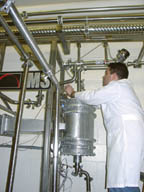
| A technician checks a microwave processing system at the North Carolina State University pilot plant. Microwave energy enters the cylindrical processing area from the horizontal ductwork on the left, creating an elliptical heating zone through which product flows. |
|
|
FE: How does cylindrical microwave technology differ from conventional approaches?
Parrott: Most genius ideas are very simple in concept, and that’s the case here. Whereas others have taken the traditional way of delivering microwave energy to a product and then trying to overcome the problem of hot and cold spots with multimode chambers and other techniques, Joines and Drozd first addressed the issue of non-uniformity. They devised a waveguide to focus microwave energy into a cylindrical format that transfers energy evenly into whatever was flowing through the applicator.
FE: How does cylindrical microwave heating work?
Parrott: There are three principal parts to the system: the microwave generator and control system that delivers the power according to the desired temperature, pressure and flow; the cylindrical applicator where energy is focused back toward the center, where the tube containing the product is situated; and the waveguide that brings energy from the generator to the cylinder. The geometry of the applicator can be elliptical or circular, depending on the product.
The walls of the tube containing the product are made of Teflon or ceramic. The CAPPS pilot plant system delivers up to 60 KW of power, with energy split and directed to two applicators. Food could be gelatinized in one applicator, then sterilized in the other. This also allows for temperature equalization between the two chambers and more targeted temperature ranges within each. Product might arrive at the second applicator at 167˚F, then be quickly heated to 295˚ to achieve sterility.
FE: What system refinements have been made during the CAPPS trials?
Parrott: The refinements mainly have been in the surrounding environment, the technology’s integration into a truly commercial aseptic system. A Marlin pump was added to control feed and pressure to the system, Feldmeier contributed a tubular system, aseptic packaging was added and so on.
FE: Have operators focused on validating effectiveness in achieving asepsis, then?
Parrott: Exactly. They’ve been running a lot of dairy products, tomato- and starch-based products, and other foods of interest to the commercial members of CAPPS. Last month, a joint USDA-NC State team successfully sterilized and aseptically packaged sweet-potato puree of much higher quality than a retorted product. We’re close to high acid commercial applications and less than a year away for most low-acid products. Commercial companies are now ready to move R&D projects in house to work on them privately.
FE: How efficient is microwave processing?
Parrott: Where uniform drying and moisture control are important, microwave is very efficient. The textiles industry investigated infrared and RF without success before turning to microwave. In an RF dryer, about 50 percent of electrical power is converted to useful heat, compared to 82-85 percent for microwave. A standard heat exchanger is more efficient than microwave, but fouling will occur because the walls of the unit are hotter than the product. With microwave, the relationship is inverted: the walls are cooler than the product, minimizing fouling.
FE: How safe is the system?
Parrott: The FDA has a standard for home microwave units and a medical-processing standard, but there was no standard for commercial food systems, so the first thing I did was work with FDA to establish one. We exceed it and are 20 times safer than batch ovens.
There is no international frequency standard for wavelength size in industrial microwave. European units typically operate at a frequency of 890 Megahertz (MHz), while U.S. units are 915 MHz. At 915 MHz, penetration of 2.5 inches is achieved, compared to 1 inch with a home microwave operating at 2,450 MHz. At 460 MHz, penetration of 5 to 6 inches is achieved. Unfortunately, cost rises as frequency decreases.
Those penetration numbers are very conservative, based on IMS’ system design to prevent leakage that could harm the operator. There are choke flanges at the top and bottom of the cylinder to reflect energy back to the processing area and minimize leakage.
As a further safety precaution, the generator is in a dry area isolated from the processing floor. Our generator can be located up to 200 feet away, with an interconnecting waveguide delivering the microwave energy. There’s no loss of power: it’s almost like shooting a beam of light down the channel.
FE: Microwave processing is somewhat similar to ohmic and electro-heating, technologies that have failed to win converts in the food industry. Why should microwave be any different?
Parrott: Ohmic was great technology that was somewhat misapplied in the U.S. because foodservice cans were used instead of distinctive packaging. Customers had no idea it was a high-value product. For that reason, we’re focusing on aseptic pouches for medical products and foods with expensive ingredients.
A processor has to decide whether to approach this technology in pure economic terms or as a way to enhance the value and quality of a particular product. If the model is economics driven, conventional heating and cooling methods could be used in conjunction with microwave. For high value-added products, microwave should provide the whole heating cycle in a two-phase approach.
FE: When do you expect the cylinder system to be applied commercially?
Parrott: Our top priority now is to get the planar belt system up and operating. That system is excellent for removing moisture from soybeans, peanuts and other foods, including dry pet food, where moisture control is a major issue. After that, we’ll focus on our cylindrical system, where our partner MicroThermics has initiated trial work on several products using lab-scale systems
We believe the Holy Grail is in sterilization for soup, baby food and other products. There’s a lot of interest in the military. Converting from refrigerated foods to high quality, shelf-stable foods would make a lot of sense.