Using AI to unlock new value from your CIP processes
Three opportunities for AI ROI
While many industries struggle to demonstrate meaningful returns on their AI investments, food and beverage manufacturers are charting a different course.
The secret to their success? Avoiding hype applications in favor of targeted improvements to their essential process – like one of the industry’s most critical (but overlooked) processes: clean in place (CIP).
By strategically applying AI-enhanced technology to CIP operations, food and beverage manufacturers are unlocking new ways to optimize washes while keeping their core production equipment food safe and compliant.
Why most AI investments fail (and how F&B manufacturers can get it right)
The promise of AI has captivated business leaders across every sector, yet the reality has proven disappointing. Adoption often directs the power of AI toward superficial applications that don’t directly impact business value or drive revenue. And too often, AI initiatives fail to make full use of process data that, ideally, serves as the generative core of AI functionality.
Recent research from MIT has put these failures into soberingly concrete terms: among companies making substantial AI investments, 95% are seeing zero return on investment.
That's not a typo. An extreme majority of AI initiatives are failing to deliver value.
Food and beverage manufacturers are avoiding these pitfalls by focusing AI efforts on processes that make a significant impact on core productivity, i.e., how much product they’re able to generate or process in a day. This focus directs their attention to operations that are both essential and prone to inefficiency––a description that fits CIP perfectly.
Applied correctly, AI-enhanced tools can help food & beverage manufacturers transform CIP from their #1 hurdle into a competitive advantage.
Here’s how.
Step #1: Turn data into actionable intelligence
Think about how much data comes out of each CIP wash. Flow, duration, chemical concentration, temperature ––combined; these metrics paint a rich picture of CIP performance over time. But traditionally, this data has been underutilized past initial verification of clean, either scattered across disconnected systems or simply neglected.
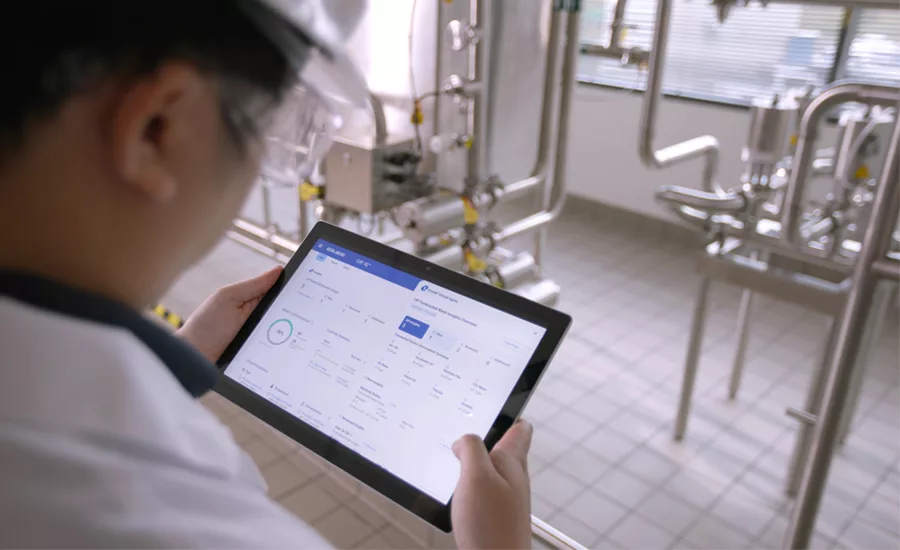
AI can help rescue this missed opportunity. AI-powered digital platforms are changing the equation by automatically gathering and analyzing CIP data as it's generated, revealing patterns that drive smarter operations and unlock hidden capacity. This extra capacity is the key to delivering the coveted ROI 95% of AI initiatives fail to deliver.
AI transforms the approach to CIP from reactive to proactive. Advanced algorithms can identify anomalies before they become problems, predict upcoming wash cycle requirements, evaluate potential risks, and dramatically reduce troubleshooting time when issues do occur.
Step #2: Unlock the complete power of process automation
Out of an abundance of caution, CIP cycles tend to be longer than they need to be. The assumption is that protecting essential food safety at the heart of CIP inevitably costs some efficiency.
But every minute spent over-washing after a thorough clean has been achieved is a minute of lost production time and lost resources. Every lost minute carries a price tag.
Combined with advanced turbidity and/or impedance sensors, new AI-enhanced monitoring and decisioning tools can eliminate this efficiency problem without putting food safety at risk. These technologies can monitor soil levels throughout the cleaning process in real time, determining precisely when contaminants have been adequately removed.
This has the potential to fundamentally change how CIP works. Instead of relying on predetermined time-based protocols that may over-clean (wasting time and resources) or, worse, under-clean (risking food safety), AI-enabled systems ensure that each wash cycle runs exactly as long as necessary. No more, no less.
Step #3: Chart a course for continuous optimization and improvement
Perhaps the most compelling aspect of AI-enhanced CIP is its capacity for ongoing optimization. The most sophisticated AI platforms don't just deliver a one-time efficiency boost. They learn, adapt, and improve.
Real-time operational data becomes a reliable history of patterns that generate increasingly refined insights. The recommendations from these systems improve over time, creating a virtuous cycle that compounds over months and years.
When paired with the right expertise and cleaning chemistries, AI-enhanced CIP represents exactly the kind of strategic AI investment that delivers lasting value: optimizing mission-critical processes to become smarter, more efficient, and more valuable with every wash cycle.
CIP’s path forward is paved with AI. Are you ready?
The benefits of AI-enhanced CIP aren't hypothetical. Food and beverage manufacturers implementing these technologies are documenting efficiency improvements of 15% in real-world operations.*
Consider what that additional 15% of production time means for your facility. As consumer preferences continue evolving and competition intensifies, this kind of operational flexibility delivers the agility manufacturers need to grow profitability.
*Based on results from Ecolab customer trials. Results will vary based on factors and circumstances in other customers’ operations.
About the Author
Melissa Cisewski is Director of Business Transformation within Ecolab’s Global Food & Beverage division, where she leads initiatives to advance digital adoption and intelligence solutions.
Looking for a reprint of this article?
From high-res PDFs to custom plaques, order your copy today!