The State of Food Manufacturing in 2025
October 14, 2025
The State of Food Manufacturing in 2025
October 14, 2025
Overall, food manufacturers continue to invest in equipment and training despite rising material and labor costs.
That’s according to FOOD ENGINEERING’s 46th State of Food Manufacturing survey, conducted annually in partnership with research firm myCLEARopinion Insights Hub. We asked food and beverage manufacturing professionals about operational improvements, equipment budgets, food safety implementation and more.
These insights, following our 48th Plant Construction Survey and our annual ranking of the Top 100 Food and Beverage Companies, offer a complete picture of manufacturers’ priorities, concerns and experiences.
The State of Food Manufacturing in 2026 Is Now Available!!
Explore how food and beverage manufacturers are investing in food safety, automation, and sustainability to enhance efficiency in a complex landscape. Discover their insights ≫
Throughput Expectations
Similar to 2024, three in five (60%) food manufacturing professionals expect their location’s throughput to increase in 2025 — by 20% on average. One quarter of respondents project their location’s throughput will increase by 6% to 10%, while 17% expect an increase of 11% to 15%. Another quarter expect a throughput increase of more than 20%.
Manufacturers cite increased business or new customers (28%) and increased demand (23%) as reasons driving growth in throughput, but expanded product offerings, expanded operations and improved efficiency also made the list.
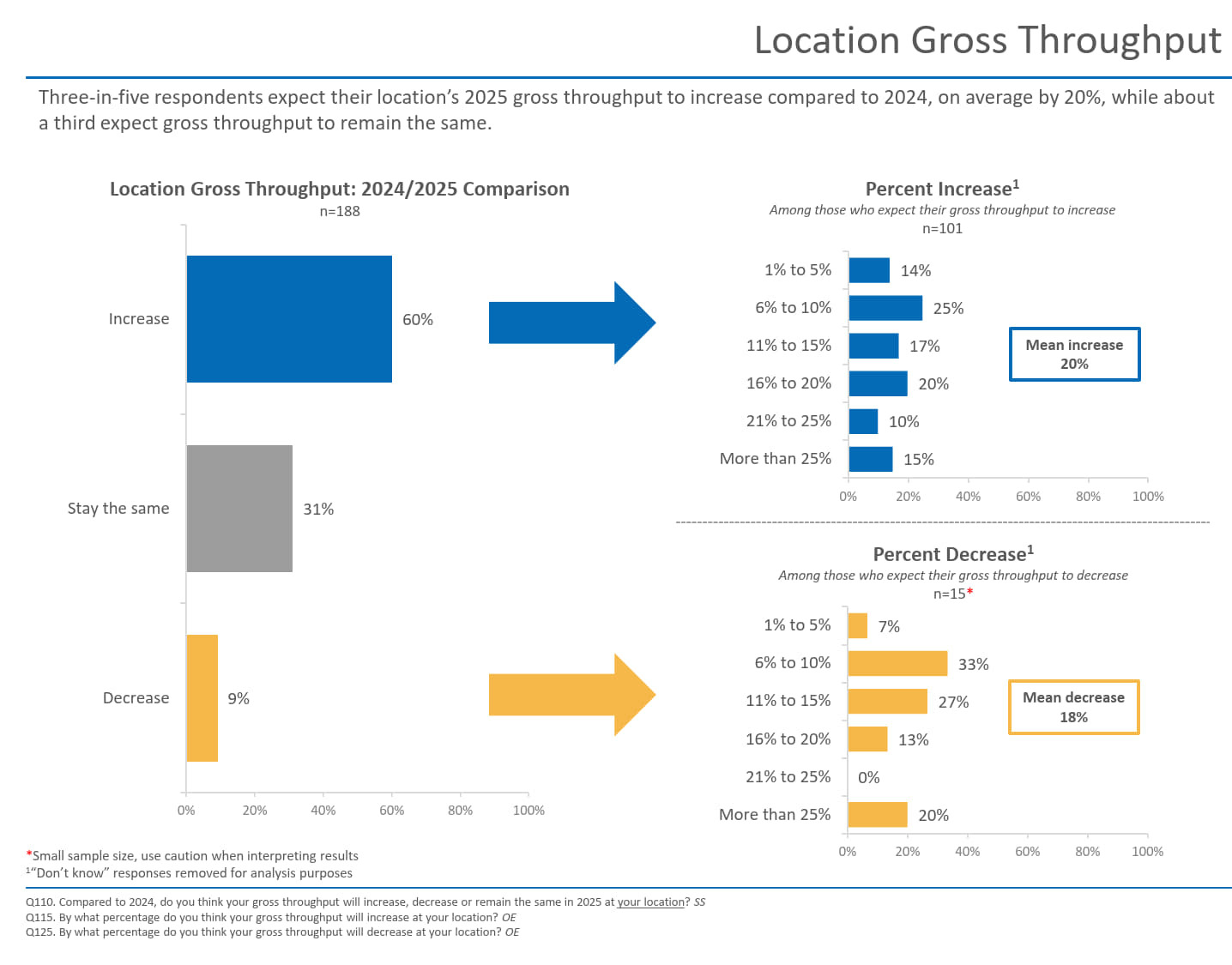
Meanwhile, 1 in 10 (9%) of respondents say their location will experience a reduction in gross throughput this year. One-third project a decrease of 6% to 10%, while another 27% expects throughput to drop by 11% to 15%. The average decrease is 18%.
Survey respondents who expect a decrease point to economic and market conditions, cost and pricing pressures, labor challenges, operational and production issues, and customer and sales impacts.
One executive cites workforce concerns: “We are unable to find labor and the only answer we have right now is to produce less product.”
Looking for a reprint of this article?
From high-res PDFs to custom plaques, order your copy today!
Another discusses shifting consumer demand in the face of economic pressures: “My products are not considered essential to consumers who are focused on basic items rather than ‘treats.’”
Cost Per Product
Overall, survey respondents say the cost of manufacturing products has increased in 2025. In fact, 78% say they’re experiencing increases from 2024, while last year, 68% of manufacturing professionals said total cost per product increased from 2023.
Nearly 70% of this year’s survey respondents say their company’s total cost per product has increased up to 10%, while 13% say costs have jumped between 11% and 15%. The mean increase is 13%.

Looking at labor costs per product, 64% of surveyed manufacturing professionals say they’re expecting an increase, while 32% expect them to remain the same. Most (42%) expect labor costs per product to grow 1% to 5%, while another third (33%) expect them to increase 6%-10%. On average, they expect labor cost per product to rise 11%.
The majority of food manufacturers (81%) also project material costs per product to rise in 2025. Nearly 40% expect an increase of 1% to 5%, while 29% expect material costs per product to grow by 6% to 10%. On average, survey respondents expect material costs per product to increase 11%.
Manufacturers cite several reasons for material cost increases, including rising ingredient costs (83%), growing raw material costs (75%) and increasing logistics and transportation costs (59%).
Equipment Budget
Some manufacturers say their budgets for production, packaging and process control equipment, as well as professional services, have increased this year. Specifically, 54% of survey respondents expect an increase, while 34% say their budgets will stay the same. Last year, exactly half (50%) expected an increase and 40% expected their budgets to remain the same.
On average, manufacturers’ equipment budgets have increased by 19%. However, 21% say their budgets increased by 1% to 5%, while 24% say their equipment budgets grew by 6% to 10%.
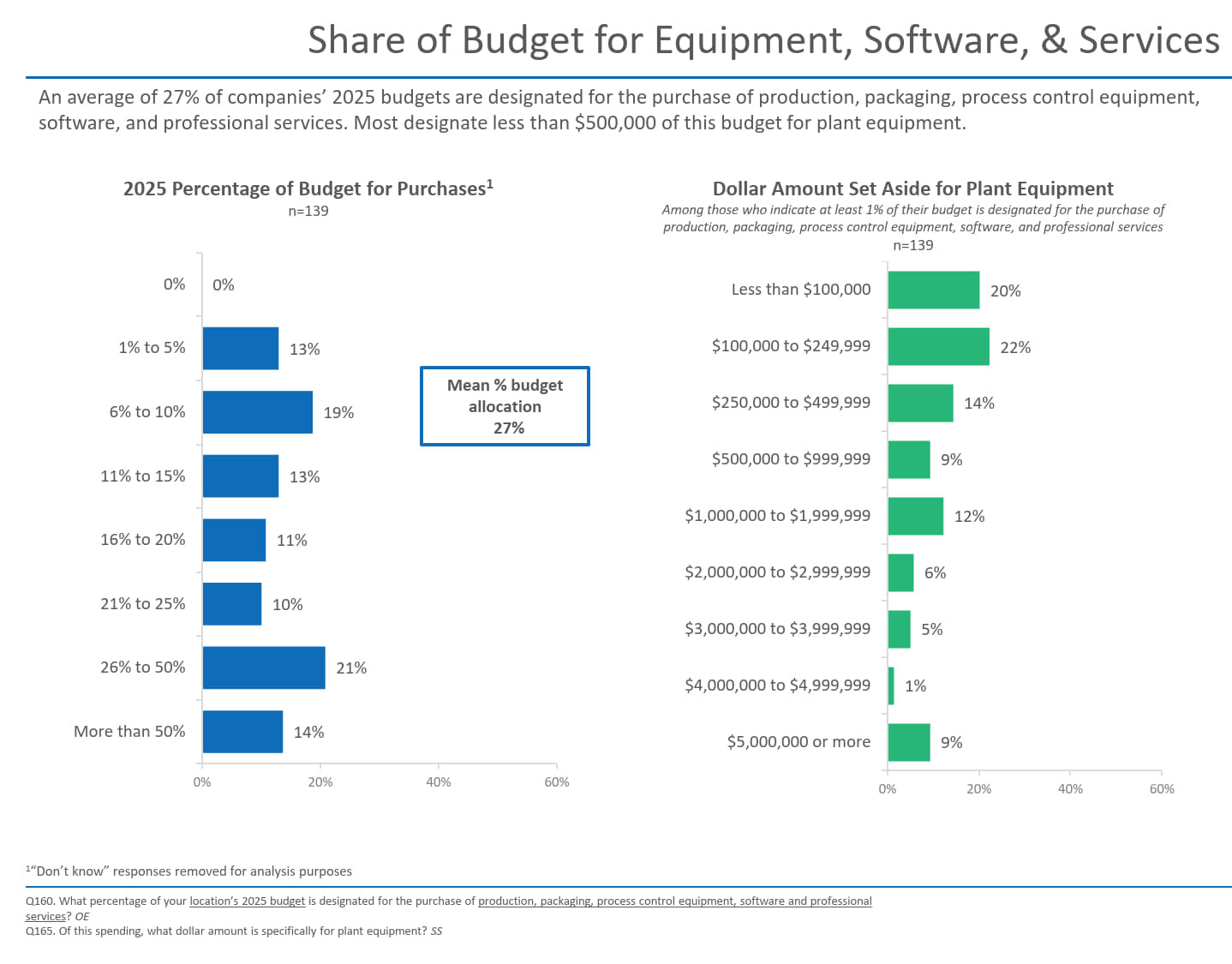
Proportionally, 21% of manufacturing professionals say one-quarter up to half of their budgets will go toward equipment purchases, while 19% say 6% to 10% of their budgets will cover equipment. On average, 27% of manufacturers’ annual budgets will go toward equipment purchases. That compares to 25% in 2024.
However, the majority (56%) plan to spend less than $500,000. That’s down from 60% in 2024. Meanwhile, one-third (33%) of manufacturing professionals expect to spend more than $1 million, with 9% expecting to spend $5 million or more.
Food Safety
With recent recalls connected to foodborne pathogens — and upcoming mandatory traceability requirements under the Food Safety Modernization Act (FSMA) — food safety is more important than ever.
Nearly half (48%) of surveyed manufacturing professionals say they’ve conducted safety-related training over the last year, compared to 46% in 2024. Additionally, 32% say they plan to purchase lab testing or analysis equipment or software, while 24% intend to purchase a food safety management system. These represent the top two categories of software and hardware purchases this year.
As for food safety methods in use, three-quarters (74%) of manufacturing professionals say they employ food allergen controls, representing the top method. Comprehensive staff training (72%) follows, as does lot-level traceability (64%) and food safety management system (63%). Rounding out the Top 5 is item-level traceability (53%).
Just over half (53%) say the rely on microbiological or chemical testing of raw materials and ingredients, while 40% say maintaining supply chain consistency is the most difficult preventative control to manage. In 2024, nearly a third of respondents (32%) said supply chain consistency was the most difficult preventative control to manage.
This year, manufacturing professionals also cite allergen controls and cross-contamination prevention (29%) and sanitation procedures (27%) as difficult to manage.
Notably, 22% of respondents say they have no difficulty managing preventative controls, which is up from 19% in 2024.
These insights represent only part of the information included in our study, which also covers methods for improving operations and productivity, workforce challenges and cybersecurity. The full study is available on the myCLEARopinion Insights Hub. We’ll also expand on these topics during our State of Food Manufacturing webinar, set for Oct. 15.