Looking Toward Water-Smart Cleaning and Sanitation
Food and beverage plants are notoriously wasteful of water, and while the overarching call is to reduce water usage, cleaning/sanitation operations is a good place to start.
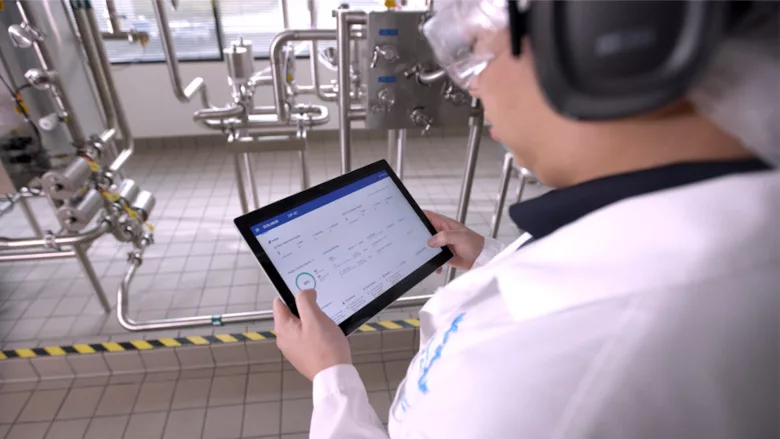
Ecolab’s CIP IQ, is a smart, AI-enhanced clean-in-place (CIP) digital solution designed to help food and beverage companies maximize product quality and food safety while reducing water usage and increasing production capacity.
If a food and beverage processor is building a new facility, the producer may have the option of locating a plant in an environment that makes it easier to maintain, clean and sanitize. For example, build a facility that produces dry products in a less humid and wet climate where availability of water for cleaning and sanitation is sufficient — but not critical. On the other hand, processes that use a lot of water for cleaning and sanitation should be located in areas where the water table is not an issue. But too much water and moisture in some geographical areas can be a problem for making any product.
Humidity should be considered with respect to building and doing so in a suitable manner, says Angela Anandappa, Ph.D., founding executive director, Alliance for Advanced Sanitation, food microbiologist, lean manufacturing and sustainability practitioner. "From Southeast Texas to South Carolina and the Midwest around the Great Lakes are common geographical areas in which high humidity can prevail, especially in the summer months and through hurricane season. As we look to reduce water use it is also important to build in the systems to eliminate water altogether in dry facilities like those that produce low moisture product and candies."
Building a fit-for-purpose facility is important no matter where the facility is planned to be located, Anandappa adds. "If we could segment where products are made by humidity simply to reduce the energy costs of conditioning the plant environment appropriately, dry and low moisture plants like cereals, candy and similar will be in the Central Plains, South and Southwest. High humidity environments do need different sanitation procedures to combat mold and pathogens like Listeria. As extreme weather events seem to strike in more unexpected areas, it becomes more important to incorporate proper building standards, raised structures, appropriate exhaust systems and auxiliary power to compensate for outages."
Water-Smart: Clever or Useful Term?
EXPLORE MORE

The term "water smart" has been bantered about lately by some of the public utilities around the U.S. and is a part of an upcoming "Water Smart Industrial Alliance," which the EU is scheduled to form this year. The EU's objective is to transition to a water-smart economy where water, energy and materials are recovered and reused, specifically aiming for a10% water efficiency improvement by 2030, according to the Brussels Sustainability Club. [1]
The Water Smart Industrial Alliance will establish best practices for industrial water reuse, and seeks to accelerate the use of smart digital tools such as sensors and AI to manage water and wastewater in industrial operations.
The ultimate vision of a water-smart facility is one that embraces true water circularity, says Andy Mulrooney, Ecolab engineering business leader – food and beverage. "That means you're reducing water used in processes outside ingredient water, reusing water across different functions and recycling water whenever possible."
That's a lot, and it doesn't happen overnight, Mulrooney says. "But it can happen a bit at a time, and most plants are already taking steps that get them closer. If a plant isn't getting advanced digital insights today, that's a great place to start. Without digital insights, you're essentially blind to the improvements that could make a significant impact."
In cleaning and sanitation procedures, digital monitoring tools can be indispensable in supporting water initiatives and helping them gain traction, Mulrooney says. "They capture information in real time without human error — things like circuit volumes, rinse times and flow rates. Newer tools can even capture information like when, exactly, each rinse in a sanitation step has removed soils so production can move on as soon as it's safe to do so instead of relying on a rigid sanitation standard operating procedure (SSOP). Visibility goes hand in hand with food safety goals, and digital is the best way to get visibility reliably."
'Water Smart' Cleaning and Sanitation
Water smart facilities need water purification systems for water reuse as well as planning for using less water, Anandappa says. "Building in appropriate water pressure is also a way of reducing and using the right amount of water. Water pressure should include the proper calculations for flow rate based on the activities that will be carried out. If water is used for conveyance, those systems may recirculate water while including filtration and reconditioning systems."
"The most water-effective cleaning facilities are those designed from the ground up to minimize the cleaning requirements," says Pablo M. Coronel, CRB senior fellow. Walls and floors are smooth to simplify cleaning, while room segregation limits cleaning to smaller, controlled areas. Placing control cabinets, electrical equipment, etc. in hallways instead of in the production floor simplifies cleaning by minimizing the surface area. Equipment should be designed to be cleaned in place (CIP) and some of the utilities (e.g. steam, process water) are recycled to maximize the usage of water.
Careful design of equipment is critical, Coronel adds. Equipment should be certified as cleanable with smooth food contact and non-food contact surfaces. Installations must avoid hard-to-clean areas such as dead legs, long straight runs and tubes that are too large in diameter. All welds must be smooth and passivated to prevent rough areas where dirt can stick.
A well-designed CIP system is made effective by using the proper chemical concentration, temperature, flow rate — and lowering cleaning time. CIP can recirculate chemicals, and in some cases, can be reused at least once, Coronel says. Depending on the product, a pigging system can also be used to maximize the product recovery and minimize the use of water.
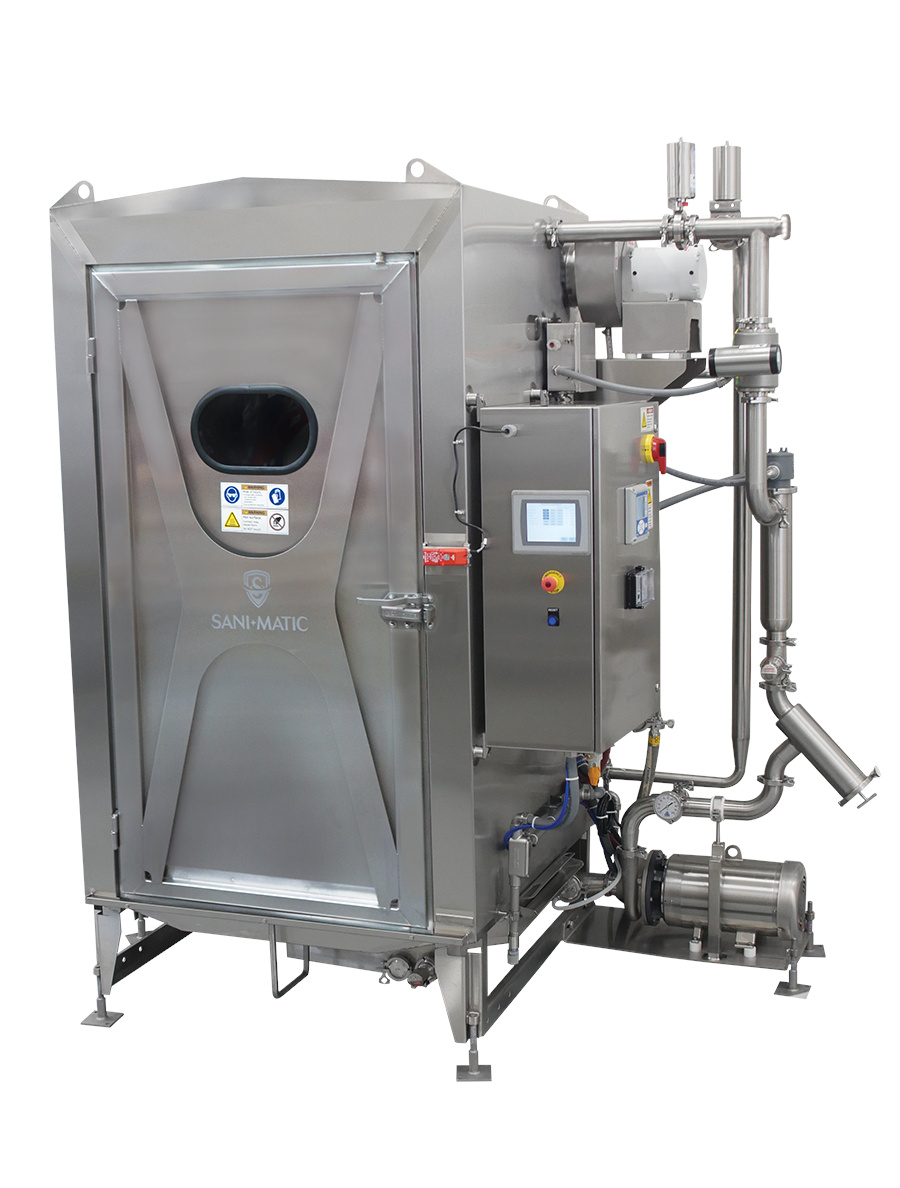
A system like the SaniCab P parts washer can wash a rack full of parts that may take 1,000 gallons of water to wash manually and reduce usage down to 60 gallons of water to pre-rinse, chemical wash, post-rinse and sanitize the parts. Photo courtesy of Sani-Matic
One of the largest areas of water use in a facility can be the sanitation process, says Peter Barrie, Sani-Matic, director of product and marketing. Barrie notes that while CIP technologies are familiar to many facilities, many processors are still doing most or all of their clean-out-of-place (COP) manually. A good improvement is planning for a COP parts washer; an even better option is automated parts washing, like washing your dishes at home.
A system like the SaniCab P parts washer can wash a rack full of parts that may take 1,000 gallons of water to wash manually and reduce usage down to 60 gallons of water to pre-rinse, chemical wash, post-rinse and sanitize the parts.
Are there any Other Places to Save Water in Sanitation?
Plenty of processors are going to bed tonight believing that they've already picked all the "low-hanging fruit" when it comes to cutting water usage at their plant, says Susan Oatney, Ecolab North America tech manager, wastewater seals, food and beverage. However, many opportunities for better water conservation remain.
"Generally, rinses are the number one source of excessive water use from a cleaning and sanitation point of view," Oatney says. "So, begin by examining the number of rinses you're cycling through per day and the volume of water per rinse."
"Ask yourself questions like: Would it be possible to get one or both of those numbers down by transitioning from commodity chemistry to a built alternative? Commodity tends to demand more rinses and more volume per rinse, creating a tough water conservation picture," Oatney adds. Custom alternatives are more often built for industry-specific needs and can clean better at lower concentrations with less equipment damage.
"Also ask yourself: Am I defaulting to commodity chemistry to keep cost per pound (or per gallon) low? Because using these benchmarks tends to hide the full picture," Oatney says. "Purpose-made chemistry, like new enzymatic formulas, has the potential to actually lower overall cost per rinse when diluted to use concentration, all while protecting your equipment and employees."
There's no one, cut-and-dry answer. But asking yourself these questions is a good start toward clarifying the water conservation opportunities that best fit your organization, Oatney says.
Managing Multiple CIP Systems
Many processors have one or more CIP systems. How can these be made more efficient? The short answer is that CIP optimization depends on the specific application, says CRB's Coronel. Each CIP system must be verified and validated based on the line, product, run time and cleaning requirements, which makes it difficult to apply a single, universal solution.
In general, good instrumentation and control can help optimize cleaning cycles, together with a thorough review of the chemicals used, temperature and flow of the cleaning solutions.
"Ultimately, cleaning effectiveness must be validated by Quality Assurance, based on their defined criteria for 'how clean is clean,' to ensure food safety requirements are consistently met," Coronel says.
"One specific way to reduce water usage for processors with many tanks that require frequent CIP is in the selection of cleaning devices," says Tyler Nichols, CRB process engineer. Rotary spray devices can use up to 30% less water for the same application as a static spray ball. Rotary jets can use up to 70% less water than a static spray ball. These figures are a rule of thumb, and your results will depend on the soil. The cost of the devices increases significantly from static, to rotary, to jet."
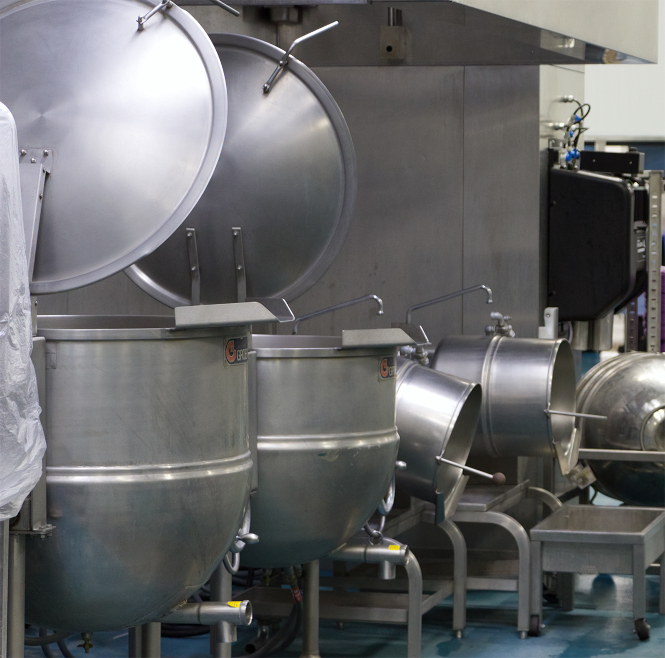
In this facility, some equipment (such as kettles) has to be manually cleaned out of place, which could use more water than built-in spray balls. When cleaning by hand, specialized foams and chemicals are required and must be well rinsed, potentially using more water than a comparable CIP cleaning operation. Photo courtesy of Wayne Labs
Many food processors operate CIP systems conservatively, using fixed recipes and extended rinse times to ensure cleanliness, says Sani-Matic's Peter Barrie. CIP efficiency can be improved by shifting to data‑driven, condition‑based cleaning supported by better instrumentation, controls and reporting.
Real‑time measurement of key parameters such as temperature, flow and conductivity allows processors to verify that cleaning objectives are achieved rather than relying solely on time‑based steps, Barrie says. When this data is automatically captured and trended using platforms like SaniTrend Cloud Cleaning Reports (CR), facilities can identify over‑cleaning, unnecessary repeat cycles or inconsistent performance between runs.
Chemical efficiency can also be improved by trending conductivity and temperature data across CIP cycles. This enables verification of correct chemical concentration and reuse, reducing excess chemical consumption while maintaining hygienic performance. Similarly, historical rinse data can be used to evaluate whether rinse steps are longer than required to reach target endpoints, supporting safe reductions in water usage and overall cycle time.
Improved controls, reliable sensors and automated reporting further increase efficiency by providing visibility into deviations such as low flow, slow heat‑up or extended cycle durations. Cloud‑based cleaning reports make these issues easier to detect, document and correct, while also supporting regulatory compliance.
Overall, CIP systems become more efficient when cleaning decisions are based on verified process data rather than assumptions, Barrie says. Digital tools enable processors to reduce water, chemical, energy use and downtime while maintaining food safety and compliance.
Facility is Only as Good as Its People
While "water smart" is not an unrealistic goal, achieving it will be the responsibility of a food and beverage plant's staff — from operations to enterprise. Today's operational staff must be highly knowledgeable in running the facility, understand how it works, what the expected efficiencies are, who to call when there is a problem and how to keep the facility running, Anandappa says. "I have seen so many facilities and pieces of equipment that aren't being used as intended — people to man the facility aren't appropriately skilled or able to correct issues."
Resource:
[1] "Questions and answers on Water Resilience Strategy," Περιεχόμενα σελίδας, European Union (Water Resilience Strategy) Website (English) accessed on 30 March 2026.
Looking for a reprint of this article?
From high-res PDFs to custom plaques, order your copy today!