Corrugated’s last stand
|
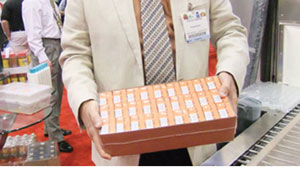
| Polypack’s Kevin Harris holds a shrink-wrapped case of drink boxes with a “corrugated belt” of cardboard for vertical strength when palletized. The concept capitalizes on the flight from cardboard to less expensive shipping materials. |
Whether under the guise of sustainability or simple cost cutting, companies are switching to less expensive materials for secondary packaging. “If a product can stack on a pallet, companies are shrink-wrapping instead of using cardboard boxes,” notes Kevin Harris, distributor sales manager at Polypack Inc., a Pinellas Park, FL maker of shrink-wrap machines.
For primary packages that do not provide adequate vertical stacking strength, the firm has developed “the corrugated belt,” a halfway solution that eliminates a box’s top and bottom flaps. Trials with Unilever and McKee Foods’ Hostess line are underway.
The belt reduces the amount of cardboard typically used to ship finished goods by about 50 percent, Harris estimates.
For more information:
Kevin Harris, Polypack Inc., 727-578-5000,
kharris@polypack.com
Looking for a reprint of this article?
From high-res PDFs to custom plaques, order your copy today!