Microwave Systems: Revolutionary Lightwaves Boost Quality
Signal variability has blocked widespread use of microwave technology in food processing. That is about to change.

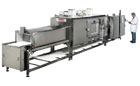
Microwave tempering units for 2.25 cu.-ft. blocks of frozen meats are gaining converts among food processors with just-in-time production schedules. Source: Heat and Control Inc.
Electromagnetic radiation still is a new and exotic option in food and beverage processing, though it gradually is finding niches in various applications as research engineers overcome the practical barriers to commercial use.
From relatively benign radio waves to highly destructive gamma waves, electromagnetic radiation has been used for everything from drying crackers to meat sterilization. The ultraviolet portion of the light spectrum increasingly is being applied to help raise hygienic standards in food plants. Infrared is segueing from a quality-assurance tool to a drying and blanching aid for grains and vegetables. But the most dynamic developments are occurring with microwave, “the sweet spot of the electromagnetic spectrum,” as described by George Harris, president of RF Technologies, Lewiston, ME.
Microwave boosters to preheat food prior to conventional cooking are becoming common. Firms such as FMC FoodTech continue to explore solutions to uneven microwave heat transfer before integrating the technology with air-impingement units. And scientists at Industrial Microwave Systems (IMS) see great promise for continuous, in-line processing of high-value foods and even pharmaceuticals. But the most excitement is being generated in labs at Washington State University (WSU), where food engineers have devised a single-mode cavity for in-container sterilization that could replace commercial retorts for many products.
From relatively benign radio waves to highly destructive gamma waves, electromagnetic radiation has been used for everything from drying crackers to meat sterilization. The ultraviolet portion of the light spectrum increasingly is being applied to help raise hygienic standards in food plants. Infrared is segueing from a quality-assurance tool to a drying and blanching aid for grains and vegetables. But the most dynamic developments are occurring with microwave, “the sweet spot of the electromagnetic spectrum,” as described by George Harris, president of RF Technologies, Lewiston, ME.
Microwave boosters to preheat food prior to conventional cooking are becoming common. Firms such as FMC FoodTech continue to explore solutions to uneven microwave heat transfer before integrating the technology with air-impingement units. And scientists at Industrial Microwave Systems (IMS) see great promise for continuous, in-line processing of high-value foods and even pharmaceuticals. But the most excitement is being generated in labs at Washington State University (WSU), where food engineers have devised a single-mode cavity for in-container sterilization that could replace commercial retorts for many products.
“It’s a major breakthrough with a high potential to improve the quality and variety of shelf-stable foods,” believes Patrick Dunne, senior technical advisor at the Department of Defense’s Combat Feeding Directorate in Natick, MA. It’s also the biggest payoff to date from a seven-year investment of time, money and talent in a microwave development consortium known as Dual Use Science and Technology (DUST), a program that pools the resources of the military, academia and industry.
“This could be the first major advancement in this technology” since the introduction of the microwave oven 62 years ago, agrees Evan Turek, senior Kraft Foods fellow. “We’re not going to be throwing out our retorts, but for fish sticks, whole-muscle foods and other products that can benefit from fast, efficient pasteurization or sterilization, this is significant.”
Until now, microwave systems have relied on multi-mode signals with many patterns of distribution and susceptibility to disturbances. The cold spot in the product becomes a moving target, and the process is not repeatable. “From a safety point of view, this is not desirable,” notes Juming Tang, professor of food engineering in WSU’s department of biological systems engineering in Pullman, WA. Tang heads the research team that in October was issued the first in what will be a series of patents for the single-mode system for microwave sterilization and pasteurization. Fabrication of a pilot-scale version is underway at the Ferrite Co., Nashua, NH.
“This could be the first major advancement in this technology” since the introduction of the microwave oven 62 years ago, agrees Evan Turek, senior Kraft Foods fellow. “We’re not going to be throwing out our retorts, but for fish sticks, whole-muscle foods and other products that can benefit from fast, efficient pasteurization or sterilization, this is significant.”
Until now, microwave systems have relied on multi-mode signals with many patterns of distribution and susceptibility to disturbances. The cold spot in the product becomes a moving target, and the process is not repeatable. “From a safety point of view, this is not desirable,” notes Juming Tang, professor of food engineering in WSU’s department of biological systems engineering in Pullman, WA. Tang heads the research team that in October was issued the first in what will be a series of patents for the single-mode system for microwave sterilization and pasteurization. Fabrication of a pilot-scale version is underway at the Ferrite Co., Nashua, NH.
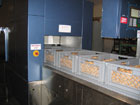
Walnuts are conveyed into an RF oven for insect control without the use of methyl bromide. Researchers originally tried microwaves, but the deeper penetration possible with lower frequency radio signals proved more effective. Source: Washington State University.
The semi-continuous pilot system will output five times as much product as the batch-mode lab unit used to date. The chamber is filled with water and pressurized, permitting processing temperatures of 265
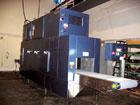
Engineers from England’s Strayfield Ltd. installed this RF unit at Diamond Foods to test radio frequencies as an alternative to chemical fumigants in post-harvest nuts. Source: Washington State University.
Here-and-now systems
Commercialization of single-mode microwave units is at least two years away, and an element of technological risk remains. In the meantime, researchers at other firms are developing and refining commercial microwave systems. Microwave is still a technological baby, with considerable room for process improvement.
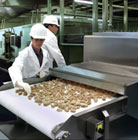
Ferrite is introducing its Image Wave technology to food and beverage this year. Harris likens Image Wave to single-mode, with the signal bouncing off a polished surface in a focused and precise manner. The system has been used successfully to weld the endothermic resins in structural beams, he says. Of course, food products demonstrate considerably more geometric variability than engineered wood, but Harris is confident that existing controls are sufficiently precise to deliver the consistency food processors demand. “We’re actually using parts developed for the cell-phone industry” in the controls hardware, he adds.
The technology is more expensive and compact than Ferrite’s multi-mode systems. A number of processors are using the company’s microwave systems as booster ovens for meatballs and other cooked meats, and Image Wave may be a logical upgrade for those value-added products. Preheating and partially cooking the food in a microwave helps retain moisture and improve yield.
Combination microwave-conventional cooking systems also have been a growth area for Hayward, CA-based Heat and Control. The company forged a partnership two years ago with former Amana technicians who formed AMTek, Cedar Rapids, IA.
“People are still a little leery of microwave technology,” allows Doug Kozenski, Heat and Control’s sales manager-further processing systems. “Because of the variability, sometimes it doesn’t work, particularly for food products.” Nonetheless, applications are growing, notably in tempering. “Instead of putting frozen blocks of beef, poultry and even vegetables into a tempering room, where it can take days to thaw, some firms are opting for microwave tempering systems that can do it in a matter of minutes,” he says. A 75 kW magnetron will either cycle on and off or run at reduced power to prevent cooking frozen goods while bringing them up to ambient temperature.
IMS is “very close to perfecting our first system for pumpable aseptic foods,” reports David Parrott, general manager of the firm’s food and beverage group. A start-up company plans to seek FDA validation of the system later this year, he says.
Based in Morrisville, NC, IMS was acquired in 2003 by Laitram LLC, a group that includes Intralox plastic conveyor belting. IMS employs a waveguide to focus energy on a processing plain (“Safe, effective microwave cooking,” Food Engineering, June 2004). Besides a continuous system for pumpable foods, IMS has designed conveyor units for use upstream or downstream of a pet-food dryer.
The firm upgraded its 2.5-in. product heating tubes to withstand pressures up to 300 psi at 320
Ferrite is introducing its Image Wave technology to food and beverage this year. Harris likens Image Wave to single-mode, with the signal bouncing off a polished surface in a focused and precise manner. The system has been used successfully to weld the endothermic resins in structural beams, he says. Of course, food products demonstrate considerably more geometric variability than engineered wood, but Harris is confident that existing controls are sufficiently precise to deliver the consistency food processors demand. “We’re actually using parts developed for the cell-phone industry” in the controls hardware, he adds.
The technology is more expensive and compact than Ferrite’s multi-mode systems. A number of processors are using the company’s microwave systems as booster ovens for meatballs and other cooked meats, and Image Wave may be a logical upgrade for those value-added products. Preheating and partially cooking the food in a microwave helps retain moisture and improve yield.
Combination microwave-conventional cooking systems also have been a growth area for Hayward, CA-based Heat and Control. The company forged a partnership two years ago with former Amana technicians who formed AMTek, Cedar Rapids, IA.
“People are still a little leery of microwave technology,” allows Doug Kozenski, Heat and Control’s sales manager-further processing systems. “Because of the variability, sometimes it doesn’t work, particularly for food products.” Nonetheless, applications are growing, notably in tempering. “Instead of putting frozen blocks of beef, poultry and even vegetables into a tempering room, where it can take days to thaw, some firms are opting for microwave tempering systems that can do it in a matter of minutes,” he says. A 75 kW magnetron will either cycle on and off or run at reduced power to prevent cooking frozen goods while bringing them up to ambient temperature.
IMS is “very close to perfecting our first system for pumpable aseptic foods,” reports David Parrott, general manager of the firm’s food and beverage group. A start-up company plans to seek FDA validation of the system later this year, he says.
Based in Morrisville, NC, IMS was acquired in 2003 by Laitram LLC, a group that includes Intralox plastic conveyor belting. IMS employs a waveguide to focus energy on a processing plain (“Safe, effective microwave cooking,” Food Engineering, June 2004). Besides a continuous system for pumpable foods, IMS has designed conveyor units for use upstream or downstream of a pet-food dryer.
The firm upgraded its 2.5-in. product heating tubes to withstand pressures up to 300 psi at 320
Microwave systems are making inroads as booster ovens for products such as meatballs and breaded poultry, speeding cook times while minimizing moisture loss. More precise control of the energy promises to greatly expand potential applications. Source: the Ferrite Co.
What's the frequency, Kenneth?
In the 1990s, food scientists began exploring alternatives to chemical treatment of post-harvest nuts and fruit. Cherries bound from the Pacific Northwest to Japan were being treated with methyl bromide, and the Japanese and European markets were demanding alternatives to chemical fumigants. Microwave treatment was one of the electromagnetic alternatives first considered.
Supported by a $1.2 million USDA grant, engineers, entomologists and other scientists from WSU, University of California-Davis and USDA’s Agricultural Research Service began evaluating both microwave and radio frequency heating as a solution in 2000. Dubbed the Initiative for Future Agriculture and Food Systems (IFAFS), the project targeted the destruction of the codling moth, navel orange worm, Mexican fruity fly and other pests.
Experiments with microwave radiation at both 2450 mega hertz (MHz) and 950 MHz frequencies were conducted, but “we found radio frequency at 27 MHz was more suitable and has some advantages to microwave,” reports Shaojin Wang, an assistant research professor in WSU’s department of biological systems engineering. Microwave proved too damaging to the quality of the fruit, and it did not penetrate deep enough.
A commercial test at Diamond Foods Inc.’s Stockton, CA, facility in 2005 confirmed those advantages: deeper wave penetration at the shorter frequency resulted in 100% kill of the most heat-resistant insects, says Wang, and there was no adverse impact on the walnuts’ color or other quality parameters.
The Stockton test involved an RF unit from Strayfield Ltd., a Berkshire, England, fabricator of drying systems for cookies, crackers and other products. Results from the Stockton trials will be published this year by Postharvest Biology and Technology, a peer-reviewed professional journal.
Ultraviolet, infrared, pulsed light and electron beam are among the electromagnetic frequencies still under development for a variety of food applications, from Salmonella destruction in almonds to Listeria control in ready-to-eat meats. With the exception of irradiation, large gaps still exist in precisely how these technologies interact with food and how they can be controlled to ensure repeatability. Microwave appears to be closing that gap and crossing the threshold to understanding and control. The impact may be profound.
Supported by a $1.2 million USDA grant, engineers, entomologists and other scientists from WSU, University of California-Davis and USDA’s Agricultural Research Service began evaluating both microwave and radio frequency heating as a solution in 2000. Dubbed the Initiative for Future Agriculture and Food Systems (IFAFS), the project targeted the destruction of the codling moth, navel orange worm, Mexican fruity fly and other pests.
Experiments with microwave radiation at both 2450 mega hertz (MHz) and 950 MHz frequencies were conducted, but “we found radio frequency at 27 MHz was more suitable and has some advantages to microwave,” reports Shaojin Wang, an assistant research professor in WSU’s department of biological systems engineering. Microwave proved too damaging to the quality of the fruit, and it did not penetrate deep enough.
A commercial test at Diamond Foods Inc.’s Stockton, CA, facility in 2005 confirmed those advantages: deeper wave penetration at the shorter frequency resulted in 100% kill of the most heat-resistant insects, says Wang, and there was no adverse impact on the walnuts’ color or other quality parameters.
The Stockton test involved an RF unit from Strayfield Ltd., a Berkshire, England, fabricator of drying systems for cookies, crackers and other products. Results from the Stockton trials will be published this year by Postharvest Biology and Technology, a peer-reviewed professional journal.
Ultraviolet, infrared, pulsed light and electron beam are among the electromagnetic frequencies still under development for a variety of food applications, from Salmonella destruction in almonds to Listeria control in ready-to-eat meats. With the exception of irradiation, large gaps still exist in precisely how these technologies interact with food and how they can be controlled to ensure repeatability. Microwave appears to be closing that gap and crossing the threshold to understanding and control. The impact may be profound.
For more information:
Tim Scheurs, AMTek, 319-365-2000
Dick Wolfe, The Ferrite Co., 800-854-1466
Doug Kozenski, Heat and Control Inc., 847-395-6478, info@heatandcontrol.com
David Parrott, Industrial Microwave Systems, 919-990-9900, dparrott@industrialmicrowave.com
George Harris, RF Technologies, 207-777-7778, gharris@rftechnologies.net
Tim Scheurs, AMTek, 319-365-2000
Dick Wolfe, The Ferrite Co., 800-854-1466
Doug Kozenski, Heat and Control Inc., 847-395-6478, info@heatandcontrol.com
David Parrott, Industrial Microwave Systems, 919-990-9900, dparrott@industrialmicrowave.com
George Harris, RF Technologies, 207-777-7778, gharris@rftechnologies.net
Looking for a reprint of this article?
From high-res PDFs to custom plaques, order your copy today!


Related Products
See More Products
×