Tech Update: Waves of the future
Fully cooked bacon has been one of the few applications for microwave technology in the food industry.
That's changing, and fast.
While the microwave oven has supplanted the gas range as the cooking appliance of choice in American homes, electromagnetic heating has remained on the periphery in food plants. Cost disadvantages for electrical energy retarded microwave applications, and control problems worked against this alternative to convection and impingement systems.
Due to a number of factors, the situation is changing. Industries such as wood and ceramics have applied microwave drying systems for years, sometimes in combination with conventional dryers, thereby expanding understanding of the technology and allowing microwave suppliers to improve system reliability. Company mergers and acquisitions have helped justify research and promotional programs to widen microwave applications. Volatile energy pricing and higher throughput demands have encouraged food manufacturers to take a closer look at microwave and how it might benefit their organizations.
For example, microwave-absorbing plasma that is 95 percent efficient at achieving high temperatures instantly is poised to transition from metal joining to food applications (see "Matter's fourth dimension," Food Engineering, March 2006). Developed by Dana Corp., atmospheric plasma absorbs and focuses microwave energy, reducing arcing and evenly distributing heat to the material being cooked. Similarly, Germany's Riedhammer GmbH developed microwave hybrid dryers several years ago for the ceramics industry to exploit microwave's ability to control product temperature gradient. Riedhammer is working with Eschen-felden, Germany-based Linn High Therm GmbH on microwave food applications.
Closer to home, Hayward, CA-based Heat and Control Inc. is incorporating microwave booster units in horizontal oven configurations. "We're seeing up to 50 percent reductions in cook time and no product degradation as a result of dielectric heating," reports James Padilla, director of product development. FMC FoodTech also is evaluating the use of microwave, though questions remain about the equipment's sturdiness and issues such as "edge effects," in which product extremes are hotter than the center, according to Project Engineer Jogesh Chandran. "We're in the brainstorming stage," says Chandran. "Before we offer microwave, we want to guarantee the customer, ‘This can improve your product.'"
"Pulse cooking" is another oven advancement under discussion. The dew point temperature of the product is reduced so that condensation cooking can continue. Further along is pulsed combustion in spray draying, a technology developed by Pulse Combustion Systems a decade ago. Only two spray dryers for food products are in operation, though company owner James A. Rehkopf believes higher energy costs will make the technology more attractive.

Aside from his own tolling plant in Payson, AZ, only Cincinnati's Berghausen Corp. is applying the technology to food drying. In both cases, gentle handling and consistent particle size distribution have made the process appealing for high-value nutritional foods and flavors. Still, Rehkopf believes the benefits of shear-free spray drying will eventually win converts.
Instead of a rotary disk or tiny nozzles, Rehkopf's gas dynamic atomization relies on a pulsating gas stream and low-pressure air feed in a tuned combustion chamber known as a Helmholtz resonator to generate high heat-transfer rates to drive off moisture. Inlet temperatures don't have to be stepped down nearly as much as in a conventional spray dryer, resulting in significant energy savings. "We burn the energy once," says Rehkopf. "We either get the heat for free or the atomization for free."
A downsized drying chamber and smaller cyclone and baghouse are side benefits to pulsed combustion. Smaller is better, both in terms of footprint and capital investment. Niro Inc. is addressing those benefits with its Tixotherm drying process for whey permeate. Tixotherm eliminates some stages in the traditional process and requires half as much building space, according to Mike Bowers, dryer group manager at the Hudson, WI, firm.
To date, only one commercial installation is operating, besides a pilot plant. Niro is developing applications beyond mozzarella whey, the original focus of Tixotherm.

"Interest spikes whenever gas prices spike," observes Robert Sunderland, director of dryer technology at Sabetha, KS-based Wenger Manufacturing Inc. "Plant engineers are trying to make sure their horizontal dryers are running as efficiently as possible. That has increased inquiries about our ASR air package that turns the exhaust system into a control loop to maximize energy use."
Water removed from the product saturates the air used to dry it. Venting the air before it is saturated increases energy costs. Optimization of venting is possible with sensors in the exhaust stream, and the newest generation of sensors is rugged enough to withstand the industrial environment and deliver reliable data. "This is not a blue-sky idea anymore," Sunderland emphasizes. Several dryers outfitted with ASR systems already are in commercial operation, and he expects some older dryers will be retrofitted as energy prices ratchet upward.
Wenger is leveraging simulation tools such as computational fluid dynamics (CFD) to boost performance through design improvements. The firm worked with engineers at Fluent Inc.'s Ann Arbor, MI, office a year ago to model a vertical cascade dryer to better understand the what and why of industrial drying and to lay the groundwork for future improvements.
Intuition and accumulated wisdom guide engineers when designing machines, be they airplanes or vertical cascade dryers used for pet food and other low-moisture foodstuffs, observes Kishor Khankari, Fluent's lead consulting engineer. The designs can be enormously successful, and prototypes can demonstrate improvements, but the application of CFD "helps you visualize things that are impossible with any other means," says Khankari.
As air is recycled through the cascade dryer's chambers, it is forced through narrow openings to filter out fines. Modeling demonstrated a cyclonic flow pattern that was created when the air entered into a settling chamber. By revealing this effect, CFD helped engineers better understand this dynamic when designing next-generation dryers.
Tools like ASR and CFD are great at the design and construction stage. Energy optimization also can get a boost with meat-and-potatoes solutions like a critical review. Baffles may be removed, fans can fail and burners might not run as designed, yet the dryer or oven keeps performing and no one notices. "Processors often call us and say, ‘We feel this dryer is running well, but we haven't had anyone look at it in five years and would like a second opinion,'" says Sunderland. "It's difficult for us not to find some overlooked mechanical issue, particularly if the equipment is run hard."
From advanced technologies like atmospheric plasma and microwave to critical maintenance evaluations, engineers are improving the performance of ovens and dryers. Reducing energy costs are motivating many plants to implement change, but superior finished goods ultimately may be the bigger return on those investments. BC50: For more information:
Seth Pulsfus, Alkar-RapidPak Inc., 608-881-5234, seth.pulsfus@alkar.com
Neil Towey, Ferrite Company Inc., 800-854-1466, neilt@ferriteinc.com
Kishor Khankari, Fluent Inc., 734-213-6821, kha@fluent.com
Jogesh Chandran, FMC FoodTech, 419-627-4305, jogesh.chandran@fmcti.com
James Padilla, Heat and Control Inc., 800-227-5980
Malte Moeller, Linn High Therm GmbH, moeller@linn.de
Mike Bowers, Niro Inc., 715-386-9371
James A. Rehkopf, Pulse Combustion Systems, 415-457-6500, jrehkopf@pulsedry.com
Robert Sunderland, Wenger Manufacturing Inc., 785-284-2133
That's changing, and fast.
Finished goods exit a spiral oven designed to optimize heat distribution. While cooking performance is exceptional, a spiral oven requires more floor space than a microwave-horizontal oven combination. Source: Heat and Control Inc.
While the microwave oven has supplanted the gas range as the cooking appliance of choice in American homes, electromagnetic heating has remained on the periphery in food plants. Cost disadvantages for electrical energy retarded microwave applications, and control problems worked against this alternative to convection and impingement systems.
Due to a number of factors, the situation is changing. Industries such as wood and ceramics have applied microwave drying systems for years, sometimes in combination with conventional dryers, thereby expanding understanding of the technology and allowing microwave suppliers to improve system reliability. Company mergers and acquisitions have helped justify research and promotional programs to widen microwave applications. Volatile energy pricing and higher throughput demands have encouraged food manufacturers to take a closer look at microwave and how it might benefit their organizations.
For example, microwave-absorbing plasma that is 95 percent efficient at achieving high temperatures instantly is poised to transition from metal joining to food applications (see "Matter's fourth dimension," Food Engineering, March 2006). Developed by Dana Corp., atmospheric plasma absorbs and focuses microwave energy, reducing arcing and evenly distributing heat to the material being cooked. Similarly, Germany's Riedhammer GmbH developed microwave hybrid dryers several years ago for the ceramics industry to exploit microwave's ability to control product temperature gradient. Riedhammer is working with Eschen-felden, Germany-based Linn High Therm GmbH on microwave food applications.
Closer to home, Hayward, CA-based Heat and Control Inc. is incorporating microwave booster units in horizontal oven configurations. "We're seeing up to 50 percent reductions in cook time and no product degradation as a result of dielectric heating," reports James Padilla, director of product development. FMC FoodTech also is evaluating the use of microwave, though questions remain about the equipment's sturdiness and issues such as "edge effects," in which product extremes are hotter than the center, according to Project Engineer Jogesh Chandran. "We're in the brainstorming stage," says Chandran. "Before we offer microwave, we want to guarantee the customer, ‘This can improve your product.'"
"Pulse cooking" is another oven advancement under discussion. The dew point temperature of the product is reduced so that condensation cooking can continue. Further along is pulsed combustion in spray draying, a technology developed by Pulse Combustion Systems a decade ago. Only two spray dryers for food products are in operation, though company owner James A. Rehkopf believes higher energy costs will make the technology more attractive.
To add the color-control advantages of a horizontal oven to the throughput capabilities of a spiral, engineers added an impingement zone (upper right) to the GyroCompact design. Source: FMC FoodTech.
Technology transfer
Many of the industrial microwave units currently used in food applications are under the umbrella of the Ferrite Company, a Nashua, NH, firm founded in 1983. Three years ago, Ferrite acquired Amana's industrial microwave division, boosting its dominance in food tempering and precooked bacon applications. Explosive growth in precooked, battered and breaded meat and poultry products has created demand for booster ovens that can bring internal temperatures up to about 90Technicians perform a test involving hamburger patties and a microwave oven. Higher throughput demands are causing many processors to take a second look at microwave, often in combination with existing systems. Source: The Ferrite Company Inc.
Shear-free spray drying
The value-added fractions of whey have spurred big investments in drying technology, and the spray dryers being installed in cheese plants are among the biggest, most energy-intense processing components in food and beverage. Pulsed combustion has the potential to improve performance, though finding processors willing to apply the technology is a challenge. "Although it's better, it's different, and different is bad" in many people's minds, laments Pulse Combustion Systems' Rehkopf.Aside from his own tolling plant in Payson, AZ, only Cincinnati's Berghausen Corp. is applying the technology to food drying. In both cases, gentle handling and consistent particle size distribution have made the process appealing for high-value nutritional foods and flavors. Still, Rehkopf believes the benefits of shear-free spray drying will eventually win converts.
Instead of a rotary disk or tiny nozzles, Rehkopf's gas dynamic atomization relies on a pulsating gas stream and low-pressure air feed in a tuned combustion chamber known as a Helmholtz resonator to generate high heat-transfer rates to drive off moisture. Inlet temperatures don't have to be stepped down nearly as much as in a conventional spray dryer, resulting in significant energy savings. "We burn the energy once," says Rehkopf. "We either get the heat for free or the atomization for free."
A downsized drying chamber and smaller cyclone and baghouse are side benefits to pulsed combustion. Smaller is better, both in terms of footprint and capital investment. Niro Inc. is addressing those benefits with its Tixotherm drying process for whey permeate. Tixotherm eliminates some stages in the traditional process and requires half as much building space, according to Mike Bowers, dryer group manager at the Hudson, WI, firm.
To date, only one commercial installation is operating, besides a pilot plant. Niro is developing applications beyond mozzarella whey, the original focus of Tixotherm.
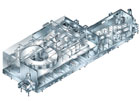
A pulsed gas atomization with a low pressure feed delivers rapid heat transfer to a spray drying system. Source: Pulse Combustion Systems.
Higher utility cost's silver lining
The upside of higher energy costs is improved economics for technical solutions to improve dryer performance. The payback for systems that monitor and control the adiabatic saturation ratio (ASR) in horizontal dryers is much more attractive than it is in times of cheap energy, for example."Interest spikes whenever gas prices spike," observes Robert Sunderland, director of dryer technology at Sabetha, KS-based Wenger Manufacturing Inc. "Plant engineers are trying to make sure their horizontal dryers are running as efficiently as possible. That has increased inquiries about our ASR air package that turns the exhaust system into a control loop to maximize energy use."
Water removed from the product saturates the air used to dry it. Venting the air before it is saturated increases energy costs. Optimization of venting is possible with sensors in the exhaust stream, and the newest generation of sensors is rugged enough to withstand the industrial environment and deliver reliable data. "This is not a blue-sky idea anymore," Sunderland emphasizes. Several dryers outfitted with ASR systems already are in commercial operation, and he expects some older dryers will be retrofitted as energy prices ratchet upward.
Wenger is leveraging simulation tools such as computational fluid dynamics (CFD) to boost performance through design improvements. The firm worked with engineers at Fluent Inc.'s Ann Arbor, MI, office a year ago to model a vertical cascade dryer to better understand the what and why of industrial drying and to lay the groundwork for future improvements.
Intuition and accumulated wisdom guide engineers when designing machines, be they airplanes or vertical cascade dryers used for pet food and other low-moisture foodstuffs, observes Kishor Khankari, Fluent's lead consulting engineer. The designs can be enormously successful, and prototypes can demonstrate improvements, but the application of CFD "helps you visualize things that are impossible with any other means," says Khankari.
As air is recycled through the cascade dryer's chambers, it is forced through narrow openings to filter out fines. Modeling demonstrated a cyclonic flow pattern that was created when the air entered into a settling chamber. By revealing this effect, CFD helped engineers better understand this dynamic when designing next-generation dryers.
Tools like ASR and CFD are great at the design and construction stage. Energy optimization also can get a boost with meat-and-potatoes solutions like a critical review. Baffles may be removed, fans can fail and burners might not run as designed, yet the dryer or oven keeps performing and no one notices. "Processors often call us and say, ‘We feel this dryer is running well, but we haven't had anyone look at it in five years and would like a second opinion,'" says Sunderland. "It's difficult for us not to find some overlooked mechanical issue, particularly if the equipment is run hard."
From advanced technologies like atmospheric plasma and microwave to critical maintenance evaluations, engineers are improving the performance of ovens and dryers. Reducing energy costs are motivating many plants to implement change, but superior finished goods ultimately may be the bigger return on those investments. BC50: For more information:
Seth Pulsfus, Alkar-RapidPak Inc., 608-881-5234, seth.pulsfus@alkar.com
Neil Towey, Ferrite Company Inc., 800-854-1466, neilt@ferriteinc.com
Kishor Khankari, Fluent Inc., 734-213-6821, kha@fluent.com
Jogesh Chandran, FMC FoodTech, 419-627-4305, jogesh.chandran@fmcti.com
James Padilla, Heat and Control Inc., 800-227-5980
Malte Moeller, Linn High Therm GmbH, moeller@linn.de
Mike Bowers, Niro Inc., 715-386-9371
James A. Rehkopf, Pulse Combustion Systems, 415-457-6500, jrehkopf@pulsedry.com
Robert Sunderland, Wenger Manufacturing Inc., 785-284-2133
Links
Looking for a reprint of this article?
From high-res PDFs to custom plaques, order your copy today!