TECH FLASH
Another look at aspartame
|
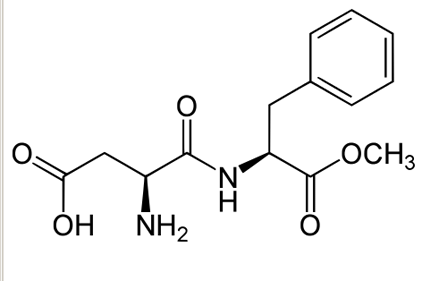
| Aspartame; Asp-Phe methyl ester. Source: Wikipedia Commons (Yikrazuul). |
The European Food Safety Authority (EFSA) is calling for scientific data on aspartame (E 951) related to 5-benzyl-3,6-dioxo-2-piperazine acetic acid (DKP) and other primary or secondary degradation products from aspartame. According to EFSA regulations, all food additives permitted before January 20, 2009 are subject to a new risk assessment.
The Scientific Panel on Food Additives and Nutrient Sources added to Food has identified the need for additional data on products that can be formed from aspartame in different types of foodstuffs, in particular DKP—depending on pH, temperature or storage time.
The purpose of this call for data is to offer interested parties and all stakeholders the opportunity to submit any available documented information, published or unpublished, also including original raw data on the products that can be formed from aspartame in the different types of foodstuffs, taking into account the conditions of manufacturing and storage and the direct use of aspartame as a table-top sweetener.
There was some discussion in the US in 2006 and 2007 about the potential carcinogenic effects of aspartame, which was approved for public use in 1981. An Italian study on rats suggested aspartame had carcinogenic issues.
In 2007, FDA completed its review concerning the long-term carcinogenicity study of aspartame entitled, Long-Term Carcinogenicity Bioassays to Evaluate the Potential Biological Effects, in Particular Carcinogenic, of Aspartame Administered in Feed to Sprague-Dawley Rats, conducted by the European Ramazzini Foundation (ERF), located in Bologna, Italy. FDA reviewed the study data and found that it does not support ERF’s conclusion that aspartame is a carcinogen. The FDA concluded the study’s data didn’t provide evidence to alter FDA’s conclusion that the use of aspartame is safe.
More information on FDA’s approval of aspartame can be found in the Government Accountability Office’s June 1987 document entitled, Food and Drug Administration: Food Additive Approval Process Followed for Aspartame.
Looking for a reprint of this article?
From high-res PDFs to custom plaques, order your copy today!