Bottling aged whiskey requires long-lived lubrication
Lubricants protect equipment and extend production runs.

Glenmorangie has been producing its Single Highland Malt Whisky since 1843. The brand is now recognized as one of the finest in the world. The distilling process is the heart and soul of Glenmorangie. Unlike other distilleries, only hard water is used to make Glenmorangie. The water, drawn from the nearby Tarlogie Springs, takes almost 100 years to travel through limestone and rise to the surface.
The Glenmorangie production facility, located in Broxburn, Scotland, is a 33-acre site made up of several warehouses and a bottling plant. The site has over 450,000 oak casks being aged for future fill at any point in time. Each cask can fill 500 bottles and new lines can fill over 250 bottles per minute, meaning that it empties a cask in just over a minute and a half.
In 2005, in conjunction with its total preventative maintenance program’s ongoing quality improvements, Glenmorangie’s Broxburn facility changed its operations to Petro-Canada’s PURITY™ FG lubricants and a complete lubricant management package from distributor Complete Lubrication Services.
Running four high-speed lines, Chas McEwan, engineering manager for Glenmorangie, has always been concerned about ensuring that downtime is minimized. “With the change to Petro-Canada’s PURITY FG lubricants and greases and Complete Lubrication Services, we have seen a step-change in operational performance,” says McEwan.
Prior to the change, Glenmorangie’s plant maintenance was more reactive than proactive. Now, with the new lubrication products and a lubricant management package from Complete Lubrication Services, which has been incorporated into the on-line planned preventative maintenance system on site, the emphasis of the system has moved to prevention. McEwan and his team have seen their production lines increase in efficiency and have an improved meantime before failure.
“We previously extended our lubrication cycles out to 12 weeks and are now considering pushing them out to every 16 weeks,” states McEwan. “This will give a reduction in our overall maintenance costs.”
McEwan also knows the value of a strong asset care plan and lubricants are fully incorporated in his plan at Glenmorangie. Geraldine O’Hagan, the asset care coordinator for Glenmorangie, ensures that all lubricants used in the plant are 100% “food safe.” “Using PURITY FG lubricants ensures we are fully compliant. Audits are easy and I don’t have any worries about cross-contamination with non-food grade products,” she says.
According to McEwan, using these food-safe lubricants is consistent with Glenmorangie’s commitment to its customer to supply nothing but the highest quality product. “We confidently ensure this by using the highest quality products in every aspect of our operation.”
One of Glenmorangie’s useful products is PURITY FG spray. According to McEwan, “It sticks and stays in place, getting into applications that are hard to reach and where we need to be sure the components are lubricated for long life.”
For more information: Colleen Flanagan, 905-804-3631, flanagan@petro-canada.ca
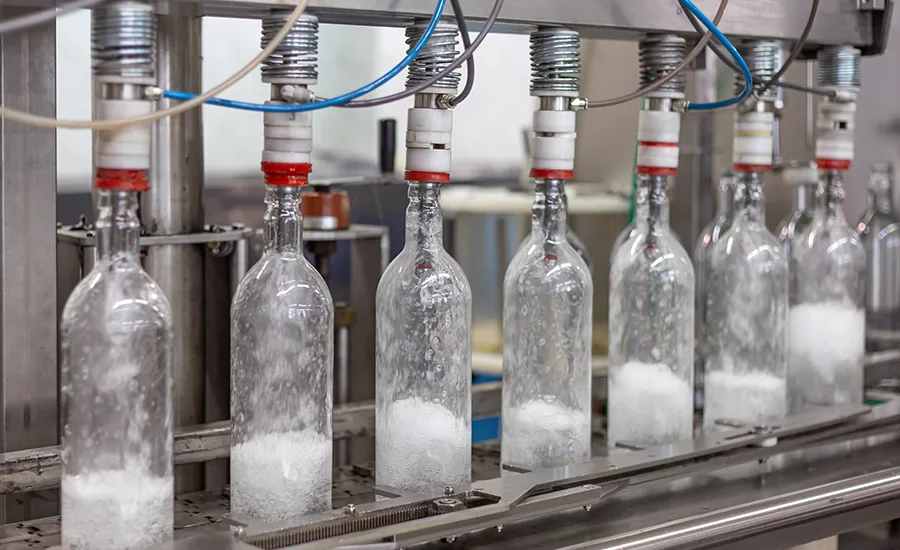
The Glenmorangie production facility in Broxburn, Scotland uses Petro-Canada’s FG series of food-grade lubricants to keep its bottling system running. Source: Petro-Canada.
Glenmorangie has been producing its Single Highland Malt Whisky since 1843. The brand is now recognized as one of the finest in the world. The distilling process is the heart and soul of Glenmorangie. Unlike other distilleries, only hard water is used to make Glenmorangie. The water, drawn from the nearby Tarlogie Springs, takes almost 100 years to travel through limestone and rise to the surface.
The Glenmorangie production facility, located in Broxburn, Scotland, is a 33-acre site made up of several warehouses and a bottling plant. The site has over 450,000 oak casks being aged for future fill at any point in time. Each cask can fill 500 bottles and new lines can fill over 250 bottles per minute, meaning that it empties a cask in just over a minute and a half.
In 2005, in conjunction with its total preventative maintenance program’s ongoing quality improvements, Glenmorangie’s Broxburn facility changed its operations to Petro-Canada’s PURITY™ FG lubricants and a complete lubricant management package from distributor Complete Lubrication Services.
Running four high-speed lines, Chas McEwan, engineering manager for Glenmorangie, has always been concerned about ensuring that downtime is minimized. “With the change to Petro-Canada’s PURITY FG lubricants and greases and Complete Lubrication Services, we have seen a step-change in operational performance,” says McEwan.
Prior to the change, Glenmorangie’s plant maintenance was more reactive than proactive. Now, with the new lubrication products and a lubricant management package from Complete Lubrication Services, which has been incorporated into the on-line planned preventative maintenance system on site, the emphasis of the system has moved to prevention. McEwan and his team have seen their production lines increase in efficiency and have an improved meantime before failure.
“We previously extended our lubrication cycles out to 12 weeks and are now considering pushing them out to every 16 weeks,” states McEwan. “This will give a reduction in our overall maintenance costs.”
McEwan also knows the value of a strong asset care plan and lubricants are fully incorporated in his plan at Glenmorangie. Geraldine O’Hagan, the asset care coordinator for Glenmorangie, ensures that all lubricants used in the plant are 100% “food safe.” “Using PURITY FG lubricants ensures we are fully compliant. Audits are easy and I don’t have any worries about cross-contamination with non-food grade products,” she says.
According to McEwan, using these food-safe lubricants is consistent with Glenmorangie’s commitment to its customer to supply nothing but the highest quality product. “We confidently ensure this by using the highest quality products in every aspect of our operation.”
One of Glenmorangie’s useful products is PURITY FG spray. According to McEwan, “It sticks and stays in place, getting into applications that are hard to reach and where we need to be sure the components are lubricated for long life.”
For more information: Colleen Flanagan, 905-804-3631, flanagan@petro-canada.ca
Looking for a reprint of this article?
From high-res PDFs to custom plaques, order your copy today!