Bullish forecast for scavengers

ACTIS, the amorphous carbon coating developed by France's Sidel Group, remains the only FDA-approved coating for food contact, and coated PET is regarded as essential if mass produced, competitively priced plastic bottles are to compete with glass in the beer market. But in announcing a takeover bid for Sidel in March, Tetra Laval president Goeran Grosskopf said, "ACTIS is good technology, but it is not yet reliable." He indicated Tetra Laval would shelve ACTIS.
"The situation with ACTIS is a setback, but it's not going t o have a dramatic impact on the North American market for plastic beer bottles," believes George O. Schroeder, an Appleton, Wis.-based packaging consultant. He points out Tetra Laval has a competing coating called Glaskin, which has not been approved for use by FDA.
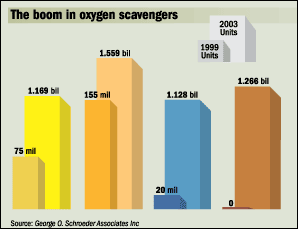
In a recently completed study on the growth of oxygen scavengers in plastic packaging, Schroeder forecasts a tripling of food and beverage applications in each of the next three years. That will boost applications in four major segments, including beer and case-ready meats, to more than 5 billion units.
The greatest penetration will be in case ready meats, and Schroeder labels his 5 percent forecast "very conservative." Some prognosticators suggest 30 percent of fresh meat will be case ready in 2003, though a 10 to 15 percent share appears closer to reality.
Schroeder's forecast of 1.2 billion oxygen scavengers in beer bottles assumes 2 percent penetration. The technology can be used with both glass and plastic bottles. The liners in bottle caps often contain oxygen absorbers to minimize flavor degradation and flatness.
Packaging economics favor the combination of barrier and scavenger agents, even though raw-material costs greatly favor barrier materials. The resins to make EVOH, for example, might cost $2 per pound, while the resins to make oxygen-absorbing films might be $6. But structures that combine both can be significantly thinner, "and you still end up with a higher functional product at a lower cost," he notes.
More than 1,000 U.S. and Japanese patents have been issued for oxygen scavengers, and significant R&D work continues. Inroads are being made in the beer market, with plastic taking share from aluminum cans at sports venues and special events. Retail sales are another story.
"Miller's beer in plastic bottles was a thud, and Anheuser-Busch's approach was an even bigger thud," says Schroeder. Consumers rejected attempts to charge a premium for such packaging. If brewers are to solve the cost issue, much faster equipment than the co-injection machines that turn out multilayered bottles will be needed, and that can be done with a monolayer PET bottle with oxygen barrier and scavenger properties.
Looking for a reprint of this article?
From high-res PDFs to custom plaques, order your copy today!