Columns

Food Packaging: Coffee roaster concentrates on foodservice
Oxygen is the enemy of liquid coffee concentrates, and Paul Kalenian is taking great pains to ensure it doesn’t degrade the flavor of his premium extracts.

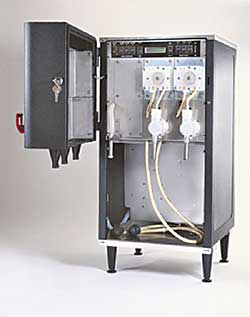
Automatic dispensing machines meter out coffee concentrates and hot water in the correct ratio, allowing restaurants to offer fresh-tasting java and multiple flavors without waste.

Kalenian is founder and president of XCafe LLC, a Northborough, Mass., company with production facilities in Portland, Maine. The firm is one of several coffee processors hoping to grab a share of the $8.9 billion foodservice coffee business by helping restaurants slash waste and serve better brew with on-demand dispensing systems.

Coffee concentrates are nothing new. George Washington served it to his Continental Army soldiers, adding to the bitterness of the Valley Forge experience. “It’s traditionally been not very good,” allows Kalenian, “but we’ve developed brewing, extraction and packaging technologies that create coffee that tastes professionally brewed.” Processing in an airtight environment is part of the process, and if hermetic conditions can be maintained with bag-in-box packaging, his extract will remain shelf stable for 120 days before any off-notes develop.

Hot water is mixed with concentrate in dispensing machines equipped with peristaltic pumps. A 1-gal. bag of XCafe produces 500 cups of coffee.

Oxidation turns concentrate stale and bitter, and Kalenian is in the process of testing several bag-in-box systems to determine which can maintain oxygen impermeability throughout distribution. Spent bags are shipped to the labs of Mocon Inc., a testing service in Minneapolis, to determine which provides the greatest product integrity.

Coffee concentrates currently account for less than 3 percent of foodservice coffee sales. Explosive growth is forecast, however, with XCafe, Sara Lee’s Douwe Egberts unit and Lykes Pasko vying for a share, along with Javo Beverage Co., which uses a cold brewing technology.

For more information:
Bob Maxner, Mocon Inc., 763-493-6370

Did you enjoy this article? Click here to subscribe to Food Engineering Magazine.

You must login or register in order to post a comment.

Multimedia

Videos

Image Galleries

Food Automation & Manufacturing Conference and Expo 2013

Images from Food Automation & Manufacturing Conference and Expo in Naples, Florida, April 14-17, 2013.

Podcasts

Burns & McDonnell Global Reporting Initiative (GRI)-certified corporate sustainability reporting (CSR) specialists discuss:

  • What is a CSR?
  • What is the GRI and the Food Processing Sector Supplement?
  • Why are companies producing CSRs?
  • What are latest CSR trends?
More Podcasts

Plant sanitation

What is the largest barrier to modernizing plant sanitation in your operation?
View Results Poll Archive

THE MAGAZINE

Food Engineering Magazine

fe may 2013 cover

2013 May

Check out Food Engineering’s May 2013 issue, featuring stories on Food Packaging, Lift Trucks and Food Safety.
Table Of Contents Subscribe

THE FOOD ENGINEERING STORE

Food-Authentication-Flyer-(.gif
Food Authentication Using Bioorganic Molecules

This text provides critical tools and data needed to augment routine food analysis and enhance food safety by aiding in the detection of counterfeit, and potentially deleterious, foods.

More Products

Clear Seas Research

Clear Seas ResearchWith access to over one million professionals and more than 60 industry-specific publications,Clear Seas Research offers relevant insights from those who know your industry best. Let us customize a market research solution that exceeds your marketing goals.

Food Master

Food MasterFood Master 2013 is now available!

Where the buying process begins in the food and beverage manufacturing market. 

Visit www.foodmaster.com to learn more.

STAY CONNECTED

facebook_40.pngtwitter_40px.pngyoutube_40px.pnglinkedin_40px.png