The business case for green
British beverage firms, suppliers and retailers are boosting their bottom lines with package waste-cutting efforts.
 When Wal-Mart talks, US manufacturers listen. Imagine how much attention they’d pay if eight similarly sized retailers made the same demand.
Essentially, that’s what is happening in the UK under a government-sponsored program called WRAP (Waste & Resources Action Programme). Thirteen major chains accounting for more than 92% of UK retail spending are committed to slashing packaging waste by 10%. Unilever, Coca-Cola, Cadbury Schweppes and other food manufacturers are falling in line. Glass represents a disproportionately large amount of container weight, and a lightweighting demonstration project in 2004 cut more than a third of the weight from private-label whiskey bottles without hurting sales or boosting breakage rates.
By coordinating efforts among retailers, manufacturers and suppliers, WRAP believes it can eliminate 340,000 metric tons of packaging waste by 2010, (about 10%) according to Nicola Jenkin of WRAP’s retail innovation team. Early results suggest that’s conservative: “I believe we can cut 25%,” says David A. Dalton, technical director of Glass Technology Services Ltd. (GTS), Sheffield, UK. “How the cost savings are split between container manufacturers, fillers and retailers is up to the supply chain to decide, but everyone should be paying less. If you can combine commercial gains and green gains, it’s a win-win.”
A lightweighting effort called GlassRite is underway, and the program paticipants from O-I Inc. and Adnams, a Southwold, UK, brewery are “committed to going the green route,” according to Paul McLavin, O-I UK’s sales & marketing manager. Blow-and-blow technology was the standard for British ales in 500 ml (17 oz.) bottles. At 450 grams (1 lb.), Adnam’s bottles were bicep builders. O-I modified the narrow neck press & blow technology common for 12 oz. bottles to produce the bigger bottles, lowering Adnam’s weight 34% to 299 g. Material distribution also is more even, making the lighter bottle stronger.
While sustainability and recyclability are glass’s strengths, weight and fragility are its drawbacks. Before any lightweight bottles go into production, Dalton’s lab conducts impact and pressure tests. GTS then orders a hollow-body mock-up from Sensor Wireless, which imbeds the bottle with sensors to measure impact levels at the shoulder and heel as the container moves through a bottling line, then relays the data via radio frequency. “Anytime a force is exerted, it’s captured and transmitted by the replica bottle,” says Dallas Kelly, business development manager for Prince Edward Island-based Sensor Wireless.
Consumer reaction to package change is a major concern for both food companies and retailers. Extensive eye-tracking studies and other perception testing by the Psychology of Design Group at the University of Leeds was conducted early on to better understand the impact of lighter weights and different shapes. Coors Brewers Ltd. cut 13% of the weight from the popular Grolsch 300 ml bottle, then slashed an additional 12% when perception research demonstrated that altering the bottle’s shape wouldn’t hurt sales.
Weight reductions and recyclability will migrate from feel-good gestures to sales-decision tools in the near future, UK marketers say. Retailers Tesco and Marks & Spencer are investing several million dollars in a labeling program that will disclose carbon-footprint information to consumers for the packages on their shelves. u
For more information:
Paul McLavin, O-I Inc., 011-44 1279 422222
Dallas Kelly, Sensor Wireless Inc., 902-367-3322,
dallas@sensorwireless.com
Nicola Jenkin, WRAP, 011-44 1295 819609, nicola.jenkin@wrap.org.uk
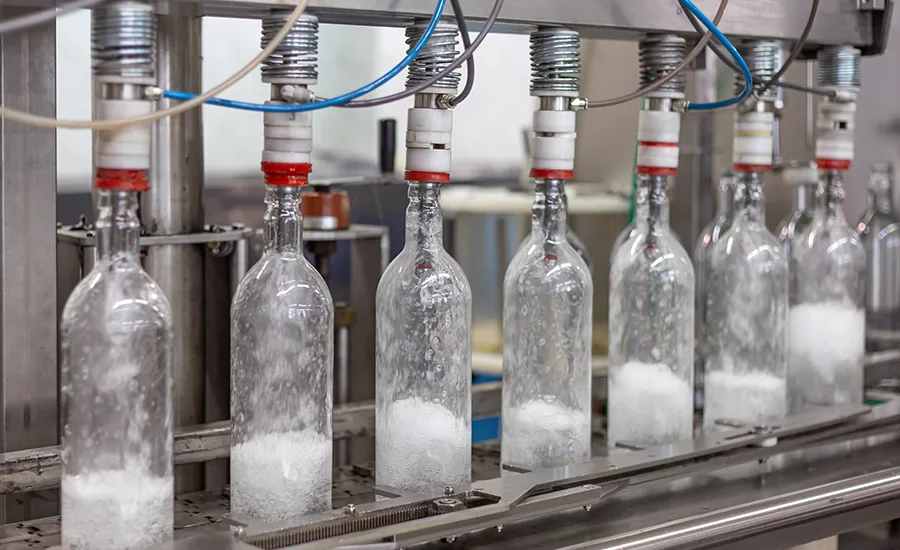
Modifications in narrow neck press & blow technology allowed O-I to shave 34% of the weight from 500 ml (17 oz.) bottles used by Adnams brewery for its English ales. Source: O-I Inc.
Essentially, that’s what is happening in the UK under a government-sponsored program called WRAP (Waste & Resources Action Programme). Thirteen major chains accounting for more than 92% of UK retail spending are committed to slashing packaging waste by 10%. Unilever, Coca-Cola, Cadbury Schweppes and other food manufacturers are falling in line. Glass represents a disproportionately large amount of container weight, and a lightweighting demonstration project in 2004 cut more than a third of the weight from private-label whiskey bottles without hurting sales or boosting breakage rates.
By coordinating efforts among retailers, manufacturers and suppliers, WRAP believes it can eliminate 340,000 metric tons of packaging waste by 2010, (about 10%) according to Nicola Jenkin of WRAP’s retail innovation team. Early results suggest that’s conservative: “I believe we can cut 25%,” says David A. Dalton, technical director of Glass Technology Services Ltd. (GTS), Sheffield, UK. “How the cost savings are split between container manufacturers, fillers and retailers is up to the supply chain to decide, but everyone should be paying less. If you can combine commercial gains and green gains, it’s a win-win.”
A lightweighting effort called GlassRite is underway, and the program paticipants from O-I Inc. and Adnams, a Southwold, UK, brewery are “committed to going the green route,” according to Paul McLavin, O-I UK’s sales & marketing manager. Blow-and-blow technology was the standard for British ales in 500 ml (17 oz.) bottles. At 450 grams (1 lb.), Adnam’s bottles were bicep builders. O-I modified the narrow neck press & blow technology common for 12 oz. bottles to produce the bigger bottles, lowering Adnam’s weight 34% to 299 g. Material distribution also is more even, making the lighter bottle stronger.
While sustainability and recyclability are glass’s strengths, weight and fragility are its drawbacks. Before any lightweight bottles go into production, Dalton’s lab conducts impact and pressure tests. GTS then orders a hollow-body mock-up from Sensor Wireless, which imbeds the bottle with sensors to measure impact levels at the shoulder and heel as the container moves through a bottling line, then relays the data via radio frequency. “Anytime a force is exerted, it’s captured and transmitted by the replica bottle,” says Dallas Kelly, business development manager for Prince Edward Island-based Sensor Wireless.
Consumer reaction to package change is a major concern for both food companies and retailers. Extensive eye-tracking studies and other perception testing by the Psychology of Design Group at the University of Leeds was conducted early on to better understand the impact of lighter weights and different shapes. Coors Brewers Ltd. cut 13% of the weight from the popular Grolsch 300 ml bottle, then slashed an additional 12% when perception research demonstrated that altering the bottle’s shape wouldn’t hurt sales.
Weight reductions and recyclability will migrate from feel-good gestures to sales-decision tools in the near future, UK marketers say. Retailers Tesco and Marks & Spencer are investing several million dollars in a labeling program that will disclose carbon-footprint information to consumers for the packages on their shelves. u
For more information:
Paul McLavin, O-I Inc., 011-44 1279 422222
Dallas Kelly, Sensor Wireless Inc., 902-367-3322,
dallas@sensorwireless.com
Nicola Jenkin, WRAP, 011-44 1295 819609, nicola.jenkin@wrap.org.uk
Looking for a reprint of this article?
From high-res PDFs to custom plaques, order your copy today!