USDA takes new steps to fight E. coli
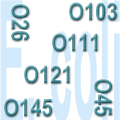
As a result of USDA’s new ruling, if the E. coli serogroups O26, O103, O45, O111, O121 and O145 are found in raw ground beef or its precursors, those products will be prohibited from entering commerce. Like E.coli O157:H7, these serogroups can cause severe illness and even death; young children and the elderly are at highest risk. The Centers for Disease Control and Prevention identifies these particular serogroups of non-O157:H7 Shiga-toxin producing E.coli, or non-O157 STEC, as those responsible for the greatest numbers of non-O157 STEC illnesses, hospitalizations and deaths in the
“The Food and Drug Administration applauds USDA for taking this action to better protect consumers,” says FDA Deputy Commissioner for Foods Mike Taylor. “We are committed to working with FSIS to prevent disease-causing, non-O157 STEC bacteria in all foods. Through implementation of the Food Safety Modernization Act, FDA will continue to place prevention at the core of the efforts to improve the food safety system.”
“STOP Foodborne Illness [STOP, formerly Safe Tables Our Priority] applauds USDA’s announcement declaring six highly virulent, pathogenic strains of E. coli as adulterants in beef products,” says Nancy Donley, president, STOP Foodborne Illness. “These additional six strains have been identified by CDC for more than a decade as being harmful to consumers, causing illness and death,” adds Donley. “We’re pleased to see the USDA act proactively rather than in reaction to another major outbreak case in declaring E. coli O157:H7 an adulterant in 1994.”
FSIS will begin testing for these six serogroups of STEC and enforcing the new policy on March 5, 2012. The Agency invites interested persons to submit comments within 60 days of publication in the Federal Register. FSIS would like to hear from the public on a number of issues highlighted in the Federal Register notice, including the implementation of the policy and additional outreach the Agency will conduct, such as public meetings.
A final note: According to CDC, on July 5, 2011, the European Food Safety Authority issued a report identifying a single lot of fenugreek seeds, from an exporter in
In previous issues of Tech Flash:
“Beef processor steps up E. coli testing to serotypes” (Vol. 7, No. 14)
“US needs to get proactive on E. coli O104:H4” (Vol. 7, No. 12)
“Class I ground beef recall for E. coli O26” (Vol. 6, No. 17)
“The ‘other’ E. coli” (Vol. 3, 10)
Additional FSIS Information: “Shiga Toxin-Producing Escherichia coli in Certain Raw Beef Products (Sep 13, 2011)”
Docket No. FSIS-2010-0023 (PDF Only) Note: This is an advance copy of document submitted to Office Federal Register and may be subject to minor changes.
Draft Risk Profile for Pathogenic Non-O157 Shiga Toxin-Producing Escherichia coli (non-O157 STEC) (PDF Only).
FSIS Guidance for Test Kit Manufacturers, Laboratories: Evaluating the Performance of Pathogen Test Kit Methods (PDF Only).Looking for a reprint of this article?
From high-res PDFs to custom plaques, order your copy today!