Diced tomatoes in a carton? Now, that's Italian
The retortable paperboard container may have stumbled out of the blocks, but Tetra Pak believes it’s a winner for tomato-based products-and it has the retail sales data to prove it.
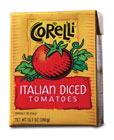
Tetra Pak created the Corelli brand to demonstrate the pull through of retorted packages on retailer shelves. Source: Tetra Pak Inc.
Introduced in mid-2004 with Hormel Foods’ chili brands, Tetra Recart represented a technical triumph and bold gambit for the aseptic packaging specialists: a primarily pulp container that can withstand up to two hours of 266
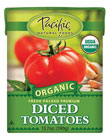
A line of organic tomatoes is being copacked for Pacific Natural Foods on the Del Monte Foods’ Tetra Recart line. Source: Pacifica Natural Foods.
Unfortunately, the chili rollout did not meet expectations, and Hormel pulled the plug on the Beloit, WI, Recart line. Undeterred, Tetra Pak mounted a 12-week test at the stores of retailers in its US Council for Aseptic Packaging. The firm created the Corelli brand of diced and crushed tomatoes, Italian diced tomatoes and tomato sauce. The result: 29 percent higher unit sales versus comparable canned products. Armed with the sales results, Tetra officials won private-label orders from several supermarket chains, including Kroger, which is carrying the Corelli brand.
Retailers such as Meijer, Hyvee and Giant Eagle are members of buying cooperative Topco Associates, which participates in Tetra Pak’s council. Under the Skokie, IL-based coop’s Food Club private label, a smattering of stores in Minnesota are stocking retorted products without ad support, and the results are encouraging, reports Dennis Dangerfield, vice president-purchasing. “There are huge operational efficiencies,” he says. “For example, shrink is reduced. If a box falls off the shelf, you just put it back. If a can falls, it dents and goes in the banana box and becomes salvage.”
The cartons are retorted at Del Monte Foods’ Hanford, CA, tomato plant, which commissioned a TPR-1 high-speed Recart filler last summer. The unit can fill up to 400 containers a minute. While the fastest US canners fill at twice that rate, the TPR-1 “is unprecedented in terms of carton-filling speed,” says Steve Hellenschmidt, general manager of Tetra Recart North America. The filler handles three container sizes: 340 g, 390 g and 500 g.
Retailers such as Meijer, Hyvee and Giant Eagle are members of buying cooperative Topco Associates, which participates in Tetra Pak’s council. Under the Skokie, IL-based coop’s Food Club private label, a smattering of stores in Minnesota are stocking retorted products without ad support, and the results are encouraging, reports Dennis Dangerfield, vice president-purchasing. “There are huge operational efficiencies,” he says. “For example, shrink is reduced. If a box falls off the shelf, you just put it back. If a can falls, it dents and goes in the banana box and becomes salvage.”
The cartons are retorted at Del Monte Foods’ Hanford, CA, tomato plant, which commissioned a TPR-1 high-speed Recart filler last summer. The unit can fill up to 400 containers a minute. While the fastest US canners fill at twice that rate, the TPR-1 “is unprecedented in terms of carton-filling speed,” says Steve Hellenschmidt, general manager of Tetra Recart North America. The filler handles three container sizes: 340 g, 390 g and 500 g.
Based on market research, Hellenschmidt says, “Consumers perceive products in a carton to be fresher than a metal can.” Merchandisers are driven by hard numbers, not perceptions, and the fact the cuboid container is “about 30 percent more efficient in terms of shelf space vs. a cylindrical can” means display and distribution advantages, he adds.
Despite the Hormel setback, Hellenschmidt is upbeat about Recart’s future. Of the 13 lines running worldwide, the one that has shifted market share the most is just south of the border, in Los Mochis, Mexico, where Corfuerte SA built a facility two years ago in partnership with Tetra Pak to pack a variety of vegetables and salsa.
For more information:
Steve Hellenschmidt, Tetra Pak Inc., 847-955-6454, steve.hellenschmidt@tetrapak.com
Despite the Hormel setback, Hellenschmidt is upbeat about Recart’s future. Of the 13 lines running worldwide, the one that has shifted market share the most is just south of the border, in Los Mochis, Mexico, where Corfuerte SA built a facility two years ago in partnership with Tetra Pak to pack a variety of vegetables and salsa.
For more information:
Steve Hellenschmidt, Tetra Pak Inc., 847-955-6454, steve.hellenschmidt@tetrapak.com
Looking for a reprint of this article?
From high-res PDFs to custom plaques, order your copy today!



Related Products
See More Products
×