Food as ad medium
Lasers can etch tracking codes on eggs, melons and other types of natural packaging. They also can inscribe ads and other promotional messages.
 Traceability and freshness coding are progressing in fits and starts in food packaging. One of the more advanced applications takes tracing and coding down to the item level, using lasers to etch information onto eggshells.
Food safety as a value-add is a focus of EggFusion, a Deerfield, IL-based firm with an unusual business model. It’s also demonstrating that technology can turn an eggshell into a promotional medium for TV shows and other messages.
The firm engineers end-of-the-line coding systems that are integrated with graders and washers in commercial egg factories. It uses CO2 gas and light to cut 50-90 microns deep into the shells, leaving an indelible lot code, expiration date or other information. The firm also lines up retailers willing to pay 3 cents per dozen for the etching and pairs them with egg suppliers willing to install the coding system, which takes up 18-sq.-ft. of floor space and measures 6-ft. tall.
The etching, which only penetrates about 5% of the shell’s depth, is accomplished in 39 milliseconds, according to EggFusion Founder and Chairman Bradley Parker. The available surface, not the size of characters or amount of information, is the limiting factor, he says. To inscribe more data, more lasers are added.
Any food with a natural package is a candidate for the technology, though “we’re focused like a laser on the egg market,” Parker deadpans. A former stockbroker, he was inspired to offer item-level coding by a 60 Minutes story about grocers repackaging out-of-date eggs in new cartons. He partnered with computer engineers who had invented an Internet ad-tracking system to develop the laser system. “I figured if they had a traceability program for advertising, they had a traceability program,” he says simply.
In 2005, Watertown, MA-based Radlo Foods became the company’s first client. A founding member of Eggland’s Best, Radlo etched 30 million of its Born Free brand eggs over two years. Six more egg suppliers have installed the systems since, etching more than 300 million eggs in the last year. In between, CBS contracted for messages on 35 million eggs to promote its fall 2006 program lineup.
The participation of Giant Food Stores and Martin’s Food Markets, two East Coast divisions of the Dutch retailer Royal Ahold, could aid Parker’s goal of cracking the 81 billion mainstream egg market. The retailers are tapping into EggFusion’s myfreshegg.com site, which provides consumers with traceability information about the eggs in their refrigerators.
Demonstrating value to manufacturers also is important, Parker allows. “We keep reducing the size of the system, and we have to demonstrate we don’t slow the line.” At one plant, sensors to monitor rinse-water temperatures and pH were incorporated. Technicians at the firm’s client solution center in Colorado noted real-time data indicating eggs were being hard-boiled. A call to the plant alerted maintenance to the problem, and personnel quickly traced the problem to a failed gasket.
Alcohol-based dyes are being stamped on eggs in the rapidly expanding specialty market, but those markers can be messy and pose legibility problems in an egg plant’s humid environment, Parker argues. His firm partners with Diamond Systems, a major supplier of egg packing and grading systems, to incorporate laser units into space currently occupied by packers.
For more information:
Bradley Parker, EggFusion Inc., 312-324-0118
Bulk packs of 26 ozs. for 13 of the manufacturer’s cereals have been converted to No. 4, petroleum-based, recyclable plastic, eliminating an estimated 437 tons of paperboard per year. To overcome merchandising issues, Nature’s Path designed a rip-top shipping container that doubles as a point-of-purchase display. By eliminating two-thirds of the packaging of conventional cereal containers, Eco-Pacs reduce CO2 gases by 1.4 million lbs. and eliminate almost 1 million gallons of wastewater.
The rush to sustainable packaging was seen as a plus for polylactide (PLA) polymer films based on corn starch, with organic food companies viewed as particularly fertile ground for suppliers such as NatureWorks. But Nature’s Path pointedly notes that its Eco-Pacs are made from “number four, petroleum-based, recyclable plastic. In adherence to Nature’s Path strict non-GMO (genetically modified organisms) policy, the packages do not consist of plastic made from GMO corn.”
Four years ago, Nature’s Path tentatively converted a dozen cereals to EnviroBox, a resizing effort that cut 10% from the box’s material. Consumer and retailer acceptance initially was uncertain, but the conversion was a hit: 50 additional cereals now use EnviroBox, saving 144 tons of paperboard and 942,128 kWh of energy, the company estimates.
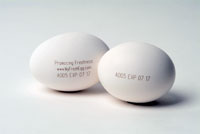
Freshness codes etched onto eggshells are one application for EggFusion’s laser printers, though promotional messages and logos are other options. Source: EggFusion Inc.
Food safety as a value-add is a focus of EggFusion, a Deerfield, IL-based firm with an unusual business model. It’s also demonstrating that technology can turn an eggshell into a promotional medium for TV shows and other messages.
The firm engineers end-of-the-line coding systems that are integrated with graders and washers in commercial egg factories. It uses CO2 gas and light to cut 50-90 microns deep into the shells, leaving an indelible lot code, expiration date or other information. The firm also lines up retailers willing to pay 3 cents per dozen for the etching and pairs them with egg suppliers willing to install the coding system, which takes up 18-sq.-ft. of floor space and measures 6-ft. tall.
The etching, which only penetrates about 5% of the shell’s depth, is accomplished in 39 milliseconds, according to EggFusion Founder and Chairman Bradley Parker. The available surface, not the size of characters or amount of information, is the limiting factor, he says. To inscribe more data, more lasers are added.
Any food with a natural package is a candidate for the technology, though “we’re focused like a laser on the egg market,” Parker deadpans. A former stockbroker, he was inspired to offer item-level coding by a 60 Minutes story about grocers repackaging out-of-date eggs in new cartons. He partnered with computer engineers who had invented an Internet ad-tracking system to develop the laser system. “I figured if they had a traceability program for advertising, they had a traceability program,” he says simply.
In 2005, Watertown, MA-based Radlo Foods became the company’s first client. A founding member of Eggland’s Best, Radlo etched 30 million of its Born Free brand eggs over two years. Six more egg suppliers have installed the systems since, etching more than 300 million eggs in the last year. In between, CBS contracted for messages on 35 million eggs to promote its fall 2006 program lineup.
The participation of Giant Food Stores and Martin’s Food Markets, two East Coast divisions of the Dutch retailer Royal Ahold, could aid Parker’s goal of cracking the 81 billion mainstream egg market. The retailers are tapping into EggFusion’s myfreshegg.com site, which provides consumers with traceability information about the eggs in their refrigerators.
Demonstrating value to manufacturers also is important, Parker allows. “We keep reducing the size of the system, and we have to demonstrate we don’t slow the line.” At one plant, sensors to monitor rinse-water temperatures and pH were incorporated. Technicians at the firm’s client solution center in Colorado noted real-time data indicating eggs were being hard-boiled. A call to the plant alerted maintenance to the problem, and personnel quickly traced the problem to a failed gasket.
Alcohol-based dyes are being stamped on eggs in the rapidly expanding specialty market, but those markers can be messy and pose legibility problems in an egg plant’s humid environment, Parker argues. His firm partners with Diamond Systems, a major supplier of egg packing and grading systems, to incorporate laser units into space currently occupied by packers.
For more information:
Bradley Parker, EggFusion Inc., 312-324-0118
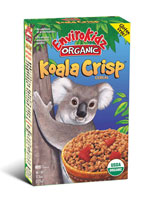
Bulk packages of the EnviroKidz line of organic cereals (right) have been converted to recyclable plastic bags, slashing packaging materials to a third of typical cereal boxes. When the brand uses boxes (left), material savings of 10% are realized. Source: Nature’s Path Organic Foods.
Petroleum-based package trumps GMO-based film
Plastic bags for cereal are more closely associated with generic foods than premium products, but Richmond, BC-based Nature’s Path Organic Foods is confident its new Eco-Pacs for organic cereal will prove sustainable, both from an environmental and business practices standpoint.Bulk packs of 26 ozs. for 13 of the manufacturer’s cereals have been converted to No. 4, petroleum-based, recyclable plastic, eliminating an estimated 437 tons of paperboard per year. To overcome merchandising issues, Nature’s Path designed a rip-top shipping container that doubles as a point-of-purchase display. By eliminating two-thirds of the packaging of conventional cereal containers, Eco-Pacs reduce CO2 gases by 1.4 million lbs. and eliminate almost 1 million gallons of wastewater.
The rush to sustainable packaging was seen as a plus for polylactide (PLA) polymer films based on corn starch, with organic food companies viewed as particularly fertile ground for suppliers such as NatureWorks. But Nature’s Path pointedly notes that its Eco-Pacs are made from “number four, petroleum-based, recyclable plastic. In adherence to Nature’s Path strict non-GMO (genetically modified organisms) policy, the packages do not consist of plastic made from GMO corn.”
Four years ago, Nature’s Path tentatively converted a dozen cereals to EnviroBox, a resizing effort that cut 10% from the box’s material. Consumer and retailer acceptance initially was uncertain, but the conversion was a hit: 50 additional cereals now use EnviroBox, saving 144 tons of paperboard and 942,128 kWh of energy, the company estimates.
Looking for a reprint of this article?
From high-res PDFs to custom plaques, order your copy today!