Food Engineering logo
search
cart
facebook twitter linkedin youtube
  • Sign In
  • Create Account
  • Sign Out
  • My Account
Food Engineering logo
  • NEWS
    • Latest Headlines
    • Manufacturing News
    • People & Industry News
    • Plant Openings
    • Recalls
    • Regulatory Watch
    • Supplier News
  • PRODUCTS
    • New Plant Products
    • New Retail Products
  • TOPICS
    • Alternative Protein
    • Automation
    • Cannabis
    • Cleaning | Sanitation
    • Fabulous Food Plants
    • Food Safety
    • Maintenance Strategies
    • OEE
    • Packaging
    • Sustainability
    • More
  • EXCLUSIVES
    • Plant Construction Survey
    • Plant of the Year
    • Sustainable Plant of the Year
    • State of Food Manufacturing
    • Top 100 Food & Beverage Companies
  • MEDIA
    • Podcasts
    • Videos
    • Webinars
    • White Papers
  • FOOD MASTER
  • EVENTS
    • Food Automation & Manufacturing Symposium and Expo
    • Industry Events
  • RESOURCES
    • Newsletter
    • Custom Content & Marketing Services
    • FE Store
    • Government Links
    • Industry Associations
    • Market Research
    • Classified Ads
  • EMAGAZINE
    • eMagazine
    • Archive Issue
    • Advertise
  • SIGN UP!
Dry Processing

Dry Processing

Norwegian confectioner improves safety and efficiency

Automatic bulk bag discharger saves on labor costs while overcoming horizontal and vertical space constraints.
By Debra Schug
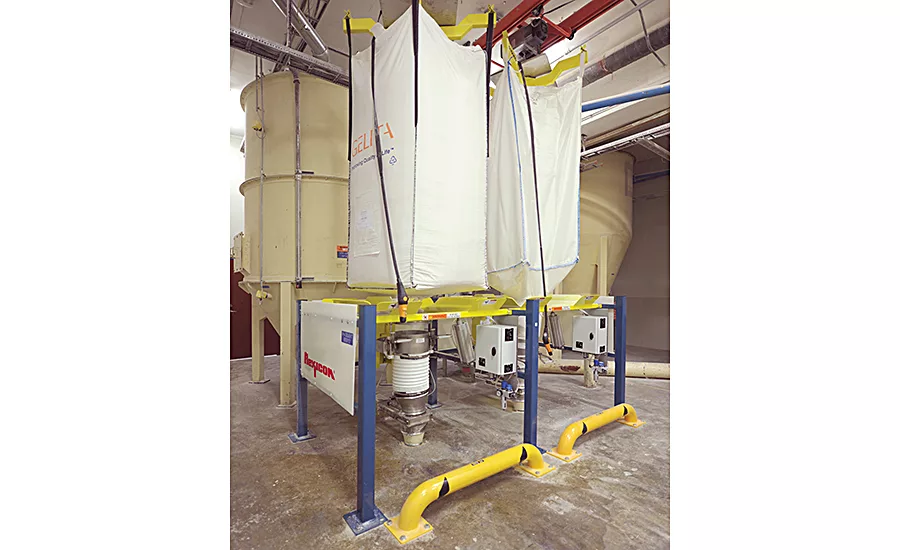
Flexicon twin bulk bag dischargers

Nidar AS added Flexicon twin bulk bag dischargers to handle two types of starch in a tight space on its fourth floor. Source: Flexicon.

February 9, 2016

Norway’s leading supplier of candy, Nidar AS, manufactures 150 products under 35 brands on 10 production lines. Built in 1950, the company’s plant has been periodically updated with newer bulk handling equipment to improve productivity and working conditions. The five-level plant has been extended six times to accommodate growth in production, but due to the building’s design, the space presents challenges for the company. “As with most old buildings, the original layout has not always been optimal for modern production,” explains Tor Ove Kvingedal, one of Nidar’s three maintenance engineers.

Tight places make gravity feeding of materials impossible in some sections of the plant. In these areas, bulk materials are transferred using bulk bag dischargers, flexible screw conveyors, rigid augers and pneumatic conveyors. These pieces of equipment not only reduce manual labor and contain dust, they also fit in the allotted space.

Ingredients such as milk powder, sugar and starch arrive in 1.2-ton bulk bags. A number of bulk bag discharge stations are dedicated to unloading them, including six supplied by Flexicon Ltd. The newest bulk bag discharger is a twin half-frame unit that handles two types of starch in a small space on the plant’s fourth floor. Previously, operators carried 55-lb. bags of starch from the third to the fourth floor where it was dumped into two large vessels, each holding 440 to 660 lb. Thirty-two bags were handled manually each eight-hour day.

“The operators were climbing stairs numerous times every day to keep the vessels filled,” says Kvingedal. He adds unloading the bags of starch by hand was hard work and dusty too. “Starch dust is not harmful, but it can be very sticky.”

The starch powder flowed by gravity from two large vessels through a pair of knife gate valves and 6-in. diameter steel chutes. The large vessels could not be replaced with two separate bulk bag dischargers because the distance between the discharger outlets would have exceeded the distance between the existing chutes. Also, the ceiling is less than 15-ft. high, which does not provide enough headroom above the units to use a forklift for loading and removing bulk bags.

To surmount both problems, a Flexicon Bulk-Out BFH-C-X 4-ft. high, twin half-frame bulk bag discharger was installed. The unit discharges through two outlets spaced closely enough to avoid relocating the knife gate valves and chutes, while the low profile design allows suspension of bulk bags from a hoist, saving 4 in. of headroom. The discharger holds two bulk bags side-by-side that provide enough starch to keep the line running for two or more days.

Removing the original tanks and installing the twin half-frame discharger above the chutes was straightforward, says Kvingedal. Only a compressed air supply is required to power the unit.

“We installed the discharger in two days,” he remembers. “A local company provided the hoist. It was critical to have the equipment installed quickly, because starch is a key ingredient on this production line.”

Once a bag is hoisted into position, an operator pulls the bag spout over a clamp ring to create a secure, dust-tight connection between the clean side of the bag spout and the clean side of a telescoping tube. Nidar considered installing extraction fans, but decided they were unnecessary since the discharger’s bag spout interface contains the dust.

As the bag empties and elongates, the telescoping tube maintains constant downward tension, promoting complete discharge. Additional support of flow through the spout is provided by the bag activators that raise opposite bottom sides of the bag into a steep “V” shape.

After descending through the telescoping tube, the starch passes through the knife gate valve and then through one of the two vertical chutes to a weighing station on the second floor. A horizontally oriented 6.7-in. diameter auger on the third floor can run in either direction, so each discharger can supply either of the two weighing stations that send the signals to open or close the knife gate valves.

“The twin half-frame bulk bag discharger is easy to keep clean using compressed air or a damp rag, and maintenance needs are very low,” says Kvingedal. “It reduces manual effort, contains dust and improves the working environment.”


For more information:

Flexicon Corp., 610-814-2400;
sales@flexicon.com, www.flexicon.com.

KEYWORDS: air handling

Share This Story

Looking for a reprint of this article?
From high-res PDFs to custom plaques, order your copy today!
Debra Schug was Editor-in-Chief of Food Engineering. She began her media career over a decade ago writing and producing broadcast news for both television and radio at the local and national level. She spent many years as the managing editor for two trade magazines in the oil industry and the research editor for an annual petroleum report. She has a master’s degree in journalism and mass communication from Iowa State University.

Recommended Content

JOIN TODAY
to unlock your recommendations.

Already have an account? Sign In

  • 2025 Top 100 Food and Beverage Companies

    FOOD ENGINEERING’s 2025 Top 100 Food and Beverage Companies

    While sales were largely down under dynamic economic and...
    Top 100 Food & Beverage Companies
    By: Alyse Thompson-Richards
  • Bottling machine

    How Optical and X-Ray Inspection Supports Bottling Safety and Quality

    By transitioning from legacy single-technology systems to...
    Food Safety
    By: Dan McKee
  • Bread baking in oven

    The State of Food Manufacturing in 2025

    Food and beverage manufacturers are investing in...
    Manufacturing News
    By: Alyse Thompson-Richards
Manage My Account
  • eMagazine
  • Newsletter
  • Online Registration
  • Manage My Preferences
  • Customer Service

More Videos

Popular Stories

The Campbell's Company logo

Campbell’s Terminates Exec Over Alleged Disparaging Comments

Frito-Lay logo

PepsiCo to Close Two Florida Facilities

alternative protein products

Alternative Protein in 2025: Key Trends and Technologies

State of Maufacturing 2025

Events

June 17, 2025

Refrigerated & Frozen Foods’ State of the Cold Chain

On Demand Kelley Rodriguez, Editor in Chief of Refrigerated & Frozen Foods, will be joined in this 60-minute webinar by industry experts to help unpack the latest research.

July 23, 2025

Decarbonizing Process Heat: What You Should Know and Next Steps

On Demand Driven by climate goals, business risk, client interest, and resilience considerations, food and beverage companies are increasingly turning their attention to decarbonizing their production processes.

View All Submit An Event

Products

Recent Advances in Ready-to-Eat Food Technology

Recent Advances in Ready-to-Eat Food Technology

See More Products

CHECK OUT OUR NEW ESSENTIAL TOPICS

Alternative ProteinAutomationCleaning/SanitationFabulous Food Plants

Food SafetyMaintenance StrategiesOEE

PackagingSustainability

Related Articles

  • feeding almonds to conveyors

    Sanitary conveyors meet almond processor's food safety needs

    See More
  • Linde impingement freezer

    Preserving quality and safety

    See More
  • safe food packaging

    Addressing safety concerns

    See More

Related Products

See More Products
  • small-occ.jpg

    Occupational Health and Safety in the Food and Beverage Industry

  • 9780367351052.jpg

    Food Process Engineering: Safety Assurance and Complements

  • milk-dairy.jpg

    Milk and Dairy Foods Nutrition, Processing and Healthy Aging

See More Products
×

Elevate your expertise in food engineering with unparalleled insights and connections.

Get the latest industry updates tailored your way.

JOIN TODAY!
  • RESOURCES
    • Advertise
    • Contact Us
    • Food Master
    • Store
    • Want More
  • SIGN UP TODAY
    • Create Account
    • eMagazine
    • Newsletter
    • Customer Service
    • Manage Preferences
  • SERVICES
    • Marketing Services
    • Reprints
    • Market Research
    • List Rental
    • Survey/Respondent Access
  • STAY CONNECTED
    • LinkedIn
    • Facebook
    • YouTube
    • X (Twitter)
  • PRIVACY
    • PRIVACY POLICY
    • TERMS & CONDITIONS
    • DO NOT SELL MY PERSONAL INFORMATION
    • PRIVACY REQUEST
    • ACCESSIBILITY

Copyright ©2025. All Rights Reserved BNP Media.

Design, CMS, Hosting & Web Development :: ePublishing