Manufacturing News
Detox Project offers residue-free certification
Label would let producers show products don't have residual glyphosate
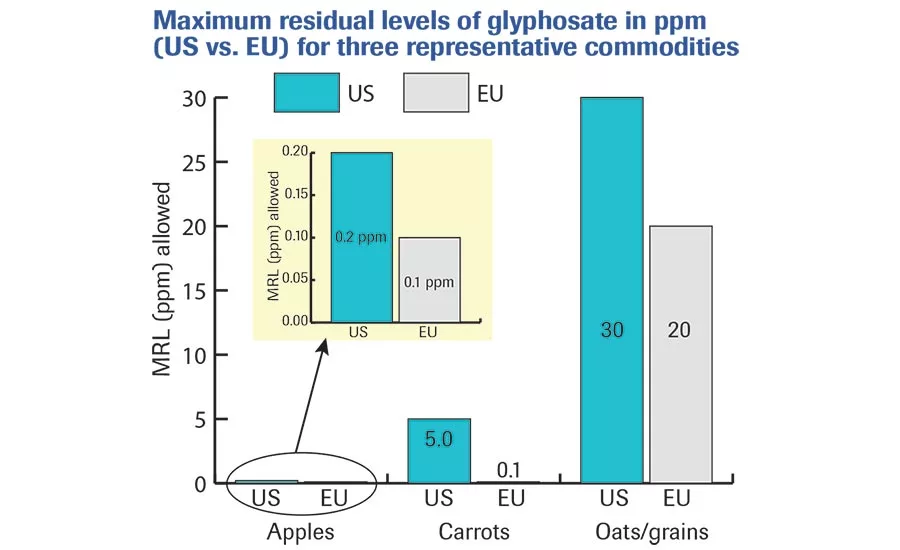
Combined regulatory agencies in the US typically allow higher residual levels of glyphosate in various commodities than those in the EU. US figures include glyphosate, metabolites and degradates. These three categories were pulled from the Global MRL Database. Data source: www.globalmrl.com.
In a move to provide a means for food and beverage processors to show their products are free of residual glyphosate (an active ingredient in Roundup and other herbicides), The Detox Project has applied and been granted a trademark symbol that processors may use on their labels, provided their products are tested and do not contain glyphosate or AMPA (aminomethylphosphonic acid) residues exceeding the limits of laboratory detection, which is typically between 0.1 and 20 parts per billion (ppb). AMPA is a metabolite of glyphosate.
AMPA is considered a weak organic acid with a phosphoric group and a primary degradation product of glyphosate. Regulators claim that glyphosate and AMPA have similar toxicological profiles, but more research is needed to confirm AMPA’s potential toxic impacts. Meanwhile, the amount of residual glyphosate in a food or beverage, which may be considered toxic, is also open to question, and US regulations typically allow higher levels than those in Europe.
The Glyphosate Residue Free certification testing program is based on the work of Anresco Laboratories, an independent FDA-registered lab.
“We will make sure that the products are tested at least three times a year, and we will also make sure that spot checks are performed regularly,” says Henry Rowlands, director of The Detox Project.
While USDA Organic processors may find it easier to earn the new certification because they typically seek out organic suppliers that are limited to using naturally occurring chemical pesticides, it doesn’t necessarily rule out non-organic suppliers if they can meet the MRL (maximum residue level) requirements for certification.
“We’re finding that about 70 percent of the organic market can be certified, and 20 percent of the conventional market can be certified,” says Rowlands.
While certified organic processors and those that use non-GMO ingredients can find favor with in-the-know consumers, shoppers still want more transparency.
“The problem with organic is that no one’s doing any testing [for chemical residues]. Obviously, the Non-GMO Project has been extremely successful, but it doesn’t address toxic chemicals, which is what consumers really want to know,” contends Rowlands.
The new glyphosate residue-free certification currently reaches beyond conventional certifications. What glyphosate level is safe?
New scientific evidence shows that probable harm to human health could begin at ultra-low levels of glyphosate, e.g., 0.1 ppb, according to the report, Glyphosate: Unsafe on any Plate. Popular foods tested for residual glyphosate have measured between 289 and as high as 1,125 ppb for some cereals.
Currently, US regulators allow a very high level of daily glyphosate in America’s food. The acceptable daily intake is set at 1.75 mg per kilogram (kg) of bodyweight per day (written as 1.75 mg/kg bw/day) in the US, versus 0.3 mg/kg bw/day in the European Union, according to the report. Tolerances in the US have been set through the submission of corporate-sponsored studies and industry influence on the regulatory process, says the report.
The classification of glyphosate as a carcinogen has been disputed. The EPA originally classified it as Category C (possible human carcinogen) but, in 1991, changed it to E (non-carcinogen) after re-evaluation of a mouse study. WHO’s International Agency for Research on Cancer Working Group concluded there is significant evidence of carcinogenicity in experimental animals and declared in March 2015 that glyphosate is a “probable human carcinogen.”
A search on the Global MRL Database shows for many uncooked types of produce/commodities a small to wide difference between US- and European-allowable glyphosate MRLs.
While the discussion about what level of glyphosate is potentially dangerous to humans will go on, the obvious conclusion is that the fewer chemicals and the lower their residual levels in our food supply, the better. And, Rowlands explains, the main purpose of the certification is not necessarily to quibble over MRLs of glyphosate or other chemicals, but to show consumers that a product is free of glyphosate.
For more information, visit www.detoxproject.org or contact Rowlands at henry@detoxproject.org.
Looking for a reprint of this article?
From high-res PDFs to custom plaques, order your copy today!