Processing
A steamy situation turns out better
Campbell Foods Belgium installs steam generators and improves production
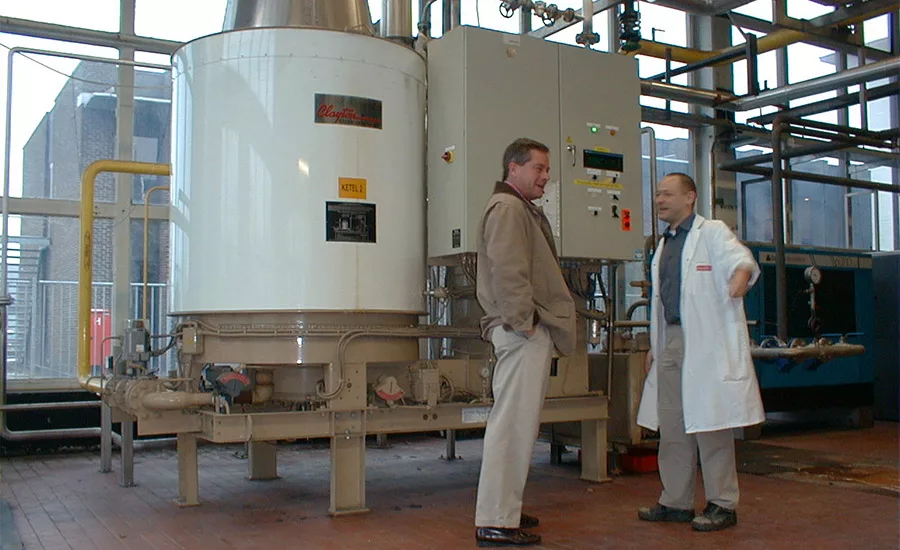
Since 1968 Campbell Foods Belgium n.v. has been producing mayonnaise, sauces, gherkins, onion, pickles and mustard under the Devos Lemmens brand name, as well as baking products, pudding, dessert sauces and kitchen aids under the Imperial Label. To do so, the Campbell Foods facility in Puurs, Belgium, requires steam to cook ingredients in heat exchangers and large, covered kettles and to provide high temperatures for autoclaves that sterilize products contained in jars.
Unfortunately, according to Peter Van Steen, engineering and technical manager at the facility, the fire-tube boilers originally installed for use as steam sources exhibited unacceptably slow start-ups. The boilers' inability to maintain pressure and temperature also made it difficult to assure product consistency and quality. For example, bringing a second autoclave on-line frequently resulted in a pressure drop that lowered the heat supply to the first. On some occasions this meant that the contents of the first autoclave had to be discarded.
Since this was not acceptable, plant management researched alternative steam-producing technologies. Among their requirements were quick start-ups and the ability to maintain constant temperatures under all circumstances, says Van Steen. Other important considerations were ease of use, low maintenance and the absence of explosion risk. During their research, management contacted Paul Lamberts of Clayton Belgium, in Bornem, Belgium, the European headquarters of El Monte, CA-based Clayton Industries. Lamberts recommended replacing the original equipment with a Clayton steam generator.
The steam generators are available in 13 sizes from 20 to 700 BHP/200 to 6,900 KW. These units provide from 690 to 20,000 lbs. of steam per hour, at pressures up to 3,000 psig/200 bar. The design is based on the forced circulation of water through a heated coil. Because only a relatively small volume of water is in the generator at any given time, the equipment is significantly smaller than a conventional boiler of similar capacity. Especially important at the Campbell complex is that the units deliver rapid start-ups and quick responses to changes in steam demand. The generators also work when fueled by natural gas, propane, light oil, heavy oil or combinations of these fuels.
Based on these characteristics, management at the Campbell facility had a steam generator installed. "We were impressed right from the start," says Van Steen. "Where it takes a boiler four minutes to fire up, the generator does it in 35 seconds. The generator consistently maintains temperature and pressure as autoclaves are brought on line sequentially, which assures us of product quality.
"In fact," he continues, "the initial reaction to the Clayton generator was so positive that we purchased a second unit later that year and placed it on standby as a back up."
Management was so impressed with the first two units that when they added an immense new autoclave to the Puurs facility, they purchased a larger generator from Clayton to maintain a constant supply of steam to all kettles and autoclaves, including the new addition. After installation, it was determined that no pressure drops occurred even when the huge autoclave began operating.
The systems continue to provide very fast startups and consistent pressure with very little maintenance, says Van Steen. "We run two production shifts, but we don't need the steam overnight. We start the generators at 5 a.m. in preparation for the first shift which begins at 5:30 and stop them at 10 p.m. The generators are very easy to start and are up and running within 15 minutes. They are simple to stop as well. And, despite the starts and stops, pressure is perfectly consistent throughout the day," Van Steen says.
For more information:
James D. Albright; Clayton Industries;
937-767-2156
Looking for a reprint of this article?
From high-res PDFs to custom plaques, order your copy today!