Connected Enterprises
How an international brewer has insight over worldwide operations
Heineken’s journey to real-time global connectivity with event-driven integration means your beer will be waiting for you after work

Thanks to Heineken's adoption of event-driven software architectures worldwide, problems with duplicate and lost orders and lost revenue have disappeared, meaning that customers will not have to substitute brands because their favorite establishment ran out or couldn't get its order in time for that special holiday. All images courtesy Heineken
Founded in Amsterdam in 1864, Heineken is one of the largest brewers on the planet, operating across 190 countries where its Heineken beers and ciders are sold. It is a household brand for many with an excellent reputation. But this is not enough in the current market climate—the company has recognized the need to ensure resilience and adaptability in its operations going forward. This was what led to the formation of its EverGreen strategy—a five-point business-wide plan to drive superior growth, fund that growth, raise the bar on sustainability and responsibility, become the best-connected brewer and unlock the full potential of its people.
To underpin this strategy, Heineken turned to its Digital & Technology (D&T) organization to help enable corporate-wide resilience and agility. The team was challenged to integrate thousands of business-critical applications across payments, logistics, inventory management, and more, while also connecting dozens of separate operating companies (OpCos), some of which still relied on local or legacy business systems. Finally, it needed to connect across 350 global and local brands in more than 190 countries—a formidable task.
Solving bursty data flows means smoother global operations
According to Guus Groeneweg, Heineken’s product owner for digital integration, becoming the world’s best-connected brewer means “providing all internal and external customers with real-time access to data provided through integration assets, and ensuring those integration processes work effectively, consistently, and without disruption.”
Enabling consistently fast, reliable and robust integration processes across diverse business functions is not an easy task for a company that frequently sees data come in large bursts from geographically dispersed sources. That “bursty” data flow—driven by orders on the back of a new beer brand launch, for example—can overwhelm integration platforms that rely on point-to-point communication via synchronous APIs (application programming interfaces). This can result in duplicate orders, lost orders, lost revenue and ultimately unhappy customers.
To overcome these challenges and meet its ambitious digital transformation targets, Heineken has adopted an event-driven approach to integration. In short, it’s underpinning its legacy integration and API management technologies with a dynamic and robust event-driven architecture layer that will deliver data from external parties, prevent data loss, mitigate system failures and guarantee business continuity in the case of cloud or iPaaS (integration platform as a service) outage.
Event-driven infrastructure bolsters cloud-based D&T strategy
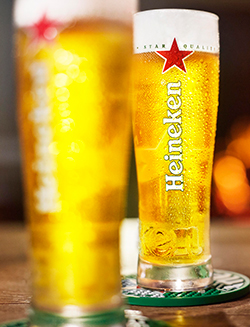 Two years ago, Heineken faced challenges relating to the increasing volume of orders it was receiving. This increase put pressure on its cloud integration infrastructure, sometimes resulting in duplicate and lost orders. They needed a solution—and fast. Event-driven integration was the answer. By event enabling its integration platform, Heineken’s processes have become more robust and reliable.
“Taking an event-driven approach has increased efficiency in what data is moved, and how this is done,” says Groeneweg. “In the past, Heineken would see hundreds or thousands of point-to-point scenarios, but now they are being leveraged with one-to-many integration patterns, where an application only has to produce an event (like an order of beer) once, and any other applications in the system (production, shipping, fulfillment, inventory, payments, cloud data lake etc.) can just subscribe to what they want to receive, and get it when it’s published.”
“We are also leveraging event-driven integration to increase the efficiency of our application development process—with an event broker in the mix, our app teams can focus on designing great apps and not worry about the messaging or event streaming infrastructure,” continues Groeneweg.
“Each and every capability of our digital integration strategy is in place. We enable all required integration patterns through a limited set of integration platforms, from interfaces between local systems in Vietnam up to interfaces from global ERP systems to local CRM systems. Now we are focused on moving towards reusable integration assets.
“That is really required, with some big standardization programs we are now deploying to more than 190 countries. Moving away from 70+ different ERP instances with different data models and process definitions to a lean core with a loosely coupled yet tightly integrated architecture; from a large set of fragmented solutions to modern cloud-based platforms that optimize end to end ways of working in specific area,” explains Groeneweg.
Event-driven integration is the glue that binds the end-to-end processes
For event-driven integration to work, the whole process needs to work correctly and efficiently; it’s what allows all the processes and applications in the value chain to communicate in real-time.
“Consider this chain of events—a large supermarket chain in New Zealand places an order through Heineken’s B2B portal, the order is processed in the back-end with the payment information, the beer is delivered, the packing lists in the brewery have to roll out of the label printer etc.,” Groeneweg explains. “Each of these activities is supported by multiple integrations between front- and back-end. All these digital integrations are developed, operated, and monitored by the Heineken global digital integration team.”
As consumer habits shift, business operations must adapt, and fast
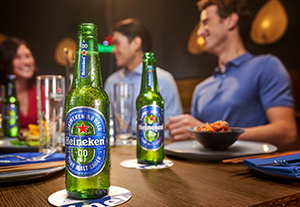 There has been a paradigm shift in consumer expectation and power. Today customer experience drives differentiation. The need for real-time, secure transactions anywhere within the 190 countries in which Heineken is active has changed integration into an enabler.
Heinken’s event-driven digital transformation has given the brewer a competitive edge, enabling it to operate smoothy around the world with excellent experiences for customers, consumers, suppliers, and employees. Further, it has empowered the brewer to deploy scalable “plug and play” solutions quickly and take advantage of timely business insights at scale.
Event-driven integration is now a core strategic capability for Heineken moving forward. The company sees greater use cases ahead, across IoT, analytics, customer facing apps and more.
Real-time data as a service to all stakeholders
Heineken is looking to utilize its capabilities to build seamless digital interactions across the entire value chain, and give all Heineken software users, both internal and external, the information they need to make smart decisions.
“To achieve this, event-driven integration must be used to deploy a global observability solution that makes data-driven insights available to operational teams in real-time. This allows us to instantly feed our business with the right data, for the right consumer, with the right application, at the time they need it,” continues Groeneweg.
Event-driven integration ultimately keeps EverGreen business strategy on track
Like many large organizations with a globally distributed supply chain, customer base, workforce, and IT infrastructure, Heineken is on a digital transformation journey to become a better-connected business.
Guided by the principles of its EverGreen strategy, Heineken is taking the bold and progressive steps required to help them keep pulse with every customer; quickly adapt to new or evolving demands; and stay one step ahead in this highly dynamic market.
With event-driven integration, this is becoming a reality.
Looking for a reprint of this article?
From high-res PDFs to custom plaques, order your copy today!