ENGINEERING R&D: Predictive Models Boost Tuna Yields

FE: What is TunaCAL?
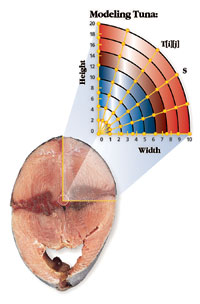
Weng: TunaCAL is a mathematical modeling software developed to optimize the tuna precooking process and provide significant benefits in product yield, consistency and quality.
FE: Where does TunaCAL fit in the tuna process?
Weng: In a typical process, the fish are frozen aboard the boats after catch, then transported to the plant and stored frozen. It could take as long as four to six months from catch to the process. When ready for processing, the fish are thawed with fresh water or seawater, then loaded into a precooker for cooking at about 214 degrees F until the desired backbone temperature is reached. Precooking denatures the protein and makes the tuna easier to clean. After cooling with a water spray, the fish are skinned and cleaned, which includes separating the white meat from the red meat. The white meat is then canned, sealed and sterilized in retorts. TunaCAL optimizes precook time and temperature to improve yields and reduce energy costs without overcooking the product, thus improving product quality in terms of texture and moisture content and reducing skinning labor as well.
FE: By how much are yields improved?
Weng: It varies, depending on the species of tuna, the environmental conditions in which they were caught, the quality of raw tuna and processing conditions in a particular plant. Generally there are three species used in canning - Yellowfin, Skipjack and Albacore. In North America, Albacore is labeled as the pure white meat, whereas Yellowfin and Skipjack are labeled as the light meat. In some species, we have seen pure meat recovery improvements of greater than 5 percent. Higher yield means higher operating profits for the processors.
FE: By how much are energy costs reduced?
Weng: Energy savings with TunaCAL are very positive. We haven't calculated exact energy savings because they will vary from one processor to another depending on all the variables -- species, size, precooker capacity -- that we discussed earlier. But we've seen steam savings of more than 30 percent, so we're quite sure that the energy savings are very significant.
FE: What product variables are measured to calculate the TunaCAL model?
Weng: The major parameters are the species of tuna; the physical dimensions of the fish including length, width, height and weight; fat (oil) content; specific heat; and thermal conductivity.
FE: What process variables are measured and predicted?
Weng: Essentially the cooking time and cooking temperature. Based on the initial incoming temperature of the fish and the physical variables, TunaCAL continuously models heat transfer in the product, predicts the cooking time and the cooking temperature required to reach the desired backbone temperature, and automatically adjusts process time to achieve the target backbone temperature, all in real time. It applies thermal credit for come-up and cooling times.
FE: How is the process controlled?
Weng: TunaCAL runs _on FMC's LOG-TEC Momentum operating system, which automatically corrects for process deviations without operator intervention. Recipes for each species are preprogrammed. The tuna are batched by species, and as close to uniform size as possible so they have essentially the same heat-transfer characteristics. Batch sizes in an Asian plant average about two tons; in a U.S.-owned plant a batch can range as high as six tons. The operator simply selects the species and fish counts per basket, and from there it's a "hands-off" process. All the valves and field devices are automatically sequenced, and LOG-TEC controls both the heating and cooling phases. LOG-TEC also captures and records process information for plant and business-system use.
FE: What kind of equipment is used for precooking? Is it sort of like a blancher?
Weng: It resembles a blancher in principle. It's a rectangular atmospheric vessel with two doors, one for loading the raw tuna and the other for discharging the cooked tuna. It uses steam for heating and water for cooling. In European plants, i.e. in Spain which is Europe's largest tuna processor, they use quite a number of vacuum precookers. FMC has developed a new vacuum precooker to improve the cooked tuna quality and yield.
FE: Can TunaCAL be installed in existing processing systems?
Weng: TunaCAL is available as a retrofit package for either non-vacuum applications or with the new FMC vacuum precooker. FMC can also provide completely integrated tuna production lines which consist of vacuum precookers, tuna fillers, vacuum liquid fillers, seamers and overpressure sterilizers for plastic containers, pouches, glass jars and traditional cans.
FE: Can the mathematical modeling concept be applied to other thermal processes, such as pasteurization or cooking other products such as meat and vegetables?
Weng: Yes, models can be developed for just about any object, such as vegetables, beef and chicken filets. We've developed models for some of these products and others are under development. And, as you know, we've developed predictive models for sterilization processes with our NumeriCAL, HydroCAL and AseptiCAL systems.
FE: Has TunaCAL been applied yet to a commercial tuna process?
Weng: Yes, several major U.S. and international tuna processors are currently using it.
Looking for a reprint of this article?
From high-res PDFs to custom plaques, order your copy today!