The new lagoon
Darin
Davis, the environmental manager of General Mills’ frozen pizza facility in
Wellston, OH, needed to find a way to turn 90 million gallons of murky pond
water into clear water with no more than 8 mg/l of suspended solids.

“We needed to drain the entire 33-acre lagoon to make it possible to remove the sludge and land apply it,” says Davis. “However, we wanted to avoid trucking the water because of the high cost and potential environmental impact.”
Treating the lagoon water in the plant’s wastewater treatment system was not an option. General Mills has a permit to discharge 700,000 gallons per day of treated wastewater into the creek, but nearly all of this capacity is required for the Wellston plant’s manufacturing operations. Two options remained: trucking the water away or discharging it into the city’s POTW (publicly-owned treatment works).
The POTW required that the total suspended solids (TSS) not exceed 8 mg/l, but the TSS in the lagoon water typically measured in excess of 200 mg/l. The readings could fluctuate to double that value after spring runoff or during high-algae growth periods in the summer months.
Davis and his team approached GE Water & Process Technologies. GE engineers proposed using entrapped air floatation (EAF), a relatively new technology. EAF improves upon conventional dissolved air floatation (DAF), a wastewater treatment method used in industrial applications for liquids, solids and oils separation. Conventional DAF uses pressurized gas to separate solids and oil from a water stream. EAF does not rely on pressurized air, but rather air introduced under atmospheric conditions. This method, in conjunction with treatment chemistry, allows precipitated contaminants to entrap the air bubble and facilitate separation from the bulk water.
“The EAF system proved to be a good solution,” says Charles Camp, supervisor of the wastewater treatment plant for Wellston General Mills. “Despite the highly variable and difficult-to-treat feedwater, we maintained an average flowrate of about 300,000 gallons per day, right through the cold winter, and we never exceeded the stringent TSS standards set by the POTW.”
Davis calculates that General Mills saved about $5 million by avoiding the expense of trucking the lagoon water. “We also saved another $150,000 because the water removal project was completed three months ahead of schedule,” he says. “It turned out we needed this additional time for the sludge-removal operation, because we ended up having to remove double the amount of sludge from the bottom of the lagoon compared to our original estimates.”
By the end of the project, the lagoon was successfully drained and all of the sludge was used to enhance the soil of the surrounding farmland and former strip mines in the area.
For more information: Joe Ward, GE Water & Process
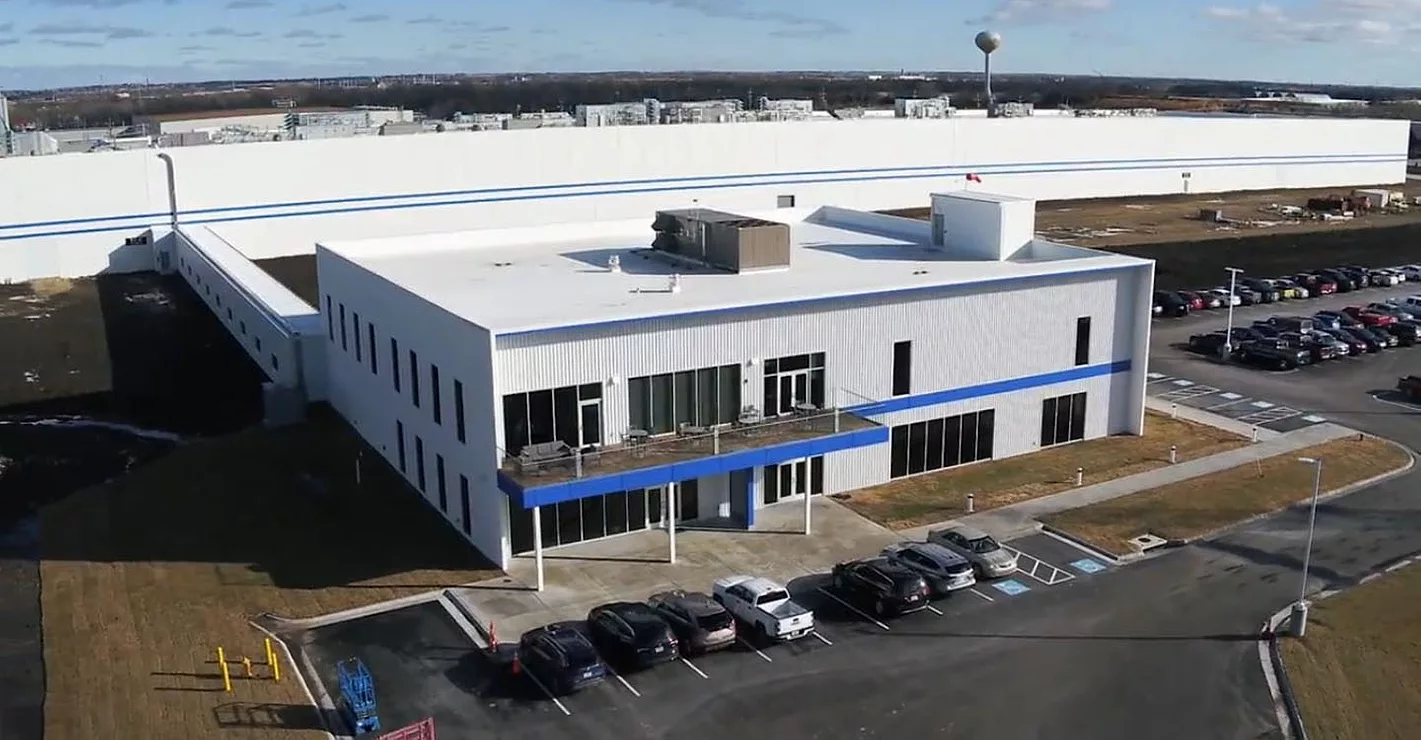
General
Mills saved an estimated $5 million by not trucking lagoon water away from its
Wellston, OH, location; instead it performed sludge removal on site. Source: GE
Water & Process Technologies.
“We needed to drain the entire 33-acre lagoon to make it possible to remove the sludge and land apply it,” says Davis. “However, we wanted to avoid trucking the water because of the high cost and potential environmental impact.”
Treating the lagoon water in the plant’s wastewater treatment system was not an option. General Mills has a permit to discharge 700,000 gallons per day of treated wastewater into the creek, but nearly all of this capacity is required for the Wellston plant’s manufacturing operations. Two options remained: trucking the water away or discharging it into the city’s POTW (publicly-owned treatment works).
The POTW required that the total suspended solids (TSS) not exceed 8 mg/l, but the TSS in the lagoon water typically measured in excess of 200 mg/l. The readings could fluctuate to double that value after spring runoff or during high-algae growth periods in the summer months.
Davis and his team approached GE Water & Process Technologies. GE engineers proposed using entrapped air floatation (EAF), a relatively new technology. EAF improves upon conventional dissolved air floatation (DAF), a wastewater treatment method used in industrial applications for liquids, solids and oils separation. Conventional DAF uses pressurized gas to separate solids and oil from a water stream. EAF does not rely on pressurized air, but rather air introduced under atmospheric conditions. This method, in conjunction with treatment chemistry, allows precipitated contaminants to entrap the air bubble and facilitate separation from the bulk water.
“The EAF system proved to be a good solution,” says Charles Camp, supervisor of the wastewater treatment plant for Wellston General Mills. “Despite the highly variable and difficult-to-treat feedwater, we maintained an average flowrate of about 300,000 gallons per day, right through the cold winter, and we never exceeded the stringent TSS standards set by the POTW.”
Davis calculates that General Mills saved about $5 million by avoiding the expense of trucking the lagoon water. “We also saved another $150,000 because the water removal project was completed three months ahead of schedule,” he says. “It turned out we needed this additional time for the sludge-removal operation, because we ended up having to remove double the amount of sludge from the bottom of the lagoon compared to our original estimates.”
By the end of the project, the lagoon was successfully drained and all of the sludge was used to enhance the soil of the surrounding farmland and former strip mines in the area.
For more information: Joe Ward, GE Water & Process
Technologies, 614-203-8811, joseph.ward@ge.com
Looking for a reprint of this article?
From high-res PDFs to custom plaques, order your copy today!