Food Engineering logo
search
cart
facebook twitter linkedin youtube
  • Sign In
  • Create Account
  • Sign Out
  • My Account
Food Engineering logo
  • NEWS
    • Latest Headlines
    • Manufacturing News
    • People & Industry News
    • Plant Openings
    • Recalls
    • Regulatory Watch
    • Supplier News
  • PRODUCTS
    • New Plant Products
    • New Retail Products
  • TOPICS
    • Alternative Protein
    • Automation
    • Cannabis
    • Cleaning | Sanitation
    • Fabulous Food Plants
    • Food Safety
    • Maintenance Strategies
    • OEE
    • Packaging
    • Sustainability
    • More
  • EXCLUSIVES
    • Plant Construction Survey
    • Plant of the Year
    • Sustainable Plant of the Year
    • State of Food Manufacturing
    • Top 100 Food & Beverage Companies
  • MEDIA
    • Podcasts
    • Videos
    • Webinars
    • White Papers
  • FOOD MASTER
  • EVENTS
    • Food Automation & Manufacturing Symposium and Expo
    • Industry Events
  • RESOURCES
    • Newsletter
    • Custom Content & Marketing Services
    • FE Store
    • Government Links
    • Industry Associations
    • Market Research
    • Classified Ads
  • EMAGAZINE
    • eMagazine
    • Archive Issue
    • Advertise
  • SIGN UP!
Dry Processing

Dry Processing

Keep the mill wheels grinding

A new flour mill uses traditional milling techniques with a state-of-the-art screener.
By Wayne Labs, Senior Contributing Technical Editor
February 6, 2013
walk mill kason dry flour processing
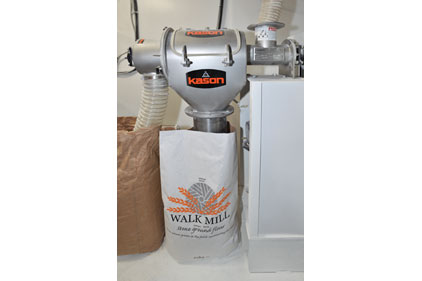
The Centri-Sifter centrifugal screener separates the flour from the rest of the ground material. The separated flour in 55-lb. (25kg) sacks is ready for shipping. Source: Kason.

Rebuilt as a replica of a 13th century mill, Walk Mill is a modern flour mill that uses water power to grind wheat with stone grinding wheels coupled with electrical augers and a modern centrifugal screener. Located near Chester, England, the mill serves two markets: upscale hotels and restaurants that make their own bread and the retail market.

Started up in 2008, the mill uses a steel waterwheel fed by a stream diverted from the nearby river. The last mill on the site ceased production in 1915, and only the footprint of the building was left, according to Ben Jones, a partner in the family-owned business, who is in charge of mill operations. “We dug the foundations to find the footprint of the building, and we also had a lot of photographs of the old mill. From the footprint and pictures we were able to construct a building that is exactly like the old mill on the outside.”

Walk Mill uses two burr stones made of hard, dense French granite. The stones are positioned horizontally, one above the other. The lower stone (called a bedder) is fixed while the upper  runner stone rotates. Wheat, conveyed from a hopper on the first floor, falls into a hole in the center of the upper stone and gradually moves to the periphery of the stones via shallow grooves in the stones. The gap is adjusted to produce white or whole meal flour, the latter being more coarse as it contains bran.

Both the stone rotation and feed rate from the hopper are governed and synchronized by a shaft that is geared to the waterwheel. “It’s self regulating,” says Jones. “If the water flow increases, the feeding and milling operations increase at the same rate.” Jones says a shaft rotation of 40rpm yields the best-quality flour. The relatively slow, gentle process avoids overheating of the flour and preserves all the good parts of the grain: protein, oils, vitamins, sugars, starches and bran.

As the flour leaves the millstones, it is swept by a blade attached to the upper stone and falls into a 28-lb. transit hopper. An auger transfers the product to a spout that feeds a Kason Corp. Centri-Sifter that separates the flour from the rest of the material. The model GOB-SS machine has a sifting area of 171 sq. in. and is driven by a 2hp motor. The sifter can process up to 1,540 lbs. per hour, well above the mill’s capacity of 176 lbs./hr.

The sifter has rotating, helical paddles within its chamber to propel the flour against the screen; the centrifugal force accelerates the particles through the screen openings. The paddles, which make no contact with the screen, also break up any agglomerated material. The separated flour is directed to a chute, from which it drops directly into a 55-lb. sack for shipping.

“The machine is very easy to operate, and there is no problem with screen clogging,” says Caroline Jones, Ben’s daughter who sometimes runs the equipment. “We occasionally dust it down, but basically it cleans itself.”

Walk Mill uses two screen sizes: 38 mesh (500 µm) for white flour and 12 mesh (1,500 µm) for the coarser whole meal flour. “Typically we produce white flour for four days, because we sell more of it, and wheat flour for one day,” says Ben Jones.

The operation also produces malted flour for wholesale and retail as well as self-rising flour for the retail market.

For more information:

Henry Alamzad, 973-467-8140, info@kason.com

KEYWORDS: screening equipment size reduction

Share This Story

Looking for a reprint of this article?
From high-res PDFs to custom plaques, order your copy today!

Wayne labs 200px
Wayne Labs has more than 30 years of editorial experience in industrial automation. He served as senior technical editor for I&CS/Control Solutions magazine for 18 years where he covered software, control system hardware and sensors/transmitters. Labs ran his own consulting business and contributed feature articles to Electronic Design, Control, Control Design, Industrial Networking and Food Engineering magazines. Before joining Food Engineering, he served as a senior technical editor for Omega Engineering Inc. Labs also worked in wireless systems and served as a field engineer for GE’s Mobile Communications Division and as a systems engineer for Bucks County Emergency Services. In addition to writing technical feature articles, Wayne covers FE’s Engineering R&D section.

Recommended Content

JOIN TODAY
to unlock your recommendations.

Already have an account? Sign In

  • 2025 Top 100 Food and Beverage Companies

    FOOD ENGINEERING’s 2025 Top 100 Food and Beverage Companies

    While sales were largely down under dynamic economic and...
    Top 100 Food & Beverage Companies
    By: Alyse Thompson-Richards
  • Bottling machine

    How Optical and X-Ray Inspection Supports Bottling Safety and Quality

    By transitioning from legacy single-technology systems to...
    Food Safety
    By: Dan McKee
  • Bread baking in oven

    The State of Food Manufacturing in 2025

    Food and beverage manufacturers are investing in...
    State of Food Manufacturing
    By: Alyse Thompson-Richards
Manage My Account
  • eMagazine
  • Newsletter
  • Online Registration
  • Manage My Preferences
  • Customer Service

More Videos

Popular Stories

The Campbell's Company logo

Campbell’s Terminates Exec Over Alleged Disparaging Comments

Anheuser-Busch Williamsburg Brewery

Anheuser-Busch to Close Two Breweries, Sell a Third

circular packaging material for frozen and chilled food packaging

Sustainable Barrier Coatings Replace PFAS, PE and other Plasticized Materials in Packaging

State of Maufacturing 2025

Events

June 17, 2025

Refrigerated & Frozen Foods’ State of the Cold Chain

On Demand Kelley Rodriguez, Editor in Chief of Refrigerated & Frozen Foods, will be joined in this 60-minute webinar by industry experts to help unpack the latest research.

July 23, 2025

Decarbonizing Process Heat: What You Should Know and Next Steps

On Demand Driven by climate goals, business risk, client interest, and resilience considerations, food and beverage companies are increasingly turning their attention to decarbonizing their production processes.

View All Submit An Event

Products

Recent Advances in Ready-to-Eat Food Technology

Recent Advances in Ready-to-Eat Food Technology

See More Products

CHECK OUT OUR NEW ESSENTIAL TOPICS

Alternative ProteinAutomationCleaning/SanitationFabulous Food Plants

Food SafetyMaintenance StrategiesOEE

PackagingSustainability

Related Articles

  • Keep the Gears Running

    See More
  • Lubrication keeps wheels turning in flash freezing applications

    See More
  • ERP systems can give everyone access to key data.

    Forecasting Production: Real-Time ERPs Keep Processors In the Know

    See More
×

Elevate your expertise in food engineering with unparalleled insights and connections.

Get the latest industry updates tailored your way.

JOIN TODAY!
  • RESOURCES
    • Advertise
    • Contact Us
    • Food Master
    • Store
    • Want More
  • SIGN UP TODAY
    • Create Account
    • eMagazine
    • Newsletter
    • Customer Service
    • Manage Preferences
  • SERVICES
    • Marketing Services
    • Reprints
    • Market Research
    • List Rental
    • Survey/Respondent Access
  • STAY CONNECTED
    • LinkedIn
    • Facebook
    • YouTube
    • X (Twitter)
  • PRIVACY
    • PRIVACY POLICY
    • TERMS & CONDITIONS
    • DO NOT SELL MY PERSONAL INFORMATION
    • PRIVACY REQUEST
    • ACCESSIBILITY

Copyright ©2025. All Rights Reserved BNP Media.

Design, CMS, Hosting & Web Development :: ePublishing