Food Engineering logo
search
cart
facebook twitter linkedin youtube
  • Sign In
  • Create Account
  • Sign Out
  • My Account
Food Engineering logo
  • NEWS
    • Latest Headlines
    • Manufacturing News
    • People & Industry News
    • Plant Openings
    • Recalls
    • Regulatory Watch
    • Supplier News
  • PRODUCTS
    • New Plant Products
    • New Retail Products
  • TOPICS
    • Alternative Protein
    • Automation
    • Cannabis
    • Cleaning | Sanitation
    • Fabulous Food Plants
    • Food Safety
    • Maintenance Strategies
    • OEE
    • Packaging
    • Sustainability
    • More
  • EXCLUSIVES
    • Plant Construction Survey
    • Plant of the Year
    • Sustainable Plant of the Year
    • State of Food Manufacturing
    • Top 100 Food & Beverage Companies
  • MEDIA
    • Podcasts
    • Videos
    • Webinars
    • White Papers
  • FOOD MASTER
  • EVENTS
    • Food Automation & Manufacturing Symposium and Expo
    • Industry Events
  • RESOURCES
    • Newsletter
    • Custom Content & Marketing Services
    • FE Store
    • Government Links
    • Industry Associations
    • Market Research
    • Classified Ads
  • EMAGAZINE
    • eMagazine
    • Archive Issue
    • Advertise
  • SIGN UP!
Sustainability

Sustainability

The Myth of ‘LEED Equivalent’

By Daniel Overbey
Myth of 'LEED Equivalent'

Photo courtesy of Getty Images / AlexLMX

February 3, 2023

It goes my many names:

…LEED-like.
…Built to LEED standards.
…LEED equivalent.

I will offer one more: a ruse.

Full disclosure, I am writing to you as a LEED Fellow. I have helped lead projects teams that have accounted for millions of LEED certified square footage. Like many of us, the U.S. Green Building Council’s (USGC) LEED rating system has benefitted me and my business. However, it has also transformed the building sector toward greater sustainability. 

As imperfect of a system as LEED may be, it continues to improve, and the building design and construction industry has never before seen a tool that has been more effective in shifting the building sector toward better, healthier, more responsible outcomes. LEED buildings and communities exist in more than 180 countries and equate to around 2.2 million square feet being certified daily. Clearly, the international market knows how to deliver high-performance, low-carbon, environmentally responsible buildings. Perhaps we don’t need LEED to guide us how to create and manage green buildings and communities. 

But the caution I raise against so-called “LEED Equivalent” buildings has nothing to do with the LEED rating system or the LEED brand itself. Rather, it has everything to do with ensuring accountability mechanisms on building projects in the face of the limited resource capitals of time and money. 

The proposition of LEED Equivalent seems innocent enough—and in simplistic terms, it stands to reason as a fiscally responsible notion: Why spend limited budgetary funds on a LEED project registration and certification review if a team has the know-how and the pertinent information is embedded in the project’s contract documents? Put in terms we might all be more familiar with, “Why spend money just to put a plaque on the wall?”

This notion of designing and constructing “to LEED standards” would suggest that everything short of paying for the LEED certification process would be accomplished on the job, including implementation of an integrative design team, high-performance systems, specification requirements, energy modeling, commissioning of the mechanical systems, due diligence and oversight during procurement, documented records of plan execution with regard to construction activity pollution prevention on the site and inside the structure, and so on—less there may be corners cut and the project would not, in fact, realize a “LEED Equivalent” standard.

In a recent study by Ball State University in collaboration with a team of building sector industry partners, namely Browning Day, Turner Construction and Applied Engineering Services (again, full disclosure, I served as the principal investigator for the study, and I am associated with both Ball State University and Browning Day), it was determined that for a standalone suburban office building in the U.S. Midwest, a team might expect the LEED registration and review to constitute around 2-4% of the total project soft costs to otherwise accomplish a “certifiable” LEED building (Fig. 1). 
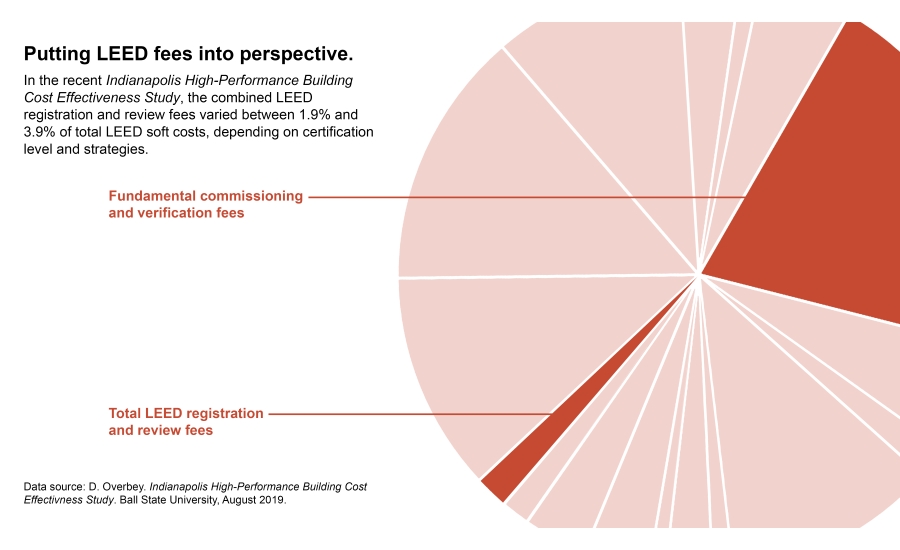

Fig-1---Putting-LEED-fees-into-perspective.jpg
Figure 1: Putting LEED fees into perspective.
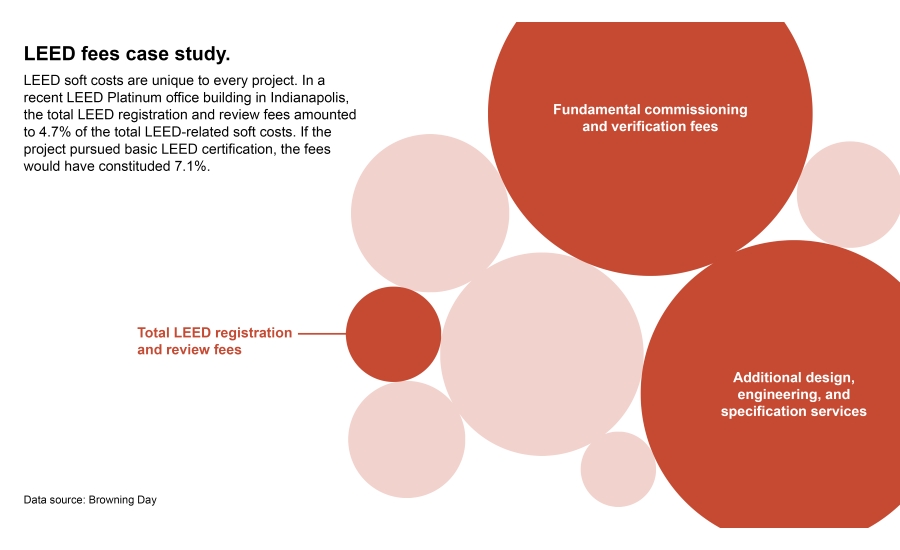

My work in managing LEED projects has reinforced the findings. For instance, I compared the figures from the study to a 160,000-sq.-ft. standalone corporate office building in Indianapolis that my firm recently completed that achieved LEED Platinum certification. The story was similar: Our total LEED fees accounted for 4.7% of the project’s total LEED-related soft costs. If we only pursued basic LEED certification and opted out of a few additional services including acoustic and daylighting optimization, the proportion rose to 7.1% (Fig. 2).


 Fig-2---LEED-fee-case-study.jpgFigure 2: LEED fees in a case study.


On a risk-adjusted basis, it makes little economic sense to pursue “LEED Equivalent” as the minuscule LEED registration and review fees fund the third-party certification review managed by Green Business Certification Inc. (GBCI). What LEED Equivalent calls for (in theory) is that a project team expends time and money on over 90% (perhaps as high as 98%) of the LEED certification effort but declines to spend money on the third-party quality assurance process that ensures the energy modeling was complete and correct, the commissioning was properly executed, and that what was designed and specified was actually executed in the field. 

Stated differently, LEED Equivalent means that a project team will spend over 90% of the money necessary to create a green building but will decline to spend a fraction more to capture the reputational capital of the LEED brand and ensure that the design and construction team delivers what the owner thinks they are paying for in terms of the green building qualities of the project.

KEYWORDS: environmental performance LEED LEED certified sustainability sustainability practices sustainable building materials sustainable construction

Share This Story

Looking for a reprint of this article?
From high-res PDFs to custom plaques, order your copy today!

Overbey   head shot 2020 (3) 350

Daniel Overbey, AIA, NCARB, LEED Fellow, LEED AP (BD+C, ID+C, O+M), WELL AP, EcoDistricts AP is an assistant professor of architecture at Ball State University’s R. Wayne Estopinal College of Architecture and Planning and is an associate principal and director of sustainability for Browning Day in Indianapolis.

Recommended Content

JOIN TODAY
to unlock your recommendations.

Already have an account? Sign In

  • 2025 Top 100 Food and Beverage Companies

    FOOD ENGINEERING’s 2025 Top 100 Food and Beverage Companies

    While sales were largely down under dynamic economic and...
    Top 100 Food & Beverage Companies
    By: Alyse Thompson-Richards
  • Bottling machine

    How Optical and X-Ray Inspection Supports Bottling Safety and Quality

    By transitioning from legacy single-technology systems to...
    Food Safety
    By: Dan McKee
  • Bread baking in oven

    The State of Food Manufacturing in 2025

    Food and beverage manufacturers are investing in...
    State of Food Manufacturing
    By: Alyse Thompson-Richards
Manage My Account
  • eMagazine
  • Newsletter
  • Online Registration
  • Manage My Preferences
  • Customer Service

More Videos

Popular Stories

The Campbell's Company logo

Campbell’s Terminates Exec Over Alleged Disparaging Comments

Frito-Lay logo

PepsiCo to Close Two Florida Facilities

alternative protein products

Alternative Protein in 2025: Key Trends and Technologies

State of Maufacturing 2025

Events

June 17, 2025

Refrigerated & Frozen Foods’ State of the Cold Chain

On Demand Kelley Rodriguez, Editor in Chief of Refrigerated & Frozen Foods, will be joined in this 60-minute webinar by industry experts to help unpack the latest research.

July 23, 2025

Decarbonizing Process Heat: What You Should Know and Next Steps

On Demand Driven by climate goals, business risk, client interest, and resilience considerations, food and beverage companies are increasingly turning their attention to decarbonizing their production processes.

View All Submit An Event

Products

Recent Advances in Ready-to-Eat Food Technology

Recent Advances in Ready-to-Eat Food Technology

See More Products

CHECK OUT OUR NEW ESSENTIAL TOPICS

Alternative ProteinAutomationCleaning/SanitationFabulous Food Plants

Food SafetyMaintenance StrategiesOEE

PackagingSustainability

Related Articles

  • rendering of Bimbo Bakery LEED facility

    Lack of specific LEED certification for food processing creates challenges

    See More
  • Organic industry goes “myth busting” throughout September

    See More
  • Egg Central Station production floor

    Vital Farms’ Egg Central Station Expansion Earns LEED Gold Certification

    See More

Related Products

See More Products
  • The 10 Principles of Food Industry Sustainability

See More Products
×

Elevate your expertise in food engineering with unparalleled insights and connections.

Get the latest industry updates tailored your way.

JOIN TODAY!
  • RESOURCES
    • Advertise
    • Contact Us
    • Food Master
    • Store
    • Want More
  • SIGN UP TODAY
    • Create Account
    • eMagazine
    • Newsletter
    • Customer Service
    • Manage Preferences
  • SERVICES
    • Marketing Services
    • Reprints
    • Market Research
    • List Rental
    • Survey/Respondent Access
  • STAY CONNECTED
    • LinkedIn
    • Facebook
    • YouTube
    • X (Twitter)
  • PRIVACY
    • PRIVACY POLICY
    • TERMS & CONDITIONS
    • DO NOT SELL MY PERSONAL INFORMATION
    • PRIVACY REQUEST
    • ACCESSIBILITY

Copyright ©2025. All Rights Reserved BNP Media.

Design, CMS, Hosting & Web Development :: ePublishing