Food Engineering logo
search
cart
facebook twitter linkedin youtube
  • Sign In
  • Create Account
  • Sign Out
  • My Account
Food Engineering logo
  • NEWS
    • Latest Headlines
    • Manufacturing News
    • People & Industry News
    • Plant Openings
    • Recalls
    • Regulatory Watch
    • Supplier News
  • PRODUCTS
    • New Plant Products
    • New Retail Products
  • TOPICS
    • Alternative Protein
    • Automation
    • Cannabis
    • Cleaning | Sanitation
    • Fabulous Food Plants
    • Food Safety
    • Maintenance Strategies
    • OEE
    • Packaging
    • Sustainability
    • More
  • EXCLUSIVES
    • Plant Construction Survey
    • Plant of the Year
    • Sustainable Plant of the Year
    • State of Food Manufacturing
    • Top 100 Food & Beverage Companies
  • MEDIA
    • Podcasts
    • Videos
    • Webinars
    • White Papers
  • FOOD MASTER
  • EVENTS
    • Food Automation & Manufacturing Symposium and Expo
    • Industry Events
  • RESOURCES
    • Newsletter
    • Custom Content & Marketing Services
    • FE Store
    • Government Links
    • Industry Associations
    • Market Research
    • Classified Ads
  • EMAGAZINE
    • eMagazine
    • Archive Issue
    • Advertise
  • SIGN UP!
Alternative ProteinLatest headlinesNew Retail Products

Plant-Based

Yeastup’s Yeastin Burger—an Environmentally Friendly Protein Ingredient
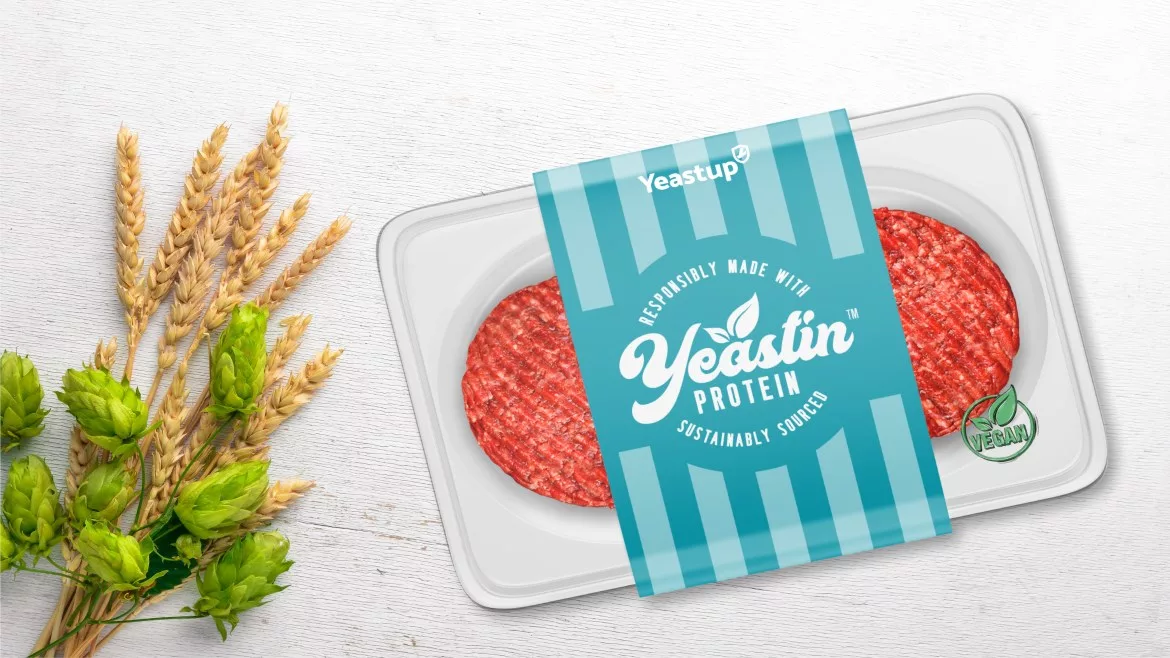
Yeastup's burger patty containing Yeastin

Image courtesy of Yeastup

March 29, 2023

A study at the University of Applied Sciences Northwestern Switzerland (FHNW) recently aimed to evaluate the environmental impact of burger patty production. A patty made with proteins sourced from brewer’s spent yeast (BSY) was compared with conventional beef and a vegan one as benchmarks. The ISO 14040 ff Life Cycle Assessment (LCA) showed that Yeastup’s Yeastin can reduce the environmental footprint of a 113-g. burger patty by 74-81% depending on the indicator examined.

According to the company, a vegan burger patty made from Yeastin protein by Yeastup has an even smaller ecological footprint than one made from pea protein. The production of pea protein had the greatest environmental impact on the conventional vegan patty (19–45%), with the meat in the beef patty producing a figure of 84–98%. 

Compared with the beef patty, the environmental ramifications of the Yeastup alternative were significantly lower across all impact assessment methods by FHNW—possibly because of the elevated global warming potential (GWP) of beef production. Daniel Gnos, founder of Yeastup AG explains another advantage, “Thanks to the use of an industrial by-product, Yeastin requires no arable land, no cultivation, no irrigation and no pesticides. This is a clear ecological benefit over animal and plant sources.”

Of the environmental footprint of Yeastin, 56% was attributable to the animal feed substitution that replaces the brewer’s spent yeast in its previous use. Compared with the benchmark pea protein, Yeastup protein has an approximately 81% lower environmental impact, 74% fewer greenhouse gas emissions and an 80% lower cumulative energy demand. Due to these statistics, the company states Yeastin has potential to become a promising alternative to animal and vegetable proteins from its environmental footprint and nutritional properties.

With a neutral taste, Yeastin’s nutritional profile matches that of animal proteins. Formulations containing the ingredient may show promising functional properties in laboratory scale trials. The company also states there is possibility for numerous application possibilities from meat substitutions and cheese alternatives to sports nutrition products.
KEYWORDS: environmental impact nutrition Vegetarian and vegan foods

Share This Story

Looking for a reprint of this article?
From high-res PDFs to custom plaques, order your copy today!
Recommended Content

JOIN TODAY
to unlock your recommendations.

Already have an account? Sign In

  • 2025 Top 100 Food and Beverage Companies

    FOOD ENGINEERING’s 2025 Top 100 Food and Beverage Companies

    While sales were largely down under dynamic economic and...
    Top 100 Food & Beverage Companies
    By: Alyse Thompson-Richards
  • Bottling machine

    How Optical and X-Ray Inspection Supports Bottling Safety and Quality

    By transitioning from legacy single-technology systems to...
    Food Safety
    By: Dan McKee
  • Bread baking in oven

    The State of Food Manufacturing in 2025

    Food and beverage manufacturers are investing in...
    Manufacturing News
    By: Alyse Thompson-Richards
Manage My Account
  • eMagazine
  • Newsletter
  • Online Registration
  • Manage My Preferences
  • Customer Service

More Videos

Popular Stories

The Campbell's Company logo

Campbell’s Terminates Exec Over Alleged Disparaging Comments

Frito-Lay logo

PepsiCo to Close Two Florida Facilities

alternative protein products

Alternative Protein in 2025: Key Trends and Technologies

State of Maufacturing 2025

Events

June 17, 2025

Refrigerated & Frozen Foods’ State of the Cold Chain

On Demand Kelley Rodriguez, Editor in Chief of Refrigerated & Frozen Foods, will be joined in this 60-minute webinar by industry experts to help unpack the latest research.

July 23, 2025

Decarbonizing Process Heat: What You Should Know and Next Steps

On Demand Driven by climate goals, business risk, client interest, and resilience considerations, food and beverage companies are increasingly turning their attention to decarbonizing their production processes.

View All Submit An Event

Products

Recent Advances in Ready-to-Eat Food Technology

Recent Advances in Ready-to-Eat Food Technology

See More Products

CHECK OUT OUR NEW ESSENTIAL TOPICS

Alternative ProteinAutomationCleaning/SanitationFabulous Food Plants

Food SafetyMaintenance StrategiesOEE

PackagingSustainability

Related Articles

  • Theresa Marquez with Organic Valley

    Organic Valley discusses the organic milk market and being environmentally-friendly

    See More
  • food plant design

    A sustainable bottom line: Environmentally friendly upgrades must save money

    See More
  • Bio-SynXtra Gear Oil ISO 68  5 Gal Pail-PR.jpg

    Environmentally Friendly Bio-E.P. Gear Oils Perform Like Synthetics

    See More

Related Products

See More Products
  • food crime.jpg

    Food Crime: An Introduction to Deviance in the Food Industry

See More Products
×

Elevate your expertise in food engineering with unparalleled insights and connections.

Get the latest industry updates tailored your way.

JOIN TODAY!
  • RESOURCES
    • Advertise
    • Contact Us
    • Food Master
    • Store
    • Want More
  • SIGN UP TODAY
    • Create Account
    • eMagazine
    • Newsletter
    • Customer Service
    • Manage Preferences
  • SERVICES
    • Marketing Services
    • Reprints
    • Market Research
    • List Rental
    • Survey/Respondent Access
  • STAY CONNECTED
    • LinkedIn
    • Facebook
    • YouTube
    • X (Twitter)
  • PRIVACY
    • PRIVACY POLICY
    • TERMS & CONDITIONS
    • DO NOT SELL MY PERSONAL INFORMATION
    • PRIVACY REQUEST
    • ACCESSIBILITY

Copyright ©2025. All Rights Reserved BNP Media.

Design, CMS, Hosting & Web Development :: ePublishing