Food Engineering logo
search
cart
facebook twitter linkedin youtube
  • Sign In
  • Create Account
  • Sign Out
  • My Account
Food Engineering logo
  • NEWS
    • Latest Headlines
    • Manufacturing News
    • People & Industry News
    • Plant Openings
    • Recalls
    • Regulatory Watch
    • Supplier News
  • PRODUCTS
    • New Plant Products
    • New Retail Products
  • TOPICS
    • Alternative Protein
    • Automation
    • Cannabis
    • Cleaning | Sanitation
    • Fabulous Food Plants
    • Food Safety
    • Maintenance Strategies
    • OEE
    • Packaging
    • Sustainability
    • More
  • EXCLUSIVES
    • Plant Construction Survey
    • Plant of the Year
    • Sustainable Plant of the Year
    • State of Food Manufacturing
    • Top 100 Food & Beverage Companies
  • MEDIA
    • Podcasts
    • Videos
    • Webinars
    • White Papers
  • FOOD MASTER
  • EVENTS
    • Food Automation & Manufacturing Symposium and Expo
    • Industry Events
  • RESOURCES
    • Newsletter
    • Custom Content & Marketing Services
    • FE Store
    • Government Links
    • Industry Associations
    • Market Research
    • Classified Ads
  • EMAGAZINE
    • eMagazine
    • Archive Issue
    • Advertise
  • SIGN UP!
SustainabilityManufacturing News

TECH FLASH

Life-cycle analysis study suggests eating less meat
July 9, 2012
LCA Analysis
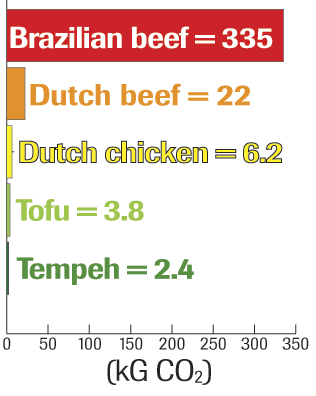
The study shows that 1 kg of Brazillian beef exacts 335 kg of carbon dioxide emissions compared to Dutch beef (22 kg). Adding to the problem is that grazing land can not be counted as vegetated or forrested land that converts carbon dioxide to oxygen. Source: Data derived from Schmidinger/Stehfest study.

A recent Austrian and Dutch study shows the production of one kilogram of beef in Brazil produces 335kg of CO2, which corresponds approximately to the emissions of driving an average European car for more than 1,600 kilometers (1,000 miles), according to the study by Kurt Schmidinger and Elke Stehfest entitled Including CO2 implications of land in LCAs—method and example for livestock products. Even Dutch beef amounts to 22 kg CO2 or 111 kilometers in a car.

Schmidinger (University of Vienna) and Stehfest (PBL Netherlands Environmental Assessment Agency) developed a fundamental enhancement of the commonly used life cycle assessment (LCA) method for foods, which now appears online in the International Journal of Life Cycle Assessment.

A key issue of relevance for the study is the integration into the calculations of the area used for production in addition to the emissions resulting from the production of foods. Despite playing a central role for the climate, area use effects have been ignored in climate balances until now. Occupation of huge areas prevents natural vegetation from replenishing itself. This vegetation would absorb CO2 from the atmosphere and stabilize the world climate.

With the now-published enhancement for LCAs, the area demand of a product is added as a missed potential carbon sink to the emissions of the food production in the balance, according to the authors.

With 6.2 kg of CO2, 1kg of Dutch chicken meat has the lowest CO2-balance among animal products. Schmidinger, a geophysicist and food scientist, warns of false conclusions. “Industrial livestock systems are not simply viable options, even if their climate balances sometimes out-compete pasture systems. Industrial livestock systems require enormous amounts of cropland, which is less available than pastures; this, in turn, threatens global food security,” says Schmidinger.

“Global pandemics, antibiotic resistance, animal welfare problems, water pollution, soil erosion and many more issues are associated with industrial livestock farming,” warns Schmidinger. “Plant-based foods, on the other hand, perform significantly better when considering all ethical aspects of nutrition.”

Protein-rich, plant-based foods show by far the lowest CO2 scores in the study, with tofu producing 3.8kg of CO2 and tempeh producing 2.4kg of CO2.

When asked about the significance of CO2 levels of beef as they compare from Brazil vs. Holland or the US, Schmidinger says, “It was not our goal to give an overall overview of beef produced in different countries in different forms of livestock.” However, Schmidinger says the ethanol issue could also be quantified in terms of CO2, based on his enriched LCA methods.

For more information on the study, visit Springerlink. Contact: Kurt Schmidinger, FEWD University Vienna, Mobile: +43-676-3322107, mailto:kurt.schmidinger@futurefood.org or mailto:kurt.schmidinger@univie.ac.at

KEYWORDS: beef climate change farms meat products

Share This Story

Looking for a reprint of this article?
From high-res PDFs to custom plaques, order your copy today!
Recommended Content

JOIN TODAY
to unlock your recommendations.

Already have an account? Sign In

  • 2025 Top 100 Food and Beverage Companies

    FOOD ENGINEERING’s 2025 Top 100 Food and Beverage Companies

    While sales were largely down under dynamic economic and...
    Top 100 Food & Beverage Companies
    By: Alyse Thompson-Richards
  • Bottling machine

    How Optical and X-Ray Inspection Supports Bottling Safety and Quality

    By transitioning from legacy single-technology systems to...
    Food Safety
    By: Dan McKee
  • Bread baking in oven

    The State of Food Manufacturing in 2025

    Food and beverage manufacturers are investing in...
    State of Food Manufacturing
    By: Alyse Thompson-Richards
Manage My Account
  • eMagazine
  • Newsletter
  • Online Registration
  • Manage My Preferences
  • Customer Service

More Videos

Popular Stories

The Campbell's Company logo

Campbell’s Terminates Exec Over Alleged Disparaging Comments

Frito-Lay logo

PepsiCo to Close Two Florida Facilities

alternative protein products

Alternative Protein in 2025: Key Trends and Technologies

State of Maufacturing 2025

Events

June 17, 2025

Refrigerated & Frozen Foods’ State of the Cold Chain

On Demand Kelley Rodriguez, Editor in Chief of Refrigerated & Frozen Foods, will be joined in this 60-minute webinar by industry experts to help unpack the latest research.

July 23, 2025

Decarbonizing Process Heat: What You Should Know and Next Steps

On Demand Driven by climate goals, business risk, client interest, and resilience considerations, food and beverage companies are increasingly turning their attention to decarbonizing their production processes.

View All Submit An Event

Products

Recent Advances in Ready-to-Eat Food Technology

Recent Advances in Ready-to-Eat Food Technology

See More Products

CHECK OUT OUR NEW ESSENTIAL TOPICS

Alternative ProteinAutomationCleaning/SanitationFabulous Food Plants

Food SafetyMaintenance StrategiesOEE

PackagingSustainability

Related Articles

  • Study: Children eating healthier, throwing less food away

    See More
  • Humans eating more meat overall, according to global study

    See More
  • University study suggests food labels mislead customers into ‘false sense of health’

    See More

Related Products

See More Products
  • GlobalData_logo_blue_header.png

    Chilled Raw Packaged Meat - Processed (Meat) Market in the United States...

  • GlobalData_logo_blue_header.png

    Cooked Meats - Packaged (Meat) Market in United States of America...

  • Military Food Engineering and Ration Technology

See More Products
×

Elevate your expertise in food engineering with unparalleled insights and connections.

Get the latest industry updates tailored your way.

JOIN TODAY!
  • RESOURCES
    • Advertise
    • Contact Us
    • Food Master
    • Store
    • Want More
  • SIGN UP TODAY
    • Create Account
    • eMagazine
    • Newsletter
    • Customer Service
    • Manage Preferences
  • SERVICES
    • Marketing Services
    • Reprints
    • Market Research
    • List Rental
    • Survey/Respondent Access
  • STAY CONNECTED
    • LinkedIn
    • Facebook
    • YouTube
    • X (Twitter)
  • PRIVACY
    • PRIVACY POLICY
    • TERMS & CONDITIONS
    • DO NOT SELL MY PERSONAL INFORMATION
    • PRIVACY REQUEST
    • ACCESSIBILITY

Copyright ©2025. All Rights Reserved BNP Media.

Design, CMS, Hosting & Web Development :: ePublishing