Food Engineering logo
search
cart
facebook twitter linkedin youtube
  • Sign In
  • Create Account
  • Sign Out
  • My Account
Food Engineering logo
  • NEWS
    • Latest Headlines
    • Manufacturing News
    • People & Industry News
    • Plant Openings
    • Recalls
    • Regulatory Watch
    • Supplier News
  • PRODUCTS
    • New Plant Products
    • New Retail Products
  • TOPICS
    • Alternative Protein
    • Automation
    • Cannabis
    • Cleaning | Sanitation
    • Cross-Functional Food Innovation
    • Fabulous Food Plants
    • Food Safety
    • Maintenance Strategies
    • OEE
    • Packaging
    • Sustainability
    • More
  • EXCLUSIVES
    • Plant Construction Survey
    • Plant of the Year
    • Sustainable Plant of the Year
    • State of Food Manufacturing
    • Top 100 Food & Beverage Companies
  • MEDIA
    • Podcasts
    • Videos
    • Webinars
    • White Papers
  • FOOD MASTER
  • EVENTS
    • Food Automation & Manufacturing Symposium and Expo
    • Industry Events
  • RESOURCES
    • Newsletter
    • Custom Content & Marketing Services
    • FE Store
    • Government Links
    • Industry Associations
    • Market Research
    • Sponsor Insights
    • Classified Ads
  • EMAGAZINE
    • eMagazine
    • Archive Issue
    • Advertise
  • SIGN UP!
Latest headlines

Carton packs perform best in environmental impact life-cycle assessment

They performed better than glass jars, metal cans, retortable pouches and plastic pots.
By Shane O'Halloran
February 3, 2014

Carton packs found to have least environmental impact

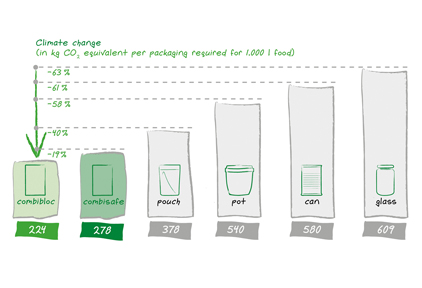
According to a life-cycle assessment conducted by the Institute for Energy and Environmental Research (IFEU), carton packs performed better on environmental impact tests than other packaging solutions including metal cans, glass jars, retortable pouches and plastic pots. Carton packs were found to save CO2 emissions by up to 63 percent over other methods, and reduce fossil fuel consumptions by up to 69 percent.

The life-cycle assessment included all environmentally relevant factors and processes across the life cycle of the packaging system. That includes the extraction and processing of the raw material used to manufacture the packaging, the processes of manufacturing and transporting the packages, the packaging of the food, distribution to retailers and the recycling or disposal of the packaging after use.The key factors in determining environmental impact were found to be the material used and the amount of it.

KEYWORDS: carton packaging materials

Share This Story

Looking for a reprint of this article?
From high-res PDFs to custom plaques, order your copy today!
Recommended Content

JOIN TODAY
to unlock your recommendations.

Already have an account? Sign In

  • CJ Schwan’s Salina facility.

    Recipe for Growth: How CJ Schwan’s Powers Pizza Production with People and Automation

    Blending advanced automation with purposeful design, this...
    Cross-Functional Food Innovation
    By: Alyse Thompson-Richards
  • Paris Baguette rendering

    FOOD ENGINEERING’s 49th Annual Plant Construction Survey

    Food and beverage manufacturers continue to invest in...
    Plant Openings
    By: Alyse Thompson-Richards
  • Bottling machine

    How Optical and X-Ray Inspection Supports Bottling Safety and Quality

    By transitioning from legacy single-technology systems to...
    Food Safety
    By: Dan McKee
Manage My Account
  • eMagazine
  • Newsletter
  • Online Registration
  • Manage My Preferences
  • Customer Service

More Videos

Sponsored Content

Sponsored Content is a special paid section where industry companies provide high quality, objective, non-commercial content around topics of interest to the Food Engineering audience. All Sponsored Content is supplied by the advertising company and any opinions expressed in this article are those of the author and not necessarily reflect the views of Food Engineering or its parent company, BNP Media. Interested in participating in our Sponsored Content section? Contact your local rep!

close
  • Close-up of a group of freshly baked stuffed empanadas being transferred onto a conveyor belt.
    Sponsored byDorner

    Smarter Line Design Improves Food Manufacturing Efficiency and Throughput

  • An old and tattered manual titled 'Revised 5/20/1971' on a desk along with a cellphone, sunglasses, Apple iWatch, laptop and keyboard, and a water bottle.
    Sponsored byEnSight Solutions

    Redefining Quality: Has the Industry Lost Sight of What Actually Matters?

  • Worker in protective food-processing attire uses a tablet beside stainless-steel conveyor equipment in a modern food manufacturing facility.
    Sponsored bySafetyChain

    Your Biggest Losses Are Hiding in Data You Already Have

Popular Stories

Beef steaks

Tyson Foods to Close Two Beef Facilities

AB Baldwinsville Investment

Anheuser-Busch Invests $13M in New York Brewery

Food processing factory workers loading into a food cart.

Managing Facility-Induced Food Waste

Promo for the 2026 Plant of the Year Award

Events

September 23, 2026

An In-Depth Look at 2026's Top 100 Food and Beverage Companies

Join Lynn Dornblaser, Client Advisor at Mintel, and Alyse Thompson-Richards, Editor-in-Chief of FOOD ENGINEERING, as they break down the 2026 Top 100 Food and Beverage Companies and discuss the factors affecting this year’s rankings.

September 29, 2026

Food Safety Execution and Your Bottom Line

Explore food safety strategies that strengthen sanitation, risk management, operational efficiency, and compliance across foodservice and facility environments.

View All Submit An Event

Products

Recent Advances in Ready-to-Eat Food Technology

Recent Advances in Ready-to-Eat Food Technology

See More Products

September 23 FE Editorial Webinar


CHECK OUT OUR NEW ESSENTIAL TOPICS

Alternative ProteinAutomationCleaning/SanitationFabulous Food Plants

Food SafetyMaintenance StrategiesOEE

PackagingSustainability

Related Articles

  • EIT Food logo

    EIT Food to Incorporate Foundation Earth with Aim to Develop Standards for Environmental Impact Data

    See More
  • USDA APHIS to prepare environmental impact statements on genetically engineered crops

    See More
  • PepsiCo

    PepsiCo pledges to use less sugar, reduce environmental impact by 2025

    See More

Related Products

See More Products
  • Rice-Engineering-Website-Cover-439x600.jpg

    Advances in Science & Engineering of Rice

  • seafood.jpg

    Innovative Technologies in Seafood Processing

  • Cleaning-in-Place: Dairy, Food and Beverage Operations, 3rd Edition

See More Products
×

Elevate your expertise in food engineering with unparalleled insights and connections.

Get the latest industry updates tailored your way.

JOIN TODAY!
  • RESOURCES
    • Advertise
    • Contact Us
    • Food Master
    • Store
    • Want More
  • SIGN UP TODAY
    • Create Account
    • eMagazine
    • Newsletter
    • Customer Service
    • Manage Preferences
  • SERVICES
    • Marketing Services
    • Reprints
    • Market Research
    • List Rental
    • Survey/Respondent Access
  • STAY CONNECTED
    • LinkedIn
    • Facebook
    • YouTube
    • X (Twitter)
  • PRIVACY
    • PRIVACY POLICY
    • TERMS & CONDITIONS
    • DO NOT SELL MY PERSONAL INFORMATION
    • PRIVACY REQUEST
    • ACCESSIBILITY

Copyright ©2026. All Rights Reserved BNP Media, Inc. and BNP Media II, LLC.

Design, CMS, Hosting & Web Development :: ePublishing
