Why Prefabrication Delivers for Food Processing Facility Design and Construction
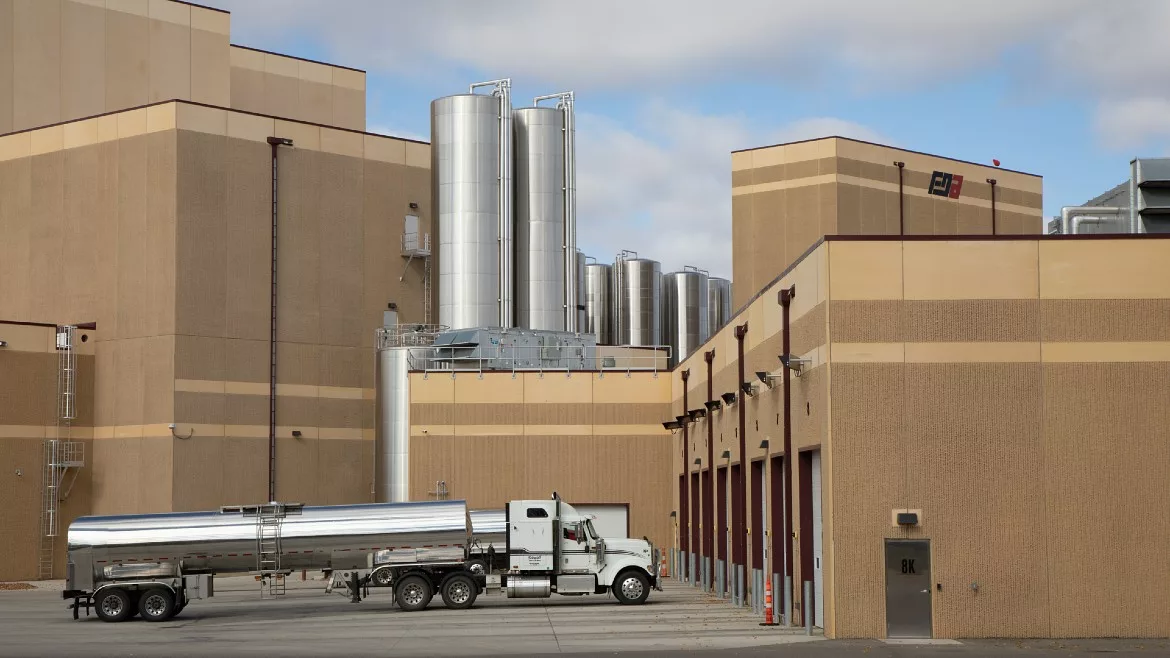
The First District Association in Litchfield, Minnesota used a complete prefabricated structural and envelope system for rapid construction and future expansion flexibility.
Food-processing facilities are some of the most demanding environments in commercial construction. Every surface, structure and connection must perform under heavy mechanical loads, extreme temperature changes and frequent, aggressive cleaning cycles. Maintaining operational uptime while meeting USDA and FDA sanitation standards creates a delicate balance between structural integrity, safety and speed of construction.
For engineers and designers, this challenge increasingly leads to one solution: prefabricated concrete building systems, known as precast. By combining the strength and resilience of concrete with the precision of controlled manufacturing, precast offers a durable, sanitary and schedule-efficient system uniquely suited to the modern food industry.
Built for Performance and Durability
From dairy processing and meat packaging to beverage bottling and cold storage, every facility in the food sector experiences constant mechanical stress. Heavy industrial equipment such as silos, conveyors, refrigeration units and automated lines can exert concentrated loads on floors and structural systems. In many cases, a single packaging silo can top out at around 280,000 pounds.
Precast is inherently designed to accommodate these kinds of loads. Manufactured under controlled conditions, it can achieve compressive strengths far beyond what field-poured concrete can reliably deliver. Prestressing strands and post-tensioning methods create internal compression that enables longer spans, higher load capacities and thinner profiles without sacrificing performance. According to the Precast/Prestressed Concrete Institute (PCI), factory-cast elements with prestressed strands routinely achieve strengths exceeding 270,000 psi — well above typical reinforced concrete benchmarks.
For food processors, this translates to tangible operational benefits. Stronger, stiffer floor systems allow overhead conveyors, process piping and mezzanines to function without excess vibration. Equipment can be rearranged or upgraded without structural modifications, extending the life of the facility and providing flexibility for future production lines.
Cleanability and Sanitary Design
In a food processing facility, cleanliness is regulatory. Facilities must maintain surfaces that can withstand repeated high-pressure washdowns, caustic chemicals and thermal shock. Any joint, seam or surface irregularity can become a potential bacterial harborage point, posing contamination risks and regulatory noncompliance.
Prefabricated concrete offers distinct advantages here. Wall and ceiling panels cast in a controlled environment can be hard-troweled to a Grade A, void-free surface, which meets or exceeds USDA standards for cleanability. The material itself is non-porous, resistant to moisture infiltration, and compatible with epoxy or antimicrobial coatings when additional surface protection is required.
Prefabricated systems such as insulated wall panels, pocket beams and double-tees create continuous, ledge-free surfaces, eliminating unnecessary joints that can collect debris. Fewer penetrations and less field-applied sealants reduce long-term maintenance while improving food safety outcomes.
Speed and Efficiency in Construction
Food producers operate on tight timelines. Every day a facility sits idle costs money and delays distribution. Prefabrication directly addresses this by shifting most of the construction process away from the job site and into a controlled manufacturing environment. While site foundations and utilities are being installed, the concrete wall and floor panels are simultaneously manufactured, cured and prepared for delivery.
When construction reaches the erection phase, installation proceeds quickly. Panels are delivered “just in time,” assembled with cranes and sealed into place, often allowing a facility to reach full enclosure weeks to months earlier than conventional construction methods. Because the construction of precast components can often be sequenced to accommodate concurrent equipment installation, teams are able to integrate process systems and building structure on parallel tracks, reducing downtime and accelerating commissioning.
Additionally, the delivery and construction speed of precast typically aligns with equipment delivery schedules, ensuring that critical assets can move directly into a protected environment without requiring separate storage or temporary enclosures. Our own studies have found that prefabricated construction can cut construction schedules by as much as 50% compared to other building materials.
The approach also reduces weather-related delays and site congestion, improving safety and minimizing conflicts among trades. For food processing projects that frequently operate in remote or climate-sensitive regions, the predictability of prefabrication can make the difference between an on-time opening and costly overruns.
Thermal Performance and Building Envelope Control
Many food processing plants combine spaces with radically different temperature zones: ambient manufacturing floors, refrigerated storage and deep-freeze areas. Managing condensation, vapor migration and energy use across these spaces requires high-performing building envelopes. Prefabricated concrete wall panels can be produced with continuous insulation and integrated vapor barriers, eliminating thermal bridging and ensuring airtight performance. Depending on the configuration, panels can achieve R-values ranging from R-22 to R-32, according to the National Precast Concrete Association.
In some cases, precast systems are used to form the refrigeration unit itself, with insulated wall, ceiling, and floor panels engineered to meet precise temperature and vapor requirements for coolers and freezers. Unlike other building systems, there are very few joints in a precast concrete wall system, minimizing air and vapor infiltration. Proprietary joint and barrier detailing within the panels create an airtight, thermally efficient space, allowing the structure to become the cooler or freezer enclosure. The insulated sandwich panels, with continuous edge-to-edge insulation, eliminate the need for a separate freezer box and help reduce energy costs while maintaining consistent interior temperatures.
This integrated approach allows designers to use the same precast system as both the load-bearing structure and the thermal enclosure, reducing the need for secondary insulated metal panels or redundant cladding systems. The result is an energy-efficient, sanitary envelope with fewer materials, fewer trades, and lower maintenance demands. For processors operating 24/7, those savings accumulate quickly in reduced heating and cooling loads.
Longevity, Maintenance, and Life-Cycle Value
Even with robust materials, long-term facility performance depends on maintenance. Food-processing plants are subjected to temperature swings, vibration, and high moisture levels that can degrade joints and coatings over time. Regular inspection of sealants, waterproofing, and expansion joints remains essential.
Prefabricated systems simplify that process. Because panels are factory-cast with integrated connections, inspection points are predictable and accessible. When deterioration occurs, repairs can be made during scheduled maintenance shutdowns with minimal disruption to operations. A proactive maintenance plan documented and aligned with USDA sanitation schedules helps prevent minor issues from developing into major repairs.
Over decades of operation, the benefits compound: less structural degradation, lower life-cycle costs, and a reduced risk of production interruptions. As sustainability targets expand across the food industry, the longevity of precast building systems also contributes to lower embodied carbon per service year compared to shorter-lived materials.
Collaboration and Design-Build Integration
Because food processing facilities rely so heavily on specialized process equipment, they benefit from a design-build or integrated project delivery approach. Prefabrication complements this model by bringing the building solutions provider’s engineering team into the design process early. This collaboration allows structural systems and construction logistics to align with process layouts like equipment openings, overhead clearances and load paths, all optimized before manufacturing begins.
In practice, that means fewer design changes, faster approvals and better coordination between the structural and mechanical systems. It also improves constructability: openings for ducts, drains and conduit can be pre-engineered, reducing field cutting and patching that could compromise sanitation.
A Design-Build Institute of America report indicates that projects using an integrated delivery approach typically achieve faster completion times, fewer cost changes and higher owner satisfaction compared to traditional design-bid-build models. When prefabrication is part of that integration, the benefits compound, both in schedule certainty and operational readiness.
Building for the Future
As the food industry continues to evolve, whether through automation, e-commerce distribution or expanded cold storage capacity, facility design must keep pace. Prefabricated concrete provides a platform for growth: open floor spans, minimal columns and robust thermal performance support adaptability and future expansion.
Facilities built today must be ready to integrate next-generation equipment and technologies tomorrow. Prefabrication’s precision, flexibility and performance make it a strong foundation for that future.
Looking for a reprint of this article?
From high-res PDFs to custom plaques, order your copy today!