Food Engineering logo
search
cart
facebook twitter linkedin youtube
  • Sign In
  • Create Account
  • Sign Out
  • My Account
Food Engineering logo
  • NEWS
    • Latest Headlines
    • Manufacturing News
    • People & Industry News
    • Plant Openings
    • Recalls
    • Regulatory Watch
    • Supplier News
  • PRODUCTS
    • New Plant Products
    • New Retail Products
  • TOPICS
    • Alternative Protein
    • Automation
    • Cannabis
    • Cleaning | Sanitation
    • Fabulous Food Plants
    • Food Safety
    • Maintenance Strategies
    • OEE
    • Packaging
    • Sustainability
    • More
  • EXCLUSIVES
    • Plant Construction Survey
    • Plant of the Year
    • Sustainable Plant of the Year
    • State of Food Manufacturing
    • Top 100 Food & Beverage Companies
  • MEDIA
    • Podcasts
    • Videos
    • Webinars
    • White Papers
  • FOOD MASTER
  • EVENTS
    • Food Automation & Manufacturing Symposium and Expo
    • Industry Events
  • RESOURCES
    • Newsletter
    • Custom Content & Marketing Services
    • FE Store
    • Government Links
    • Industry Associations
    • Market Research
    • Classified Ads
  • EMAGAZINE
    • eMagazine
    • Archive Issue
    • Advertise
  • SIGN UP!

Safe, effective microwave cooking

By Kevin T. Higgins
June 3, 2004
By better focusing microwave energy and reducing signal attenuation that results in uneven heating, engineers hope to make continuous-flow microwave processing commercially viable.

David Parrott
Microwave ovens have reshaped the way Americans prepare meals, but industrial microwave heating remains a niche application for specialty products such as cooked bacon. That's beginning to change, as firms like Classica Microwave Technologies introduce in-container sterilization (see Food Engineering, November 2003) and Industrial Microwave Systems (IMS), Morrisville, N.C., expands beyond chemical and textile processes to focus on pumpable foods and drying applications.

IMS was founded in 1997 by two electrical engineers, Professor William T. Joines of Duke University and protégé J. Michael Drozd. The men conceived a method to focus the energy from a magnetron and overcome the uneven heating that characterizes the technology. They developed two systems for controlling electromagnetic energy: a cylindrical chamber through which fluids flow, and a planar system for drying on a moving belt. The planar requires a conveyor. Last fall, Harahan, La.-based Laitram LLC, which also owns conveyor belting manufacturer Intralox, acquired IMS. The potential synergies have made planar applications a priority for now, although continuous-flow processing in a tube may become the technology's most dynamic food processing application.

An IMS microwave cylindrical heating system was installed two years ago in an aseptic pilot plant at the Center for Advanced Processing and Packaging Studies (CAPPS) at North Carolina State University. The system feeds electromagnetic energy into two applicator chambers, one to preheat viscous product and the second to achieve extended shelflife or asepsis. Near-instantaneous heating is achieved with product flowing through the chambers in a 1.5-inch diameter pipe at a rate of about two gallons per minute. The system has been tested extensively on fluids of varying viscosity, and work with particulates is underway. The absence of hot surfaces minimizes the problem of product burn-on, and noncontact, rapid heating and cool-down make the process well suited for heat-sensitive proteins and nutrients.

Bringing the microwave system to the commercial world is David L. Parrott, IMS's general manager, food group. Before joining IMS, Parrott was general manager, North American operations for API Schmidt-Bretten, a fabricator of sanitary heat exchangers. He spent 22 years with the APV Group, filling technical development and managerial positions worldwide. Parrott holds undergraduate and advanced degrees in chemical engineering, specializing in non-Newtonian heat transfer. Food Engineering spoke with him recently at the International Petfood Forum in suburban Chicago.
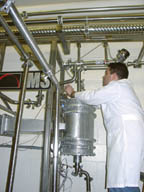
A technician checks a microwave processing system at the North Carolina State University pilot plant. Microwave energy enters the cylindrical processing area from the horizontal ductwork on the left, creating an elliptical heating zone through which product flows.
FE: How does cylindrical microwave technology differ from conventional approaches?

Parrott: Most genius ideas are very simple in concept, and that's the case here. Whereas others have taken the traditional way of delivering microwave energy to a product and then trying to overcome the problem of hot and cold spots with multimode chambers and other techniques, Joines and Drozd first addressed the issue of non-uniformity. They devised a waveguide to focus microwave energy into a cylindrical format that transfers energy evenly into whatever was flowing through the applicator.

FE: How does cylindrical microwave heating work?

Parrott: There are three principal parts to the system: the microwave generator and control system that delivers the power according to the desired temperature, pressure and flow; the cylindrical applicator where energy is focused back toward the center, where the tube containing the product is situated; and the waveguide that brings energy from the generator to the cylinder. The geometry of the applicator can be elliptical or circular, depending on the product.

The walls of the tube containing the product are made of Teflon or ceramic. The CAPPS pilot plant system delivers up to 60 KW of power, with energy split and directed to two applicators. Food could be gelatinized in one applicator, then sterilized in the other. This also allows for temperature equalization between the two chambers and more targeted temperature ranges within each. Product might arrive at the second applicator at 167

Share This Story

Looking for a reprint of this article?
From high-res PDFs to custom plaques, order your copy today!


Kevin Higgins was Senior Editor for FE.

Recommended Content

JOIN TODAY
to unlock your recommendations.

Already have an account? Sign In

  • 2025 Top 100 Food and Beverage Companies

    FOOD ENGINEERING’s 2025 Top 100 Food and Beverage Companies

    While sales were largely down under dynamic economic and...
    Top 100 Food & Beverage Companies
    By: Alyse Thompson-Richards
  • Bottling machine

    How Optical and X-Ray Inspection Supports Bottling Safety and Quality

    By transitioning from legacy single-technology systems to...
    Food Safety
    By: Dan McKee
  • Bread baking in oven

    The State of Food Manufacturing in 2025

    Food and beverage manufacturers are investing in...
    State of Food Manufacturing
    By: Alyse Thompson-Richards
Manage My Account
  • eMagazine
  • Newsletter
  • Online Registration
  • Manage My Preferences
  • Customer Service

More Videos

Popular Stories

The Campbell's Company logo

Campbell’s Terminates Exec Over Alleged Disparaging Comments

alternative protein products

Alternative Protein in 2025: Key Trends and Technologies

circular packaging material for frozen and chilled food packaging

Sustainable Barrier Coatings Replace PFAS, PE and other Plasticized Materials in Packaging

State of Maufacturing 2025

Events

June 17, 2025

Refrigerated & Frozen Foods’ State of the Cold Chain

On Demand Kelley Rodriguez, Editor in Chief of Refrigerated & Frozen Foods, will be joined in this 60-minute webinar by industry experts to help unpack the latest research.

July 23, 2025

Decarbonizing Process Heat: What You Should Know and Next Steps

On Demand Driven by climate goals, business risk, client interest, and resilience considerations, food and beverage companies are increasingly turning their attention to decarbonizing their production processes.

View All Submit An Event

Products

Recent Advances in Ready-to-Eat Food Technology

Recent Advances in Ready-to-Eat Food Technology

See More Products

CHECK OUT OUR NEW ESSENTIAL TOPICS

Alternative ProteinAutomationCleaning/SanitationFabulous Food Plants

Food SafetyMaintenance StrategiesOEE

PackagingSustainability

Related Articles

  • GFSI Update: Creating a Safe and Effective Worldwide Food System

    See More
  • Effective Odor Control

    Natural Neutralizers are the Key Ingredient for Safe and Effective Odor Control

    See More
  • Engineering R&D: Microwave muscles into processing mainstream

    See More

Related Products

See More Products
  • seafood.jpg

    Innovative Technologies in Seafood Processing

  • fe.jpg

    Food Engineering: Emerging Issues, Modeling, and Applications

See More Products
×

Elevate your expertise in food engineering with unparalleled insights and connections.

Get the latest industry updates tailored your way.

JOIN TODAY!
  • RESOURCES
    • Advertise
    • Contact Us
    • Food Master
    • Store
    • Want More
  • SIGN UP TODAY
    • Create Account
    • eMagazine
    • Newsletter
    • Customer Service
    • Manage Preferences
  • SERVICES
    • Marketing Services
    • Reprints
    • Market Research
    • List Rental
    • Survey/Respondent Access
  • STAY CONNECTED
    • LinkedIn
    • Facebook
    • YouTube
    • X (Twitter)
  • PRIVACY
    • PRIVACY POLICY
    • TERMS & CONDITIONS
    • DO NOT SELL MY PERSONAL INFORMATION
    • PRIVACY REQUEST
    • ACCESSIBILITY

Copyright ©2025. All Rights Reserved BNP Media.

Design, CMS, Hosting & Web Development :: ePublishing