Food Engineering logo
search
cart
facebook twitter linkedin youtube
  • Sign In
  • Create Account
  • Sign Out
  • My Account
Food Engineering logo
  • NEWS
    • Latest Headlines
    • Manufacturing News
    • People & Industry News
    • Plant Openings
    • Recalls
    • Regulatory Watch
    • Supplier News
  • PRODUCTS
    • New Plant Products
    • New Retail Products
  • TOPICS
    • Alternative Protein
    • Automation
    • Cannabis
    • Cleaning | Sanitation
    • Cross-Functional Food Innovation
    • Fabulous Food Plants
    • Food Safety
    • Maintenance Strategies
    • OEE
    • Packaging
    • Sustainability
    • More
  • EXCLUSIVES
    • Plant Construction Survey
    • Plant of the Year
    • Sustainable Plant of the Year
    • State of Food Manufacturing
    • Top 100 Food & Beverage Companies
  • MEDIA
    • Podcasts
    • Videos
    • Webinars
    • White Papers
  • FOOD MASTER
  • EVENTS
    • Food Automation & Manufacturing Symposium and Expo
    • Industry Events
  • RESOURCES
    • Newsletter
    • Custom Content & Marketing Services
    • FE Store
    • Government Links
    • Industry Associations
    • Market Research
    • Sponsor Insights
    • Classified Ads
  • EMAGAZINE
    • eMagazine
    • Archive Issue
    • Advertise
  • SIGN UP!
Food SafetyManufacturing News

Manufacturing News

FDA takes measures to promote the microbiological safety of leafy greens
By Wayne Labs, Senior Contributing Technical Editor
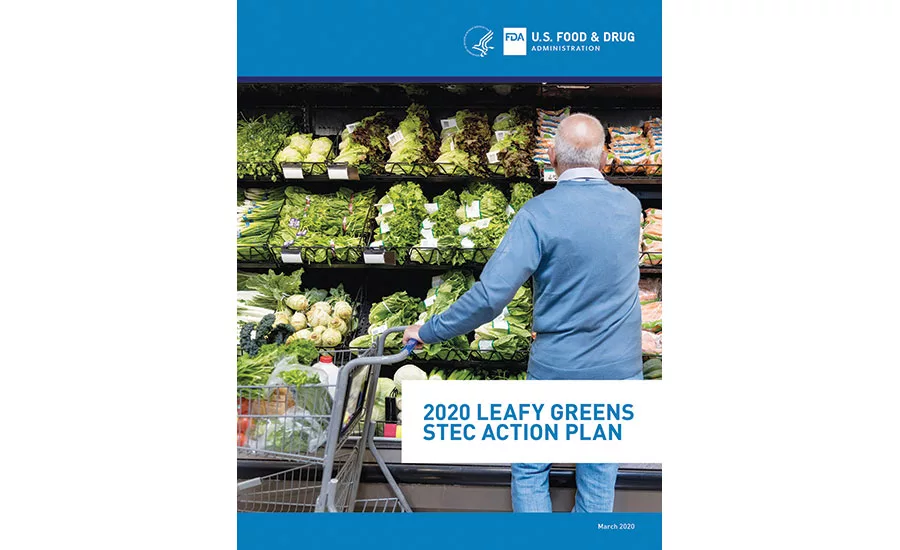
2020 Leafy Greens STEC Action Plan
May 4, 2020

Over a decade or two, FE has reported the repeated and repeated E. coli O157:H7/STEC (Shiga toxin-producing E. coli) infections in leafy greens, especially in lettuce and spinach from the Salinas area of California, and last year from Yuma, Arizona. Most recently FE (Feb. 2020) cited New York Senator Kirsten Gillibrand’s efforts in introducing a bill to allow FDA to take on-premises environmental samples on USDA farms, and FE covered the issue of produce farms being located adjacent to CAFOs as former FDA Deputy Commissioner Michael Taylor (FE, July 2019) described at last year’s Food Safety Summit.

To combat recurring food safety issues, the agency has come up with a plan for 2020, called the “2020 Leafy Greens STEC Action Plan.” The document outlines a set of preventive, responsive and evaluative measures to promote the microbiological safety of leafy greens. 

The Produce Manufacturers Association welcomes the move as a step in the right direction. “We support efforts to provide end-to-end traceability and establish uniform traceability requirements, invest in a systems approach and critical path analysis of adjacent land risk and verifiable interventions,” says PMA Chief Science Officer Maximum Teplitski.

The FDA document outlines several steps in improving agricultural water safety, enhancing inspection and auditing, doing microbiological surveys for the presence of STEC, and improving supply chain communications in terms of track and trace. While there is a lot of emphasis on testing and data communications, the paper also addresses geographical and land use issues, which are at the heart of the problem. E. coli O157:H7 doesn’t magically appear on produce; it comes from animal sources, primarily cattle—but goats, sheep and pigs can carry it as well.


A deeper dive into FDA’s commodity-specific action plan

FDA plans to advance work in three areas: “prevention, response and addressing knowledge gaps.” Expediting the improved safety of leafy greens will require collaboration between FDA and stakeholders in the public and private sectors, including industry and regulatory partners. The plan is designed to help foster a more urgent, collaborative and action-oriented approach.

Beyond FSMA, FDA wants to focus on several areas, some including:

  • Developing a proposed rule for advanced agricultural water safety (other than sprouts)
  • Enhancing inspection, auditing and certification programs
  • Helping retailers define buyer specifications 
  • Setting up a leafy green data trust
  • Performing microbiological surveys for STEC detection and enhanced sampling protocols 
  • Increasing awareness and the addressing of concerns around adjacent and nearby land use
  • Establishing and strengthening regular outreach and communication programs for stakeholders in growing regions
  • Publishing a Salinas outbreak investigation report
  • Conducting follow-up surveillance on the fall 2020 growing/harvest season
  • Promoting tech-enabled traceability
  • Advancing root cause analysis activities
  • Conducting longitudinal studies, for example, looking at pathogen survival in water reservoirs and pipelines
  • Looking at adjacent and nearby land use
  • Creating a sampling assignment with California

FDA plans to emphasize the importance of using good agricultural practices while the agency works on a proposed water rule. In addition, FDA will support the EPA approval of an FDA-developed protocol that chemical companies may use in obtaining registration of antimicrobial products for treating irrigation water.

With respect to longitudinal studies, the FDA has launched an initiative with support from the Arizona Department of Agriculture, and in conjunction with the University of Arizona Cooperative Extension, the Welton-Mohawk Irrigation and Drainage District and members of the leafy greens industry to better understand the ecology of human pathogens in the Yuma growing region. Exploratory discussions have also been initiated in the Salinas and Santa Maria regions of California. 

Activities occurring on nearby or adjacent land can influence or contribute to contamination. Information about nearby or adjacent land uses can help growers with effective mitigation strategies. 

FDA will collaborate with federal and state partners, research organizations and industry stakeholders to identify existing data and knowledge on the impact of adjacent and nearby land use on growing areas and help growers implement effective mitigation strategies. 

FDA will work with government partners and industry stakeholders to explore the feasibility of implementing preharvest best management strategies for cattle raised near leafy green growing areas and encourage research into preharvest mitigation strategies for cattle.

Regarding the use of compost materials in California, FDA will continue analyzing samples of commercial compost for the presence of foodborne pathogens to inform baseline understanding and encourage standardization and collection of data around compost.

KEYWORDS: agriculture FDA produce regulations

Share This Story

Looking for a reprint of this article?
From high-res PDFs to custom plaques, order your copy today!

Wayne labs 200px
Wayne Labs has more than 30 years of editorial experience in industrial automation. He served as senior technical editor for I&CS/Control Solutions magazine for 18 years where he covered software, control system hardware and sensors/transmitters. Labs ran his own consulting business and contributed feature articles to Electronic Design, Control, Control Design, Industrial Networking and Food Engineering magazines. Before joining Food Engineering, he served as a senior technical editor for Omega Engineering Inc. Labs also worked in wireless systems and served as a field engineer for GE’s Mobile Communications Division and as a systems engineer for Bucks County Emergency Services. In addition to writing technical feature articles, Wayne covers FE’s Engineering R&D section.

Recommended Content

JOIN TODAY
to unlock your recommendations.

Already have an account? Sign In

  • Bread going through conveyor belt in manufacturing plant.

    The State of Food Manufacturing in 2026

    Food and beverage manufacturers encounter significant...
    Automation
    By: Alyse Thompson-Richards
  • FE Top100 Food & Beverage Companies hero, gold lettering with black background.

    FOOD ENGINEERING’s 2026 Top 100 Food and Beverage Companies

    See where the world’s leading food and beverage companies...
    People & Industry News
    By: Alyse Thompson-Richards
  • CJ Schwan’s Salina facility.

    Recipe for Growth: How CJ Schwan’s Powers Pizza Production with People and Automation

    Blending advanced automation with purposeful design, this...
    Cross-Functional Food Innovation
    By: Alyse Thompson-Richards
Manage My Account
  • eMagazine
  • Newsletter
  • Online Registration
  • Manage My Preferences
  • Customer Service

More Videos

Sponsored Content

Sponsored Content is a special paid section where industry companies provide high quality, objective, non-commercial content around topics of interest to the Food Engineering audience. All Sponsored Content is supplied by the advertising company and any opinions expressed in this article are those of the author and not necessarily reflect the views of Food Engineering or its parent company, BNP Media. Interested in participating in our Sponsored Content section? Contact your local rep!

close
  • Illustration of businessman standing in the middle of a large scale, balancing between two green dollar signs at each end, one larger than the other. Blue background with very small white clouds.
    Sponsored by3-A Sanitary Standards, Inc.

    6 Questions: Before You Buy Food Processing Equipment

  • Construction crews use aerial lifts to install insulated wall panels inside an industrial facility.
    Sponsored byBurns & McDonnell

    Food Manufacturing’s Growth Calls for Integrated Project Delivery

  • Close-up of a group of freshly baked stuffed empanadas being transferred onto a conveyor belt.
    Sponsored byDorner

    Smarter Line Design Improves Food Manufacturing Efficiency and Throughput

Popular Stories

Bread going through conveyor belt in manufacturing plant.

The State of Food Manufacturing in 2026

Niagara Bottling Facility

Niagara Bottling Opens $141M Facility in Kentucky

Kerry coffee extract

Kerry Opens Coffee Extraction Facility in Pennsylvania

An image of baked bread on a conveyor belt with text promoting the 2026 State of Food Manufacturing report.

Events

January 1, 2030

Webinar Sponsorship Information

For webinar sponsorship information, visit www.bnpevents.com/webinars or email webinars@bnpmedia.com.

View All Submit An Event

Products

Food Process Engineering and Technology, 3E

Food Process Engineering and Technology, 3E

Combining scientific depth with practical usefulness, this book serves as a tool for graduate students as well as practicing food engineers, technologists and researchers looking for the latest information on transformation and preservation processes as well as process control and plant hygiene topics.

See More Products
Promo for the 2027 Plant of the Year Award


CHECK OUT OUR NEW ESSENTIAL TOPICS

Alternative Protein Automation Cleaning/Sanitation Fabulous Food Plants

Food Safety Maintenance Strategies OEE

Packaging Sustainability

Related Articles

  • FDA takes steps to advance safety of leafy greens

    FDA takes steps to advance safety of leafy greens

    See More
  • FDA logo blue

    Voluntary recall of greenhouse leafy greens

    See More
  • FDA partners with leafy greens industry to enhance food safety

    See More
×

Elevate your expertise in food engineering with unparalleled insights and connections.

Get the latest industry updates tailored your way.

JOIN TODAY!
  • RESOURCES
    • Advertise
    • Contact Us
    • Food Master
    • Store
    • Want More
  • SIGN UP TODAY
    • Create Account
    • eMagazine
    • Newsletter
    • Customer Service
    • Manage Preferences
  • SERVICES
    • Marketing Services
    • Reprints
    • Market Research
    • List Rental
    • Survey/Respondent Access
  • STAY CONNECTED
    • LinkedIn
    • Facebook
    • YouTube
    • X (Twitter)
  • PRIVACY
    • PRIVACY POLICY
    • TERMS & CONDITIONS
    • DO NOT SELL MY PERSONAL INFORMATION
    • PRIVACY REQUEST
    • ACCESSIBILITY

Copyright ©2026. All Rights Reserved BNP Media, Inc. and BNP Media II, LLC.

Design, CMS, Hosting & Web Development :: ePublishing