Food Engineering logo
search
cart
facebook twitter linkedin youtube
  • Sign In
  • Create Account
  • Sign Out
  • My Account
Food Engineering logo
  • NEWS
    • Latest Headlines
    • Manufacturing News
    • People & Industry News
    • Plant Openings
    • Recalls
    • Regulatory Watch
    • Supplier News
  • PRODUCTS
    • New Plant Products
    • New Retail Products
  • TOPICS
    • Alternative Protein
    • Automation
    • Cannabis
    • Cleaning | Sanitation
    • Cross-Functional Food Innovation
    • Fabulous Food Plants
    • Food Safety
    • Maintenance Strategies
    • OEE
    • Packaging
    • Sustainability
    • More
  • EXCLUSIVES
    • Plant Construction Survey
    • Plant of the Year
    • Sustainable Plant of the Year
    • State of Food Manufacturing
    • Top 100 Food & Beverage Companies
  • MEDIA
    • Podcasts
    • Videos
    • Webinars
    • White Papers
  • FOOD MASTER
  • EVENTS
    • Food Automation & Manufacturing Symposium and Expo
    • Industry Events
  • RESOURCES
    • Newsletter
    • Custom Content & Marketing Services
    • FE Store
    • Government Links
    • Industry Associations
    • Market Research
    • Sponsor Insights
    • Classified Ads
  • EMAGAZINE
    • eMagazine
    • Archive Issue
    • Advertise
  • SIGN UP!

Pandemic is changing layout and design of food plants

By Rose Shilling
modular health space

Black & Veatch developed a Rapid Modular Health System to provide space outside of plants for health screening and testing.

Image courtesy of Black & Veatch

locker room (before)

BEFORE: A rendering by Epstein shows conditions in a pre-pandemic locker room without distancing measures.

Image courtesy of Epstein
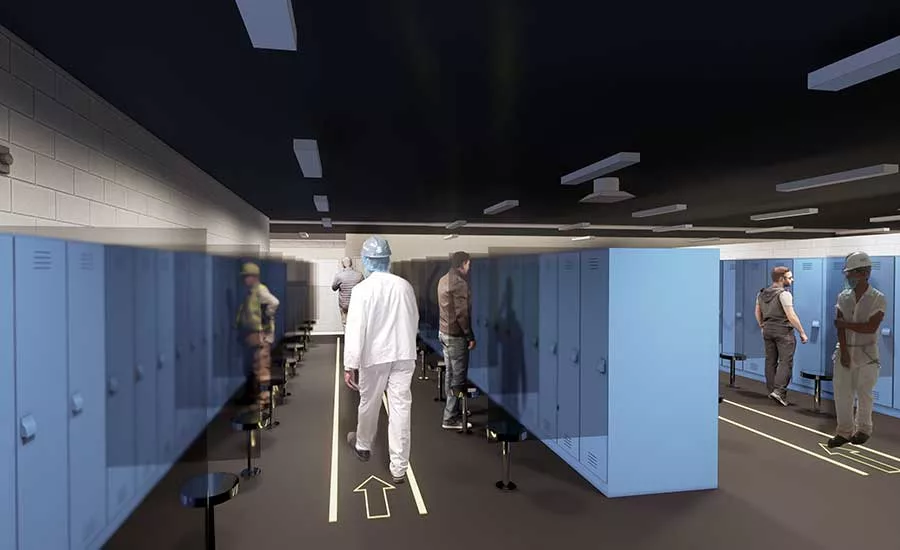
locker room (after)

AFTER: Epstein developed conceptual designs so clients could picture what common areas might look like with distancing precautions, such as the dividers and one-way traffic lanes added to this locker room.

Image courtesy of Epstein

gym at the Herbalife dietary supplements facility

Businesses are weighing whether communal spaces, like this gym at the Herbalife dietary supplements facility, are what buildings need right now when workers have to remain separate. CRB says companies are developing new protocols for cleaning and using shared spaces.

Photo courtesy of CRB

modular health space
locker room (before)
locker room (after)
gym at the Herbalife dietary supplements facility
July 20, 2020

Is more automation a solution for pandemic woes?

The pandemic is speeding up discussions about increasing automation, design-build experts say.

Interest in automating has been high for years, first for its ROI and more recently because of difficulty finding enough employees. “This will add to the reasons that processors will look to add automation,” says Darrin McCormies, senior vice president and director of industrial services for Epstein design and construction.
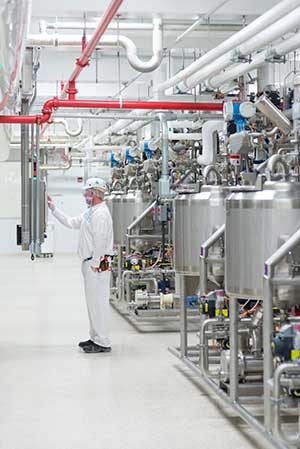
colorbatch tanks at Mars Chocolate in Topeka, Kansas
As a result of COVID-19, CRB expects plants will be more focused on adding a new layer of automation, like these colorbatch tanks at Mars Chocolate in Topeka, Kansas, shown in a prepandemic photo.

Jeff Matis, senior project director at CRB, points out that processors typically automate in phases as budget allows, “capturing low-hanging fruit” before making more expensive investments. "The issue with COVID now just makes people more focused in looking at another level of automation, whereas perhaps in the past, it was marginal in its payback."

For processors that decide to stay centralized, A M King expects more automation adoption as equipment becomes more sophisticated, especially in handling irregular food shapes and consistencies, says John Koury, who provides architectural services for the firm. Operations that take a more dispersed and localized direction likely will feel less pressure to automate, he says.

As always, plants are trying to balance automating tasks to reap a variety of savings and benefits, including removing human pathogen carriers with maintaining a nimble workforce that can react quickly to demand fluctuations or supply chain trouble.

Here are the factors that processors are weighing, according to David Ziskind, director of engineering, for Black & Veatch, NextGen Ag: Automation that reduces personnel has the added benefit of removing potential carriers from the process, creating physical distancing and possibly allowing a facility to continue to operate when an area experiences an outbreak. However, automation generally reduces flexibility, which we saw in recent months when some manufacturers struggled to turn on a dime from food service and institutional packaging to retail. Plus, in certain parts of the world, a very low labor rate could be a barrier to adopting automation solutions.

“For example, a manufacturer focused on food service or institutional packaging may not want to give up automation in order to have the flexibility to switch to retail on a dime in the future, but they might consider break points where they could bulk off product (for example, into totes) and send to a copacker for retail packaging, or even purchase some inexpensive portable packaging equipment that could be quickly pressed into temporary service,” says Chris Vigil, Black & Veatch NextGen Ag project manager.
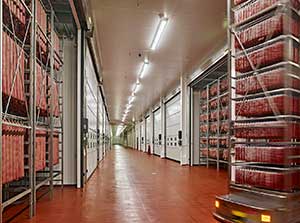
salami plant aging room
A robot in a salami plant aging room is an example of the type of automation project that A M King expects to become more relevant because of the pandemic. Photo courtesy of A M King

Even though the pandemic is adding priority to some automation projects, companies must prepare for the change, and funding, resource availability and timeframe must align, says Michael Petrusma, vice president of EV Group construction and safety management.

Automating processes solves several short-term issues but may create new issues in their place, he notes.  “A well-thought-out plan and execution is the only way a facility will see the full benefit of automation.”

He shares an example of how vital employee training and skilled staff are: A pet food facility that installed a new automated line last year experienced a human error during the pandemic that shut down the line. The line remained down several weeks because the OEM couldn’t visit due to travel restrictions. Lack of on-site knowledge and parts delivery delay were problematic. “If the facility had the right training and resources on site, weeks of lost productivity could have been days,” Petrusma says.
 

<< Return to main article

KEYWORDS: design/build future of food manufacturing hygienic design pathogens worker safety

Share This Story

Looking for a reprint of this article?
From high-res PDFs to custom plaques, order your copy today!

Rose shilling author

Rose Shilling is a previous managing editor of Food Engineering Magazine. She wrote feature stories on a variety of topics and tracked the food packaging industry. A journalist with an editing background at news services and newspapers, she also has driven editorial projects in health care and higher education.

Recommended Content

JOIN TODAY
to unlock your recommendations.

Already have an account? Sign In

  • CJ Schwan’s Salina facility.

    Recipe for Growth: How CJ Schwan’s Powers Pizza Production with People and Automation

    Blending advanced automation with purposeful design, this...
    Plant of the Year
    By: Alyse Thompson-Richards
  • Paris Baguette rendering

    FOOD ENGINEERING’s 49th Annual Plant Construction Survey

    Food and beverage manufacturers continue to invest in...
    Plant Construction Survey
    By: Alyse Thompson-Richards
  • Bottling machine

    How Optical and X-Ray Inspection Supports Bottling Safety and Quality

    By transitioning from legacy single-technology systems to...
    Food Safety
    By: Dan McKee
Previous 1 2 Next
Manage My Account
  • eMagazine
  • Newsletter
  • Online Registration
  • Manage My Preferences
  • Customer Service

More Videos

Sponsored Content

Sponsored Content is a special paid section where industry companies provide high quality, objective, non-commercial content around topics of interest to the Food Engineering audience. All Sponsored Content is supplied by the advertising company and any opinions expressed in this article are those of the author and not necessarily reflect the views of Food Engineering or its parent company, BNP Media. Interested in participating in our Sponsored Content section? Contact your local rep!

close
  • Close-up of a group of freshly baked stuffed empanadas being transferred onto a conveyor belt.
    Sponsored byDorner

    Smarter Line Design Improves Food Manufacturing Efficiency and Throughput

  • An old and tattered manual titled 'Revised 5/20/1971' on a desk along with a cellphone, sunglasses, Apple iWatch, laptop and keyboard, and a water bottle.
    Sponsored byEnSight Solutions

    Redefining Quality: Has the Industry Lost Sight of What Actually Matters?

  • Worker in protective food-processing attire uses a tablet beside stainless-steel conveyor equipment in a modern food manufacturing facility.
    Sponsored bySafetyChain

    Your Biggest Losses Are Hiding in Data You Already Have

Popular Stories

FE Top100 Food & Beverage Companies hero, gold lettering with black background.

FOOD ENGINEERING’s 2026 Top 100 Food and Beverage Companies

AB Baldwinsville Investment

Anheuser-Busch Invests $13M in New York Brewery

Granola

Roskam Foods to Close California Plant as Part of Cereal Production Consolidation

Graphic with text on the left: ‘Food Engineering 2026 Top 100 - Explore leaders.’ Right side: images of juice bottles and chicken on a conveyor. Bottom text 'View Rankings'.


Promo for the 2027 Plant of the Year Award

Events

September 23, 2026

An In-Depth Look at 2026's Top 100 Food and Beverage Companies

Join Lynn Dornblaser, Client Advisor at Mintel, and Alyse Thompson-Richards, Editor-in-Chief of FOOD ENGINEERING, as they break down the 2026 Top 100 Food and Beverage Companies and discuss the factors affecting this year’s rankings.

September 29, 2026

Food Safety Execution and Your Bottom Line

Explore food safety strategies that strengthen sanitation, risk management, operational efficiency, and compliance across foodservice and facility environments.

View All Submit An Event

Products

Recent Advances in Ready-to-Eat Food Technology

Recent Advances in Ready-to-Eat Food Technology

See More Products

September 23 FE Editorial Webinar


CHECK OUT OUR NEW ESSENTIAL TOPICS

Alternative ProteinAutomationCleaning/SanitationFabulous Food Plants

Food SafetyMaintenance StrategiesOEE

PackagingSustainability

Related Articles

  • How the COVID-19 pandemic is changing CPG production

    How the COVID-19 pandemic is changing CPG production

    See More
  • Aurora Organic Dairy facility

    Fabulous Food Plants: Design, build, succeed

    See More
  • Agentic AI

    From Recall Reaction to Prevention: How AI Is Changing Food Safety Execution

    See More

Related Products

See More Products
  • The 10 Principles of Food Industry Sustainability

  • handbookfoodscience.jpg

    Handbook of Food Science and Technology 2: Food Process Engineering and Packaging

  • food engineering.jpg

    Handbook of Food Engineering, Third Edition

See More Products
×

Elevate your expertise in food engineering with unparalleled insights and connections.

Get the latest industry updates tailored your way.

JOIN TODAY!
  • RESOURCES
    • Advertise
    • Contact Us
    • Food Master
    • Store
    • Want More
  • SIGN UP TODAY
    • Create Account
    • eMagazine
    • Newsletter
    • Customer Service
    • Manage Preferences
  • SERVICES
    • Marketing Services
    • Reprints
    • Market Research
    • List Rental
    • Survey/Respondent Access
  • STAY CONNECTED
    • LinkedIn
    • Facebook
    • YouTube
    • X (Twitter)
  • PRIVACY
    • PRIVACY POLICY
    • TERMS & CONDITIONS
    • DO NOT SELL MY PERSONAL INFORMATION
    • PRIVACY REQUEST
    • ACCESSIBILITY

Copyright ©2026. All Rights Reserved BNP Media, Inc. and BNP Media II, LLC.

Design, CMS, Hosting & Web Development :: ePublishing