How Solar Power Helps Food Manufacturers Control Rising Energy Costs
Trucks are lined up at the loading dock of a fruit processing facility in the middle of harvest season. Production is running at capacity, and every hour of downtime means spoiled product and lost revenue. The facility can't pause, but it's bleeding money on energy costs.
How can you tackle this problem when every minute of operation matters?
It's a challenge across the food and beverage industry. Many companies operate on razor-thin margins, so energy costs can quickly become crippling. When utility rates spike, you can't simply pass those costs downstream. Your contracts are already set.
And the demand is enormous. Food production accounts for 30% of global energy consumption. In the United States, food and beverage manufacturing alone represents 6% of total industrial emissions. By one estimate, refrigeration accounts for 79% of warehouse energy use, making it the second-highest operating cost after labor.
Utility rates have climbed steadily over the past decade and are projected to increase at an even steeper pace in the years to come. It's concerning — but there's a way to change the math.
On-site solar and energy storage systems offer control. They let you generate power when you need it most, reduce exposure to rate fluctuations and meet sustainability commitments. Plus, financing structures have evolved to make these projects practical.
The logistics of installing solar in food and beverage facilities aren't simple. Any solution must respect the flow of operations and the integrity of the product — but plenty of facilities have successfully installed solar without disruptions.
Why Solar Works for F&B
Solar power aligns naturally with food and beverage operations. Energy use is often higher during daylight hours, which is when solar panels generate electricity.
How much solar energy you need depends on your facility. A large processing plant might require a system larger than 1 MW to offset its consumption. A refrigerated warehouse could realize meaningful savings with a 300 kW to 500 kW system that cuts into daytime demand. With a typical reduction in energy costs of 15%-30%, a facility spending $500,000 a year on electricity would realize $75,000-$150,000 in annual savings.
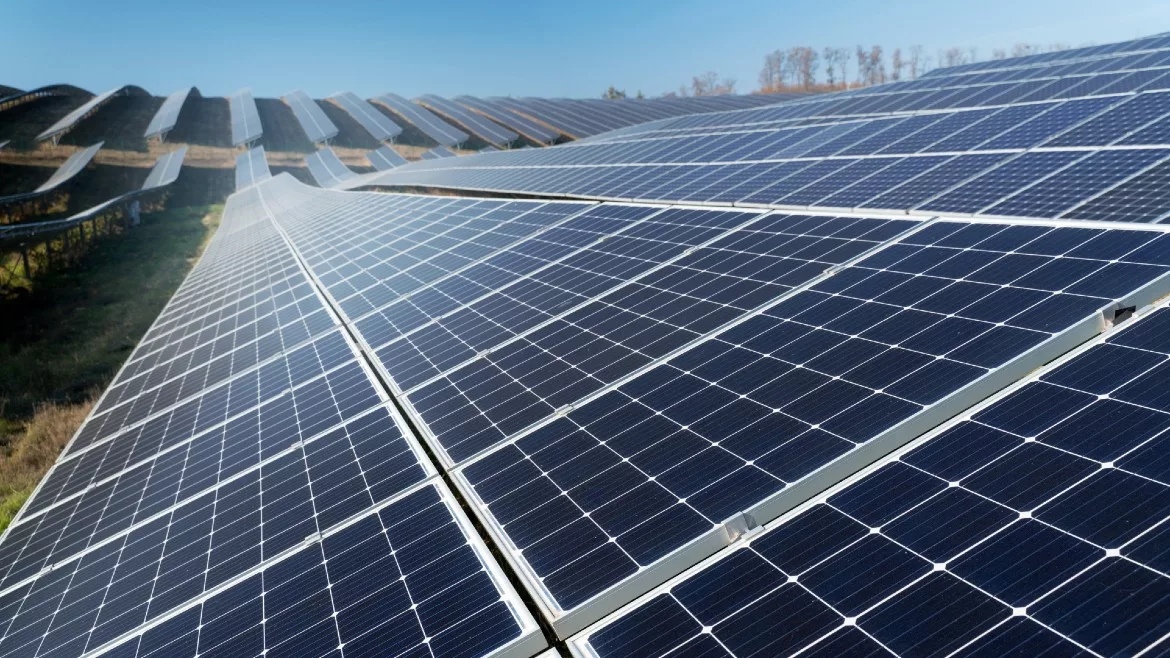
Design depends on your physical footprint. Rooftop arrays are common because many facilities already have large, flat roofs with minimal shading and sufficient load-bearing capability. Sites with open land can use ground-mount systems to generate power without affecting production space. Parking canopies can perform double duty by shading equipment storage or vehicle fleets while generating electricity overhead.
Solar power also helps lower costs by mitigating demand charges, which account for 30%-50% of an electricity bill and are based on a facility's highest 15-minute usage period each month. A single production spike can set elevated rates for the entire month. Having solar power available during these intense production hours helps flatten those peaks and reduce what you pay.
When it comes to maintaining operations, installing solar doesn't mean shutting down production. Experienced developers coordinate the work to keep facilities running by using generators or existing backup systems during brief electrical tie-ins. Most system installations take place on rooftops or open land, with minimal presence in active work areas.
You won't cover all your energy needs with solar. Most systems are sized for long-term savings, not total replacement. Developers often keep projects just below utility thresholds to avoid triggering expensive infrastructure upgrades or match them to a facility's baseline daytime usage to maximize on-site consumption.
Pairing solar with battery storage unlocks additional benefits for facilities running power-intensive equipment around the clock.
Reducing Costs and Adding Demand Charge Management
Battery storage takes demand charge reduction further by discharging stored electricity to blunt those peaks. For operations with sharp load swings, such as a meat processing plant that has to power up conveyor systems, batteries can cut demand charges by 30%-50% beyond what solar achieves.
Those benefits are no longer out of reach. Battery storage just got dramatically more affordable. The cost of a turnkey energy storage system dropped 40% in 2024 — the biggest one-year decline on record. That translates to payback periods shrinking from 10 to 12 years to about six to eight years for facilities with significant demand charges. If you explored batteries before 2024 and passed, the math has changed.
But battery storage doesn't make sense for every facility. The economics depend on local utility rates and how much your energy usage fluctuates throughout the day. Still, what was once a niche add-on is becoming standard practice. A few years ago, only the most forward-thinking companies or those in incentive-rich states added storage to their solar projects. Now, even mid-sized manufacturers routinely include batteries in their RFPs.
The hardware is reliable and the economics are continuing to improve, but whether a project moves forward still depends on how it's financed and what the policy environment allows.
Finance, Policy and the Window Ahead
Project viability hinges on timing. Incentives are available, but access depends on how and when you act — and your evaluation process should begin immediately.
The One Big Beautiful Bill Act (OBBBA) changed the federal incentive structure for renewable energy. Unless construction begins by July 4, solar projects that enter service after 2027 may no longer qualify for the Investment Tax Credit (ITC) — a 30% reduction in project costs. Without it, your payback period will be extended by three to five years. Also, new domestic sourcing rules for batteries will take effect Jan. 1, further narrowing eligibility. Battery storage projects, however, will continue to qualify for the ITC, further increasing project economics and resilience where batteries make sense.
Even without federal incentives, other forces continue to support adoption. State-level programs remain viable. Corporate ESG and sustainability mandates, and companies with net-zero commitments, need renewable energy infrastructure to meet those targets.
Financing makes the model work. Power purchase agreements (PPAs) dominate commercial solar for a reason. Under a PPA, a developer finances, builds and owns the solar and storage system on your property. You buy the output at a fixed rate per kWh that's typically a few cents below your utility rate and locked in for 20-25 years. The structure eliminates upfront capital requirements and provides immediate savings. Plus, many PPAs include provisions to exit or renegotiate if electricity costs fall dramatically.
Credit shapes the PPA's terms. Organizations with strong credit profiles typically see better rates and more flexible buyout options. PPAs often allow you to purchase the system within a specified timeframe or transfer the contract to a new owner if you sell the facility.
Once financing is structured, developers will handle permitting and interconnection applications while coordinating with your operations team on timing and logistics. A project can still stall, but starting conversations early gives enough buffer that permitting delays don't derail it.
The process isn't always smooth, but the payoff is more than worth it.
Solar Brings Cost Certainty
Look at how much you've been paying for energy in recent years and compare that to what a PPA can contractually guarantee for the next two decades.
A dairy processing facility is spending $800,000 annually on electricity, with costs rising 4%-5% each year. If it signs a PPA for a 1.2 MW solar system at a fixed rate 15% below the utility baseline, it saves $50,000 after 12 months. A decade in, if utility rates climb 50%, it will save $180,000 annually — with 10 years left on the contract. That's $1.5 million in cumulative savings without upfront costs.
You can't predict electricity prices in 2040. Nobody can. But with solar, you've locked in a known rate for one of your largest operating expenses. That's cost certainty in an uncertain market.
The harvest season keeps coming. The compressors keep running. The electricity bills keep arriving. With solar power in place, you control your energy costs now — and that's the difference.
Looking for a reprint of this article?
From high-res PDFs to custom plaques, order your copy today!