The State of Food Manufacturing in 2026
October 13, 2026
The State of Food Manufacturing in 2026
October 13, 2026
Need to Know
- Food manufacturers are prioritizing equipment upgrades, line expansions and targeted modernization over new facility construction amid economic uncertainty.
- Food safety and traceability remain critical investment priorities, with manufacturers preparing for FSMA 204 requirements in 2028.
- Robotics adoption is expected to rise from 72% to 95% among surveyed packaging and processing manufacturers by 2031, driven by automation and workforce challenges.
Food and beverage manufacturers face many challenges beyond their main goal: delivering product to customers and consumers.
Tightening regulations, rising costs and deepening concerns around labor availability intensify pressure on manufacturers to operate as efficiently and safely as possible. This is often easier said than done.
However, food manufacturers continue to invest in their operations with consideration toward food safety, traceability, automation and sustainability.
Equipment Purchasing and Capital Expenditure
In its 2026 Packaging State of the Industry Report, PMMI, The Association for Packaging and Processing Technologies, valued the U.S. packaging machinery market at $11.7 billion in 2025. Food machinery represented $5.1 billion – or roughly 44% – of the market. PMMI projects food machinery shipments to reach $7.1 billion by 2031.
However, equipment orders don’t necessarily lead to new construction. In the 2026 Processing State of the Industry Report – a joint research project between PMMI and the Food Production Solutions Association (FPSA) – indicates new equipment orders are outpacing new facility construction, driven by economic uncertainty and risk averseness. The report also points toward unfavorable borrowing conditions and a lack of skilled labor for new plants.
“That pattern suggests caution in the near term,” FPSA President and CEO Chris Lyons recently told FOOD ENGINEERING. “There is still a lot of uncertainty for any business with tariffs, inflationary pressure and skills shortages. Spending will remain focused on brownfield upgrades, line expansions and targeted modernization. I think construction will eventually catch up.”
David Pelyhes, business partner at JPG Resources, adds capacity expansion is often more attainable, since it may be easier to prove a quick return on investment – particularly for automation and safety upgrades.
“Those that are investing for capacity expansion can look at some of the extras around line integration, more automation,” he says. “How do I automate to reduce cost of goods sold (COGS) on this new line that I couldn’t do on the existing line? I think that they can design out some of the hygienic design issues on the existing line. It might have some impact on COGS through shorter sanitation.”
Looking for a reprint of this article?
From high-res PDFs to custom plaques, order your copy today!
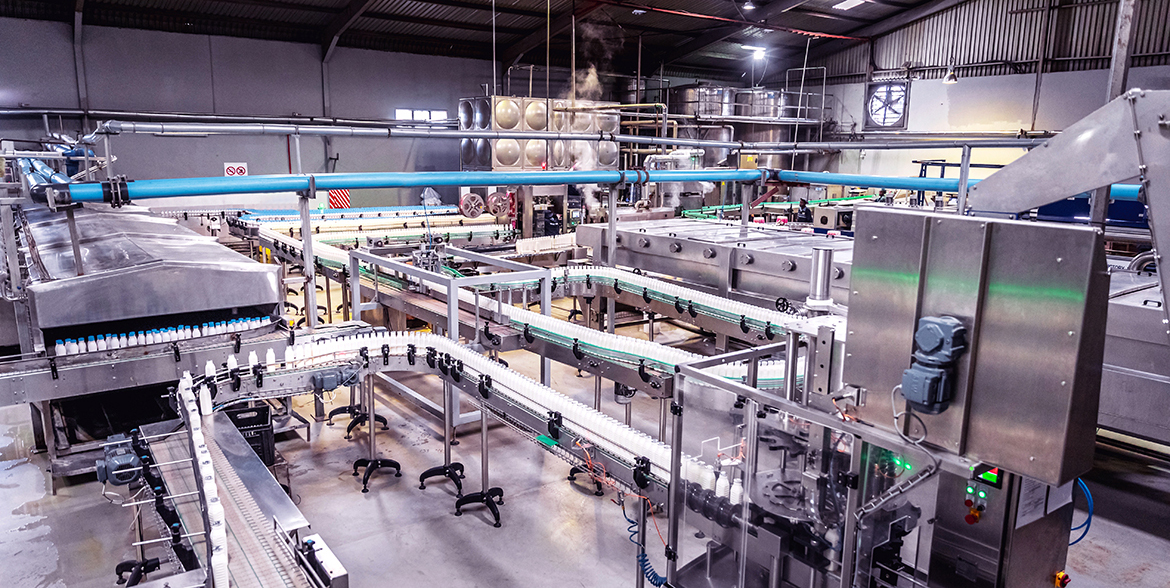
Image credit: GCShutter / E+ / Getty Images
Food Safety and Traceability
As major food safety incidents continue to arise, sanitation, hygienic design and traceability advance to the forefront of conversations around equipment purchasing and plant and process design.
“Companies are stressing food safety, and they’re trying to make strides,” says Nolan Lewin, executive director of Rutger University’s Food Innovation Center. “The companies that I work with — it’s a priority. It never used to be as high a priority as it is now, but they realize they have to protect their name and their brands.”
Research from FPSA and PMMI indicates that food safety concerns are often “structural,” relating to cross-contact control, residue removal and consistency during cleaning cycles. Increased SKU variation also plays a role, leading to differing cleaning procedures and more frequent changeovers.
As a result, original equipment manufacturers (OEMs) are working with sanitation system providers earlier in the process, while food manufacturers seek equipment features designed around sanitation, such as washdown-rated hardware and access panels that remain in place during cleaning.
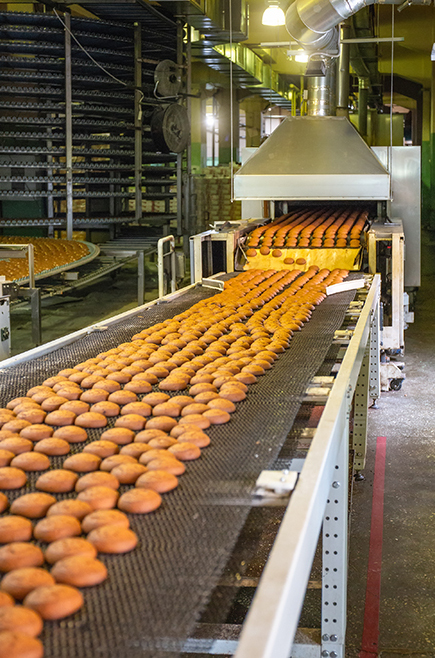
Image credit: DedMityay / iStock / Getty Images
“There is more emphasis on hygienic design than I’ve ever heard before,” Pelyhes says. “Our resources are almost exclusively focused on it.”
Pelyhes also notes smaller manufacturers that may not have vast equipment budgets are benefiting from improving their safety and sanitation programs, especially when it comes to achieving SQF and BRF certifications.
With the compliance deadline for FSMA 204’s traceability requirements looming in 2028, manufacturers are also under pressure to augment environmental monitoring and data management capabilities. An enterprise resource planning (ERP) system can help with that, but some manufacturers are still operating with spreadsheets, Pelyhes says. He adds many manufacturers are not yet ready to meet the rule’s traceability requirements.
“A lot of folks are familiar with ERP systems, and now it’s going to be on steroids in the next year and half,” Pelyhes says. “That’ll be a big shock. It’s not just going to be for the smaller manufacturers — even the larger manufacturers are going to be challenged with it.”
Both Lewin and Pelyhes pointed to the potential for vision systems enhanced by artificial intelligence (AI), which can boost product quality and reduce false reject rates. FPSA and PMMI’s research shows U.S. shipments of inspection equipment have grown 4.4% between 2024 and 2025, jumping from $604 million to $630 million. At nearly a quarter (24%), the meat and poultry sector represents the largest share of those purchases.
“We haven’t seen yet AI’s impact on what food manufacturing is going to look like,” Lewin says. “It’s still a little expensive to do that on the scale that food plants have to operate, but you’re seeing more and more of that coming into play.”
Automation and Workforce
Automation is a broad term, covering everything from AI, data collection and analysis, to robotics. Manufacturers continue to adopt these technologies at varying rates. In its 2026 Robotics in US Packaging & Processing Report, conducted in partnership with Interact Analytics, the U.S. robotics market serving packaging and processing was valued at $440 million in 2025 and is projected to climb to $800 million by 2031.
Specifically, 72% of manufacturers surveyed for the report use robotics, but the adoption rate is expected to soar to 95% by 2031.
For co-manufacturers, investment in automation needs to bolster their ability to support multiple brand-owning clients. That often starts at the end of the line with cartoning, case-packing and palletizing, but Pelyhes says he’s also seeing investment in metering and dosing equipment.
“They need something flexible that would have applicability to other business that they have in their plant or could expect to have in their plant,” Pelyhes says. “The co-manufacturers that we typically work with can afford to invest in a unit op at time, so the integration doesn’t get as much attention or investment.”
For reference, PMMI valued U.S. shipments of cartoning, multipacking and case-packing equipment at $2.1 billion in 2025, while shipments of palletization and load stabilization equipment totaled $1 billion. In their joint report, FPSA and PMMI valued the material handling and conveyance equipment market for the food and beverage sector at $1.07 billion, up from $1.04 billion in 2024.
Lewin agrees that automation investment is often pursued in stages to dampen the risk, especially in the face of quickly evolving consumer trends.
“Manufacturers, at this stage of the game, have to do it piecemeal based on what they can afford to do without taking too big of a risk,” Lewin says. “What works well one day next month might turn into something else.”
Labor concerns typically go hand-in-hand with automation investment. While developing automated processes can reduce the number of employees needed on the floor, today’s manufacturing roles often require greater technical skills and training.
“Managers and companies have realized that it pays to keep employees that they’ve had there for a time rather than having to retrain them, especially when there’s more technical expertise required to train them,” he says.
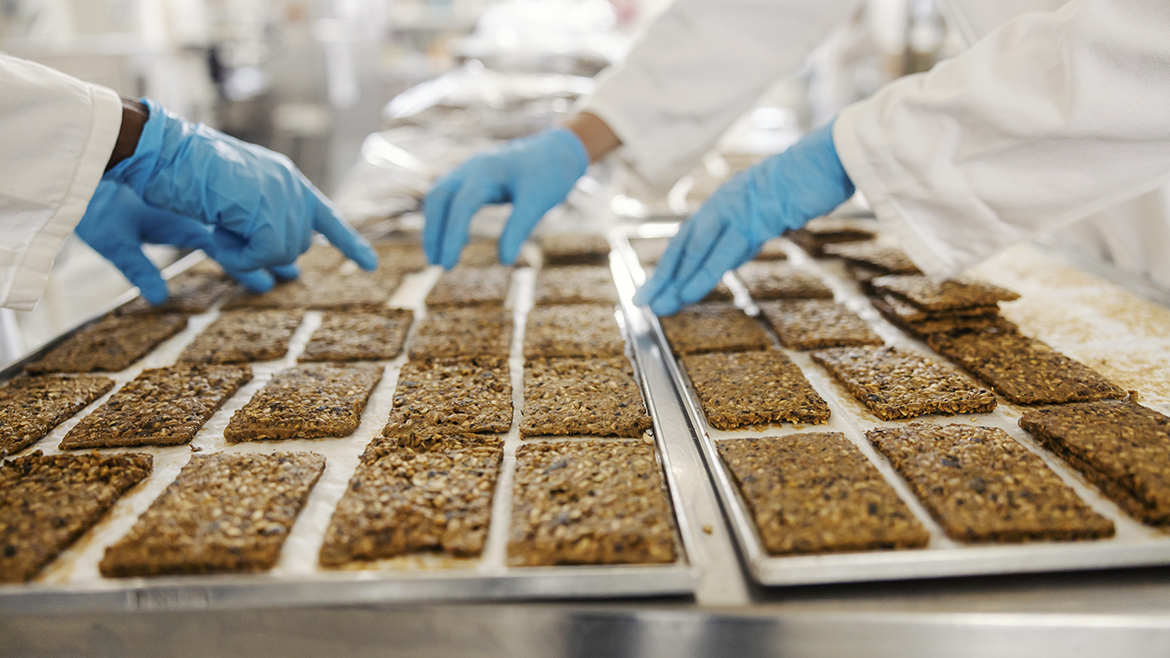
Image credit: dusanpetkovic / iStock / GettyImages
Sustainability
When it comes to sustainability, for many manufacturers the primary concerns are lowering operational costs, improving efficiency and boosting product quality. Areas of focus include water reduction, waste reduction and energy efficiency, FPSA and PMMI research reveals.
Especially for smaller or mid-market manufacturers that don’t have to report annually on ESG goals, sustainability may be more centered around operations and compliance, Pelyhes says.
“Sustainability or environmental (concerns) – it’s going to be compliance-driven,” Pelyhes says. “They’re not going to be mission-focused on that because … delivery to their customers or clients, the brands —that’s existential for them.”
In a recent interview, Christine Daugherty, vice president and chief sustainability officer of Conagra Brands, said sustainability underlies the company’s operations – not only for environmental stewardship but to augment how Conagra Brands delivers product.
Specifically, Daugherty pointed to an assessment of water use across its plant network with the goal of locating production with lower water needs in water-stressed regions. For example, Conagra Brands makes Angie’s BOOMCHIKAPOP popcorn – a low-water process, Daugherty says – at its facility in Reno, Nevada.
“Sustainability is just part of making sure businesses are there for the long term,” Daugherty says. “They're doing right by the environment, by the communities that they work in and it's right as a business proposition. Combining sustainability and business is really how I think about things, and that's what makes this job really exciting.”