Food Engineering logo
search
cart
facebook twitter linkedin youtube
  • Sign In
  • Create Account
  • Sign Out
  • My Account
Food Engineering logo
  • NEWS
    • Latest Headlines
    • Manufacturing News
    • People & Industry News
    • Plant Openings
    • Recalls
    • Regulatory Watch
    • Supplier News
  • PRODUCTS
    • New Plant Products
    • New Retail Products
  • TOPICS
    • Alternative Protein
    • Automation
    • Cannabis
    • Cleaning | Sanitation
    • Fabulous Food Plants
    • Food Safety
    • Maintenance Strategies
    • OEE
    • Packaging
    • Sustainability
    • More
  • EXCLUSIVES
    • Plant Construction Survey
    • Plant of the Year
    • Sustainable Plant of the Year
    • State of Food Manufacturing
    • Top 100 Food & Beverage Companies
  • MEDIA
    • Podcasts
    • Videos
    • Webinars
    • White Papers
  • FOOD MASTER
  • EVENTS
    • Food Automation & Manufacturing Symposium and Expo
    • Industry Events
  • RESOURCES
    • Newsletter
    • Custom Content & Marketing Services
    • FE Store
    • Government Links
    • Industry Associations
    • Market Research
    • Classified Ads
  • EMAGAZINE
    • eMagazine
    • Archive Issue
    • Advertise
  • SIGN UP!
Manufacturing News

TECH FLASH

Federal ethanol mandates mean higher grocery bills for consumers, inferior feed for meat producers

High corn demand has commodity prices up and farmers using distiller’s dried grains as feed.
By Shane O'Halloran
February 13, 2013
Federal ethanol mandates mean higher grocery bills for consumers, inferior feed for meat producers
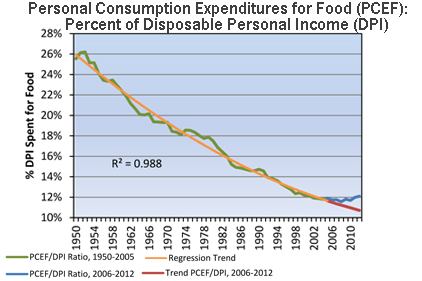
The gap between the 1950-2005 long-term affordability trend and actual food cost is growing. Source: Thomas Elam, FarmEcon

Increasing affordability of goods and services has been a major long-term trend in US economics. But that trend has reversed since 2006, according to Thomas Elam of FarmEcon, leading to decreased spending on consumer goods and services and hindering job growth.

Food prices are increasing compared to those of other goods, and consumers’ food costs are increasing relative to disposable income. As a result, the gap between the 1950-2005 long-term affordability trend and actual food cost is growing. That means consumers are spending more of their money on food than ever before—the last time the gap grew in a similar manner was during the mid-1970s when farm commodity prices boomed on strong grain exports, but even that gap was much smaller than the current one.

What’s to blame for the sea change in food affordability? Elam’s study argues that the trend results from rising raw commodity costs, and in particular corn for use in ethanol production. Unlike what happened in the 1970s, corn and grain exports are actually falling. However, the growing use of corn in ethanol production, even in the face of decreased production, has prices booming.

Demand for corn in ethanol production has been spurred by the 2005 advent of federal mandates for fuel ethanol consumption and the 2007 Energy Independence and Security Act. Corn prices have more than tripled since the mandates came into effect.

Farmers have turned to distiller’s dried grains with solubles (DDGS), a feed by-product of ethanol production, but DDGS is an imperfect substitute for corn as a feed. Nutrition issues include the protein profile (especially for lysine digestibility), fat and phosphorous content. DDGS’s energy value is approximately 17 percent lower than corn’s, which represents the greatest obstacle to its use as feed for poultry.

DDGS’s nutritional content also varies due to conditions including differences in the corn feedstock, processing at the ethanol plant, drying temperatures and the amount of solubles added back into the product. Also, DDGS’s high fiber content means its use as a feed will decrease pig carcass yields, bringing in less income for pig producers. 

Finally, DDGS presents physical handling issues as it tends to clump during storage and transportation. As a result, DDGS is now an export product despite declining corn supplies.

The rise in corn prices also has caused an increase in the price of other major crops as well, from field crops like soybean and wheat to horticultural crops like potatoes, strawberries and processing vegetable crops. These prices have increased relative to their long-term trend far more than food prices have increased relative to their long-term trend.

Because the chain of production for items using these crops is so long, price increases don’t show up at the market right away. In fact, minor fluctuations rarely register at all. But with sustained increases since 2005, consumers are finally starting to bear the burden of higher commodity prices.

According to the study, that burden amounts to $514 over trend price, or $2,055 for a family of four. The dollar-above trend 2012 food bill in the US was $162 billion. The increase in spending is roughly equivalent to annual consumer spending on auto repairs, college education or telecommunications. With 2013 prices predicted to remain high, another large food bill increase this year is likely.

Of the $162 billion above-trend food cost increase in 2012, about $71.3, or 44 percent, is due to the 2005-2012 price increases on grains, soybean products, DDGS and hay.

Of course, the most obvious impact of this staggering increase has been Americans diverting larger portions of their income to food costs. But another, less obvious, impact has been in rapidly increasing farmland prices. As the price of crop farmers’ goods are driven up by increases in grain prices, profits increase as well. With increased profitability comes increased land prices—from 2005-2012, the value of land owned by US farmers increased by over $700 billion. During that same period, farm debt increased by only about $16 billion, a sure sign that windfall profits drove land prices up.

KEYWORDS: animal welfare farms global markets

Share This Story

Looking for a reprint of this article?
From high-res PDFs to custom plaques, order your copy today!
Recommended Content

JOIN TODAY
to unlock your recommendations.

Already have an account? Sign In

  • 2025 Top 100 Food and Beverage Companies

    FOOD ENGINEERING’s 2025 Top 100 Food and Beverage Companies

    While sales were largely down under dynamic economic and...
    Top 100 Food & Beverage Companies
    By: Alyse Thompson-Richards
  • Bottling machine

    How Optical and X-Ray Inspection Supports Bottling Safety and Quality

    By transitioning from legacy single-technology systems to...
    Food Safety
    By: Dan McKee
  • Bread baking in oven

    The State of Food Manufacturing in 2025

    Food and beverage manufacturers are investing in...
    State of Food Manufacturing
    By: Alyse Thompson-Richards
Manage My Account
  • eMagazine
  • Newsletter
  • Online Registration
  • Manage My Preferences
  • Customer Service

More Videos

Popular Stories

The Campbell's Company logo

Campbell’s Terminates Exec Over Alleged Disparaging Comments

alternative protein products

Alternative Protein in 2025: Key Trends and Technologies

circular packaging material for frozen and chilled food packaging

Sustainable Barrier Coatings Replace PFAS, PE and other Plasticized Materials in Packaging

State of Maufacturing 2025

Events

June 17, 2025

Refrigerated & Frozen Foods’ State of the Cold Chain

On Demand Kelley Rodriguez, Editor in Chief of Refrigerated & Frozen Foods, will be joined in this 60-minute webinar by industry experts to help unpack the latest research.

July 23, 2025

Decarbonizing Process Heat: What You Should Know and Next Steps

On Demand Driven by climate goals, business risk, client interest, and resilience considerations, food and beverage companies are increasingly turning their attention to decarbonizing their production processes.

View All Submit An Event

Products

Recent Advances in Ready-to-Eat Food Technology

Recent Advances in Ready-to-Eat Food Technology

See More Products

CHECK OUT OUR NEW ESSENTIAL TOPICS

Alternative ProteinAutomationCleaning/SanitationFabulous Food Plants

Food SafetyMaintenance StrategiesOEE

PackagingSustainability

Related Articles

  • Sequester could cause billions of dollars in losses for meat producers

    See More
  • Price less important for meat consumers

    See More
  • Grocery bills to jump in 2013

    See More

Related Products

See More Products
  • statical.jpg

    Statistical Process Control for the Food Industry: A Guide for Practitioners and Managers

  • Functionalizing Carbohydrates for Food Applications

  • GlobalData_logo_blue_header.png

    USA: Food & Grocery - Market Shares, Summary & Forecasts to 2023

See More Products

Events

View AllSubmit An Event
  • June 19, 2018

    Total Cost of Quality: Uncovering hidden opportunities for food and beverage producers

    ON DEMAND: 58% of food producers worldwide have been affected by a recall in the last five years. Do you know how much you’re spending on food safety and quality? From appraisals and prevention to managing production failures and product returns, the costs can add up quickly – and often aren’t measured. Poor product quality and safety issues impact not just the bottom line but also a brand’s reputation with retailers and consumers.
View AllSubmit An Event
×

Elevate your expertise in food engineering with unparalleled insights and connections.

Get the latest industry updates tailored your way.

JOIN TODAY!
  • RESOURCES
    • Advertise
    • Contact Us
    • Food Master
    • Store
    • Want More
  • SIGN UP TODAY
    • Create Account
    • eMagazine
    • Newsletter
    • Customer Service
    • Manage Preferences
  • SERVICES
    • Marketing Services
    • Reprints
    • Market Research
    • List Rental
    • Survey/Respondent Access
  • STAY CONNECTED
    • LinkedIn
    • Facebook
    • YouTube
    • X (Twitter)
  • PRIVACY
    • PRIVACY POLICY
    • TERMS & CONDITIONS
    • DO NOT SELL MY PERSONAL INFORMATION
    • PRIVACY REQUEST
    • ACCESSIBILITY

Copyright ©2025. All Rights Reserved BNP Media.

Design, CMS, Hosting & Web Development :: ePublishing