Food Engineering logo
search
cart
facebook twitter linkedin youtube
  • Sign In
  • Create Account
  • Sign Out
  • My Account
Food Engineering logo
  • NEWS
    • Latest Headlines
    • Manufacturing News
    • People & Industry News
    • Plant Openings
    • Recalls
    • Regulatory Watch
    • Supplier News
  • PRODUCTS
    • New Plant Products
    • New Retail Products
  • TOPICS
    • Alternative Protein
    • Automation
    • Cannabis
    • Cleaning | Sanitation
    • Fabulous Food Plants
    • Food Safety
    • Maintenance Strategies
    • OEE
    • Packaging
    • Sustainability
    • More
  • EXCLUSIVES
    • Plant Construction Survey
    • Plant of the Year
    • Sustainable Plant of the Year
    • State of Food Manufacturing
    • Top 100 Food & Beverage Companies
  • MEDIA
    • Podcasts
    • Videos
    • Webinars
    • White Papers
  • FOOD MASTER
  • EVENTS
    • Food Automation & Manufacturing Symposium and Expo
    • Industry Events
  • RESOURCES
    • Newsletter
    • Custom Content & Marketing Services
    • FE Store
    • Government Links
    • Industry Associations
    • Market Research
    • Classified Ads
  • EMAGAZINE
    • eMagazine
    • Archive Issue
    • Advertise
  • SIGN UP!
Manufacturing News

TECH FLASH

Stable growth and demand patterns reveal room for cost optimization

Stabilizing patterns allow manufacturers to focus on productivity improvement for margin growth.
By Shane O'Halloran
March 26, 2013

Stable growth and demand patterns reveal room for cost optimization

Are your company’s cost performance goals in line with those of the rest of the industry? A new cost optimization study by the Hackett Group maps typical cost optimization goals and identifies top strategies to achieve them. Hackett’s targets include all components of the cost of goods sold (COGS), including labor, manufacturing overhead and material, and take into account both prior and expected future results.

Hackett says companies should plan for continued growth in 2013, and stabilized global growth and demand patterns will allow manufacturers to focus on productivity improvement for margin growth. Revenue increased by an average of 1.6 percent in 2011 and 3.9 percent in 2012, and is predicted to increase by an additional 4.3 percent in 2013. Companies are taking advantage of this stability by sourcing more strategically, using assets more effectively and managing operations for greater efficiency.

In the US, growth has been stronger in manufacturing than other industries, due in part to favorable energy costs in the US relative to other markets. However, capacity utilization in the US remains well below recent highs. Hackett’s data shows only 31.5 percent of firms operated at or above 85 percent capacity in December 2012, compared to the 43.3 percent recorded in September 2011. That gap suggests many companies could support immediate growth with existing capacity before needing to make major investments in new capacity.

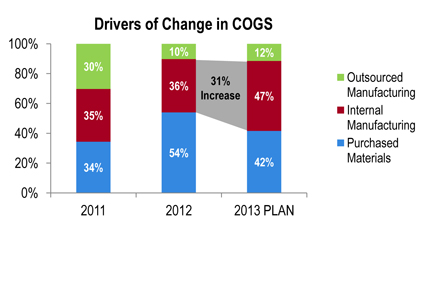
Margin growth in 2012 was far less reliant on outsourcing than it was in 2011, when 30 percent of COGS improvements were realized through outsourced manufacturing. The study expects the trend away from outsourcing to continue, as major companies have already outsourced many of the activities that can be effectively managed by third parties. On-shore and near-shore have become more attractive as stable demand reduces the need for the flexibility companies sought by outsourcing.

Companies will also seek to reduce total materials cost in 2013, continuing a trend that saw a nearly 1 percent reduction in 2012. However, 77 percent of the forecasted drop in material costs is due only to price savings from lower commodity costs or better sourcing. The remaining 22 percent of the decline in material costs came due to techniques like managing product specifications and designs to reduce material requirements, optimizing product mix to manage costs and using value engineering to extract additional savings.

In addition to reducing total material costs, companies were able to reduce internal manufacturing costs by 1.8 percent in 2012. According to Hackett, survey respondents plan an additional 1.7 percent cut in 2013, with productivity improvements continuing to represent the largest share of manufacturing cost improvements. Internal operations efficiency has benefited from aggressive plant management to remove underperforming plants, integrated business planning for more efficient resource allocation, targeted manufacturing investment of equipment and systems and the continued use of lean manufacturing techniques.

Declining energy costs and stabilized demand contributed to cost reduction in logistics and warehousing costs, leading companies to optimize distribution networks and spend to lock in logistics savings in the future. Sourcing improvements and low fuel costs also contributed to 2012’s logistics savings, and Hackett expects that trend to continue.

KEYWORDS: Total Cost of Ownership

Share This Story

Looking for a reprint of this article?
From high-res PDFs to custom plaques, order your copy today!
Recommended Content

JOIN TODAY
to unlock your recommendations.

Already have an account? Sign In

  • 2025 Top 100 Food and Beverage Companies

    FOOD ENGINEERING’s 2025 Top 100 Food and Beverage Companies

    While sales were largely down under dynamic economic and...
    Top 100 Food & Beverage Companies
    By: Alyse Thompson-Richards
  • Bottling machine

    How Optical and X-Ray Inspection Supports Bottling Safety and Quality

    By transitioning from legacy single-technology systems to...
    Food Safety
    By: Dan McKee
  • Bread baking in oven

    The State of Food Manufacturing in 2025

    Food and beverage manufacturers are investing in...
    State of Food Manufacturing
    By: Alyse Thompson-Richards
Manage My Account
  • eMagazine
  • Newsletter
  • Online Registration
  • Manage My Preferences
  • Customer Service

More Videos

Popular Stories

The Campbell's Company logo

Campbell’s Terminates Exec Over Alleged Disparaging Comments

Frito-Lay logo

PepsiCo to Close Two Florida Facilities

alternative protein products

Alternative Protein in 2025: Key Trends and Technologies

State of Maufacturing 2025

Events

June 17, 2025

Refrigerated & Frozen Foods’ State of the Cold Chain

On Demand Kelley Rodriguez, Editor in Chief of Refrigerated & Frozen Foods, will be joined in this 60-minute webinar by industry experts to help unpack the latest research.

July 23, 2025

Decarbonizing Process Heat: What You Should Know and Next Steps

On Demand Driven by climate goals, business risk, client interest, and resilience considerations, food and beverage companies are increasingly turning their attention to decarbonizing their production processes.

View All Submit An Event

Products

Recent Advances in Ready-to-Eat Food Technology

Recent Advances in Ready-to-Eat Food Technology

See More Products

CHECK OUT OUR NEW ESSENTIAL TOPICS

Alternative ProteinAutomationCleaning/SanitationFabulous Food Plants

Food SafetyMaintenance StrategiesOEE

PackagingSustainability

Related Articles

  • Weak but stable growth predicted for R&D

    See More
  • Steakholder_Foods_Ltd_logo_900x550.jpg

    Steakholder Foods Announces Cost Reduction in Growth Media for Bovine Cell Cultivation

    See More
  • Orange slice close up

    Rising Demand for Natural Products Fuels Growth in Fruit Pulp and Puree Markets

    See More

Related Products

See More Products
  • statical.jpg

    Statistical Process Control for the Food Industry: A Guide for Practitioners and Managers

  • Functionalizing Carbohydrates for Food Applications

  • The-Food-Business-Toolkit-Cover.jpg

    The Food Business Toolkit for Entrepreneurs (ebook)

See More Products

Events

View AllSubmit An Event
  • June 19, 2018

    Total Cost of Quality: Uncovering hidden opportunities for food and beverage producers

    ON DEMAND: 58% of food producers worldwide have been affected by a recall in the last five years. Do you know how much you’re spending on food safety and quality? From appraisals and prevention to managing production failures and product returns, the costs can add up quickly – and often aren’t measured. Poor product quality and safety issues impact not just the bottom line but also a brand’s reputation with retailers and consumers.
View AllSubmit An Event
×

Elevate your expertise in food engineering with unparalleled insights and connections.

Get the latest industry updates tailored your way.

JOIN TODAY!
  • RESOURCES
    • Advertise
    • Contact Us
    • Food Master
    • Store
    • Want More
  • SIGN UP TODAY
    • Create Account
    • eMagazine
    • Newsletter
    • Customer Service
    • Manage Preferences
  • SERVICES
    • Marketing Services
    • Reprints
    • Market Research
    • List Rental
    • Survey/Respondent Access
  • STAY CONNECTED
    • LinkedIn
    • Facebook
    • YouTube
    • X (Twitter)
  • PRIVACY
    • PRIVACY POLICY
    • TERMS & CONDITIONS
    • DO NOT SELL MY PERSONAL INFORMATION
    • PRIVACY REQUEST
    • ACCESSIBILITY

Copyright ©2025. All Rights Reserved BNP Media.

Design, CMS, Hosting & Web Development :: ePublishing