How Centrifuge Technology Supports Plant Protein Processing
As global food systems shift toward more sustainable and ethical alternatives, plant-based proteins are no longer fringe products — they’re front and center in the race to feed a growing population. With global numbers expected to swell from 7.6 billion today to over 11 billion by 2100, the urgency to find scalable, environmentally friendly protein sources has never been greater.
The plant protein sector has surged as a result, propelled by a perfect storm of consumer demand, technological innovation and mounting environmental pressures. But as this new protein economy expands, so do the challenges — especially when it comes to efficient, high-quality protein extraction.
That’s where centrifuge separation becomes an ideal solution in helping producers scale sustainably and profitably.
Meeting the Demands of a Booming Market
The demand for plant proteins is multifaceted. It spans health-conscious consumers, vegan and flexitarian lifestyles, and even industrial needs such as biodegradable packaging and cosmetics. But all this potential comes with a caveat: protein quality matters.
Not all plant proteins are created equal, and their commercial viability hinges on three things — purity, yield and functionality. Achieving the right balance between these parameters requires not only deep process know-how but also world-class equipment.
Centrifuge separation technology provides fully integrated, turnkey solutions that address the full spectrum of challenges in protein processing — including oil crops like soy and lupine or starch crops such as peas, beans, and lentils.
A Sustainable Shift: The Case for Wet Fractionation
Wet fractionation is at the heart of this solution. It’s a method that allows processors to extract protein, fiber and starch from plant meals in an efficient, hygienic and scalable way.
Depending on the raw material, the process yields two to three valuable product streams:
- Proteins with high emulsifying, foaming or gelling properties
- Fibers with water-holding capacity and clean flavor
- Starch suitable for food and industrial uses
Compared to animal proteins, this method reduces water use, land requirements and carbon emissions. Biodiversity is also preserved through crop diversity, such as the increased use of flowering legumes such as peas and lupines.
For this industry, one size does not fit all. Instead, engineers configure each system according to the unique demands of the raw material and desired outputs.
For Starch Crops
The extraction process separates soluble proteins from insoluble starch and fiber. The starch-fiber mixture is further refined using centrifugal screens for fractionation of starch and fibers, if required. Starch may be further refined (washed) via hydrocyclones with the mechanical dewatering of fibers before drying via the belt press. The protein fraction is treated through acid precipitation and neutralization, then dried or further processed depending on the end use.
Typical results:
- Protein purity up to 85%
- Yield of up to 75%
- Starch and fiber recovery rates at 95%
Equipment in Action
Behind every high-performance plant protein process is a network of engineered machines, each designed to handle a specific step with precision. At the core of these systems are separation technologies that transform plant meals into product streams such as protein isolates, dietary fibers and starches — all while preserving quality and minimizing waste.
Decanter Centrifuges: The Heart of Separation
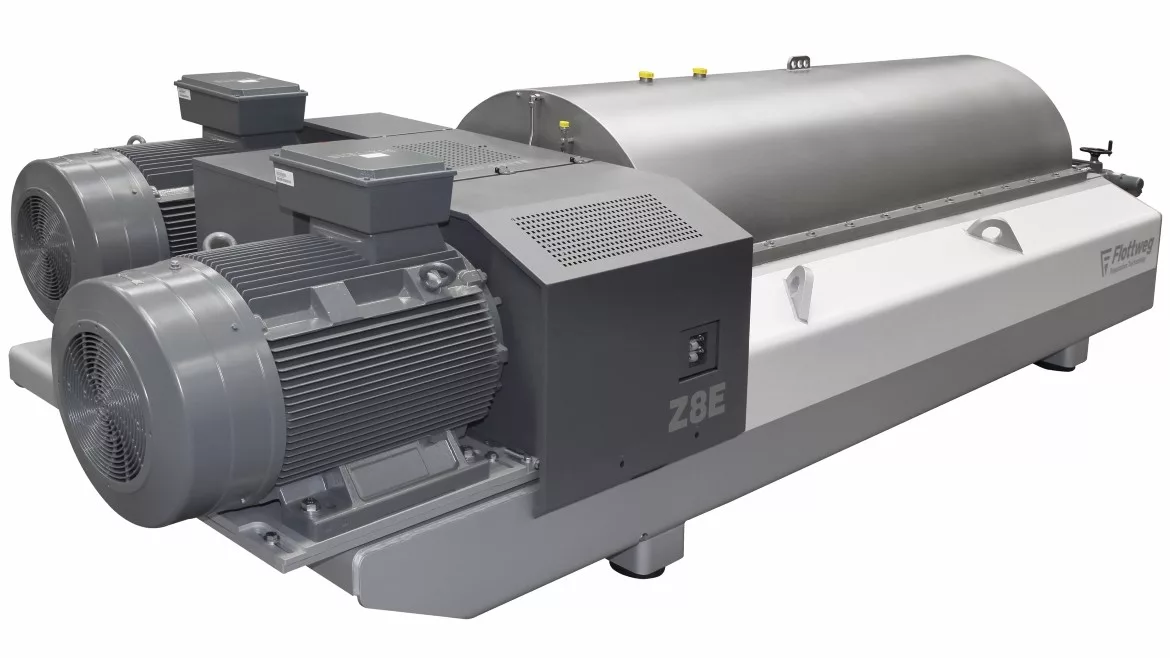
Decanter centrifuges are workhorses in both the extraction and coagulation stages of protein processing. Their primary role is to continuously separate solids and liquids under high centrifugal forces. In protein extraction, they help isolate the soluble protein fraction from the insoluble fiber and starch. In the subsequent coagulation stage, they remove the newly precipitated proteins from the liquid phase.
 Flottweg
What sets these machines apart is their ability to operate under variable conditions. The adjustable impeller system allows real-time control of the pond depth (the interface between heavy and light phases), which is essential for consistent performance when feedstock characteristics vary. This precision ensures better separation efficiency and less product loss.
 Flottweg
The SIMP-Drive system — a specialized torque-sensitive drive mechanism — further enhances performance by controlling the differential speed between the decanter’s bowl and scroll. This affects the residence time of solids inside the machine, allowing operators to optimize moisture content in the discharged solids and reduce energy consumption during drying.
These centrifuges also play a key role in starch separation. After proteins are removed, the remaining starch-fiber slurry is processed using centrifugal sieves or hydrocyclones to isolate starch granules. Mechanical dewatering — either with decanters or peeling centrifuges — reduces the energy load of subsequent drying stages, making the overall process more efficient and sustainable.
Sedicanter: Precision for Fine Proteins
Plant protein manufacturing is the ultimate challenge for centrifuges and manufacturing technology in general. The functionalities and separation behavior are highly complex and affected by many different process parameters. Even if just one of these parameters along the whole value chain is running out of limits, the performance and/or properties easily run out of specifications.
For processes that require the recovery of fine, delicate protein particles, the Sedicanter offers a tailored solution. It operates at higher g-forces than conventional decanters, reaching up to 10,000 g, which enables it to separate ultra-fine particles with exceptional clarity.
This makes it especially valuable for applications where protein functionality — such as solubility, foaming, or emulsification — is critical. The Sedicanter excels in preserving the structural integrity of these proteins, thanks to its gentle yet highly effective dewatering performance. Its hygienic design and closed system also make it well-suited for food-grade and oxidation-sensitive applications.
In many cases, the Sedicanter is used to complement earlier decanter stages, targeting fractions that are otherwise too fine or fragile to be separated effectively. This layered approach enables processors to capture more value from each batch while maintaining strict quality standards.
 Flottweg
Belt Presses: Efficient Fiber Dewatering
In fiber recovery, water removal is often the costliest part of the process due to the energy demands of thermal drying. Mechanical dewatering via belt presses offers a practical and sustainable alternative. These systems apply alternating pressure and shear forces across woven filter belts to extract moisture from fibrous material — such as pea or fava bean pulp — prior to drying.
Modern belt presses are designed for continuous operation and can be integrated into automated cleaning systems (CIP), reducing downtime and ensuring compliance with strict hygienic standards. The result is a drier fiber cake that reduces the thermal load in the next step and lowers overall operational costs. This not only enhances processing efficiency but also supports circular economy goals by valorizing byproducts with reduced environmental impact.
Hygienic Design and CIP Integration: Ensuring Product Safety and Efficiency
Sanitation is paramount in plant protein processing, where residue buildup or cross-contamination can affect both safety and product functionality. It is even more critical for sensory reasons because proteins can quickly produce an unpleasant smell. Equipment used throughout the process — especially in protein isolation and fiber handling — is engineered with hygienic principles in mind.
Features include polished stainless-steel surfaces, FDA-compliant seals, sanitary welds and CIP nozzles in critical areas. Automated flushing and scroll rinsing minimize the need for manual cleaning while reducing water usage. These design choices ensure systems meet global food safety standards and can adapt to multi-product environments where fast changeovers are required.
Automation and Control: Precision at Every Step
Advanced automation is what ties all this technology together. Through programmable logic controllers (PLCs), operators can fine-tune parameters such as impeller depth, bowl speed, torque and feed rate in real time. Automation also enables rapid adaptation to fluctuations in raw material quality — common in seasonal or multi-source operations — while maintaining consistent output quality.
These systems also provide detailed data logging for traceability, integration with plant-wide monitoring systems, and compatibility with automated CIP cycles. By reducing manual intervention, automation enhances reliability, safety and repeatability — all essential in a competitive and quality-driven market.
 Flottweg
Engineering Considerations for Scalable, Hygienic Processing
Effective plant protein extraction doesn’t begin or end with a single machine. It requires a system-wide approach, from initial material testing to full-scale process design, that accounts for raw material variability, hygienic requirements and energy optimization.
Pilot testing and lab-scale analysis help establish key parameters like protein solubility (NSI), particle size distribution and anti-nutritional factors (ANFs). These early insights guide process development and equipment configuration to suit specific crop types and product goals — whether the target is protein isolate, concentrate, fiber or starch.
From there, engineering teams develop modular system layouts that incorporate everything from extraction and separation to dewatering, cleaning and automation. Clean-in-place (CIP) design and process automation are often integrated to meet hygienic standards and minimize manual intervention, especially in food-grade facilities. The ability to scale — from pilot lines to full production capacity — ensures flexibility as market demand evolves.
Meeting Global Standards Through Design and Deployment
Across the globe, food manufacturers are modernizing protein extraction lines to meet increasingly strict regulatory and sustainability standards. Equipment design must accommodate not only performance requirements, but also sanitary specifications and traceability demands.
That’s why plant protein systems typically rely on materials such as polished stainless steel for product-contact surfaces and use hygienically welded components that can withstand frequent cleaning cycles. Integration with FDA-compliant seals, automated flushing systems, and robust mechanical designs ensures longevity and compliance in continuous or multi-shift operations.
Installations vary widely — from regional facilities producing for local markets to large-scale international processors supplying global food brands — but the engineering principles remain consistent: precision, hygiene and adaptability.
Meeting the Plant Protein Challenge with Smart Processing
The rapid growth of the plant-based protein market reflects a larger, global shift in how we think about food, sustainability and resource use. Whether driven by population growth, dietary trends, or environmental imperatives, one thing is clear: the need for alternative proteins is not just a trend — it’s a structural transformation in the global food supply chain.
Yet this transformation brings significant technical and economic challenges. Not all plant proteins are easily extractable, and not all are functionally useful in food formulations. To be commercially viable, plant proteins must meet high standards for purity, yield and functionality — factors that are heavily influenced by the extraction method and process design.
That’s where separation technology plays a pivotal role. Efficient, hygienic and scalable wet fractionation processes allow producers to recover valuable proteins, starches and fibers from a range of raw materials. By optimizing these processes — minimizing energy use, reducing water consumption and improving product quality — manufacturers can help ensure that plant proteins become a cornerstone of future food systems.
The ultimate challenge is one of balance: meeting surging global demand without compromising product quality or sustainability. The right combination of process knowledge, equipment design and engineering support can help bridge this gap — transforming raw plant material into high-value ingredients for food, feed and beyond.
As industry continues to evolve, investing in smarter, more adaptable protein processing systems isn’t just good business — it’s essential for building a food future that is both nutritious and sustainable.
Looking for a reprint of this article?
From high-res PDFs to custom plaques, order your copy today!