Processing Room Sanitation: Understanding the Importance of Hygienic Air
Reliable and efficient processing room sanitation is the backbone of quality food production. Without the proper equipment in place, processing rooms can easily become susceptible to contamination requiring longer and more frequent wash-down intervals.
Maintaining superior food safety requires precise and consistent control of temperature, air filtration, air distribution and room pressurization. Many food manufacturers rely on ceiling-hung evaporators to maintain healthy processing room conditions after wash-downs. However, these systems are often limited to producing a recirculated stream of cold air. As a result, plant personnel are unable to control the humidity, airflow and filtration within the space – factors that can leave processing rooms susceptible to microbial growth and the spread of pathogens.
To establish a truly sanitary environment, food engineers must rethink the importance of hygienic air and its impact on both food products and the teams who manage these processes.
Risks from the Status Quo
It is recognized that temperature regulation after wash cycles is a critical component to maintaining a safe processing environment. However, managing humidity from temperature instabilities is also essential. Evaporators blast cold air to balance the inrush of heat produced during wash-down intervals, but this process provides little to no control over the direction of the airflow. As airborne water vapors settle, condensation can form — creating an environment for microbial activation and migration. In parallel, any contaminants within the room can easily become disrupted during the wash-down process. Without proper air filtration and room pressurization, these transient microbes are recirculated within the space and given access to migrate throughout the facility. Similarly, airborne particles can also enter the processing room from adjacent dirty rooms if each space is not adequately pressurized.
Air quality within the processing room also impacts the health and well-being of employees. Low-positioned ceiling-hung evaporators may blow cold air directly into employee workspaces, creating an environment that can be uncomfortable. Staff are also subject to poor indoor air quality (IAQ) from recirculated airflow that can potentially be contaminated with microbes and pathogens.
With traditional in-room cooling designs, it may seem nearly impossible to control air, but with the right equipment, processing rooms can be transformed into high-performing, healthy environments that support public and employee safety while preserving food quality.
Enhance Safety with Hygienic Air Systems
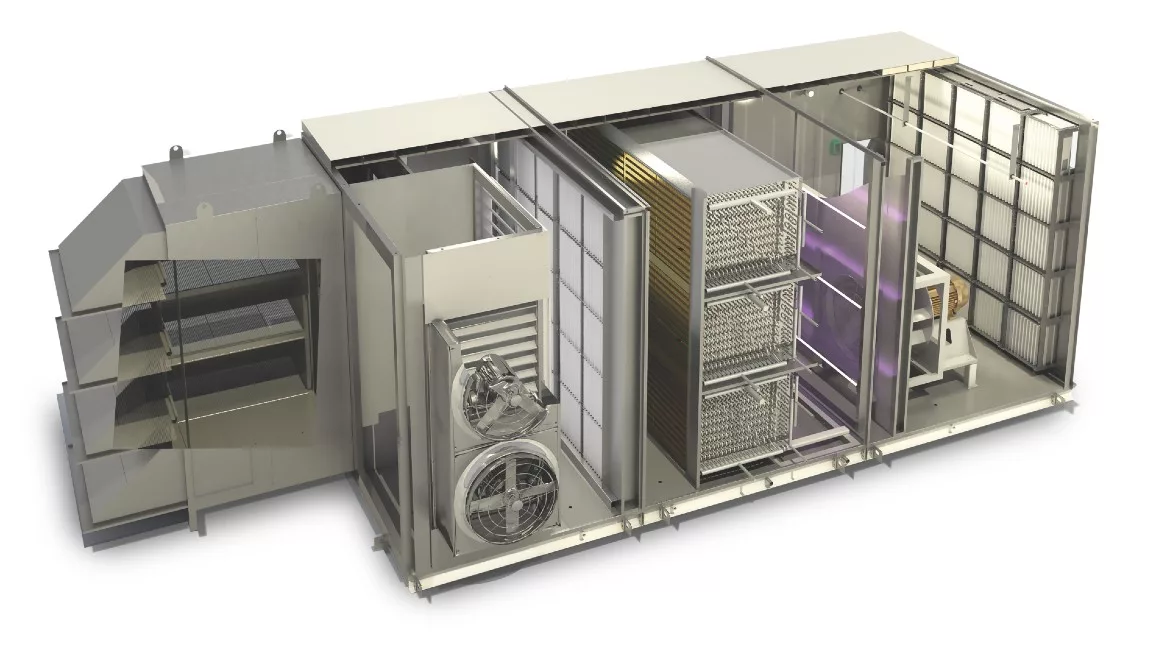
Hygienic air systems provide food engineers with a customizable solution to manage processing room sanitation. These purpose-built systems are engineered to meet the unique moisture and heat requirements of each processing room as it continuously flushes the space with dry, clean air and exhausts moisture and airborne contaminates.
During operation, fresh outside air is drawn into the hygienic air system and immediately conditioned to ensure fresh, clean air is introduced into the space. Filtration features a combination of either HEPA- or MERV-rated filters that can pair with ultraviolet lighting to sanitize airflow and support healthy IAQ for employees. The filtered air replaces any air that naturally escapes the process room to provide positive pressurization within the space to prevent cross-contamination from less hygienic rooms.
Hygienic air systems also provide humidity control by modulating between cooling and re-heat features that are designed to match the specific requirements of the space. Relative humidity levels are programmed within the system based on ideal processing conditions for each product, such as dairy or bread. Additionally, the system can automate operating levels in response to ambient conditions.
The equipment also manages air velocity to help ensure maximum coverage throughout the room and eliminate “dead spots” that may go untreated. Using a multi-directional stream, air sweeps across the ceiling to quickly dry surfaces and eliminate suspended condensation. This process also creates a more hospitable work environment for employees because air is not directly blown onto workstations.
Designing Processing Rooms for Maximum Uptime and Quality
Hygienic air systems are engineered to be roof-mounted outside of the building. This not only frees up space within the processing room; it also eliminates the need to sanitize the equipment itself. Each processing room must be equipped with a dedicated unit. This prevents cross-contamination and allows the transition from ceiling-hung evaporators to be scaled over time, if desired. Size, air volume, functionality and configuration of the equipment are determined by each processing room’s unique requirements. For example, ready-to-eat (RTE) products may need enhanced filtration, whereas meat processing often requires stringent temperature control.
Like most building equipment, hygienic air system operation is maximized when integrated within a complete building automation system (BAS). Features such as real-time humidity sensing, automated reheat and economizer mode control can be enabled through the BAS to further optimize performance.
Sanitation is a necessary function within the processing room, but outdated practices reliant on ceiling-hung evaporators can create an environment that is susceptible to contamination. These high-risk conditions not only threaten public and employee health and well-being – they can also result in longer, more frequent wash cycles than are necessary. Specifying purpose-built hygienic air systems can alleviate these concerns by improving air distribution while delivering precise temperature and humidity control to enable faster dry times, maximized uptime and a longer-lasting clean environment
Looking for a reprint of this article?
From high-res PDFs to custom plaques, order your copy today!