How to Select the Right Pump for Food and Beverage Processing Environments
There’s no shortage of pump technologies on the market, but processors know that getting top performance requires making the right match between pump technology and the application in their plant.
Pump selection stands out as a critical determinant of product quality, operational efficiency and food safety outcomes. For process engineers specifying equipment for diverse food products — from low-viscosity beverages to meat and poultry pieces — understanding the operational advantages and limitations of each pump technology proves essential.
Highly regulated food processing environments demand equipment that preserves delicate product structures, accommodates variable viscosities, resists contamination and integrates with automated cleaning protocols. When engineers align pump technology with specific product characteristics and processing requirements, they establish a foundation for consistent production and reduced total cost of ownership.
Fundamental Operating Principles
Food processing pumps operate through two distinct mechanical approaches. Centrifugal technology generates flow by imparting velocity through a rotating impeller, creating flow rates that vary inversely with system backpressure. While centrifugal pumps excel with low-viscosity fluids, their performance degrades substantially as fluid viscosity increases or when entrained air enters the system.
Positive displacement (PD) technology moves fluid by mechanically capturing and transporting fixed volumes with each cycle. Flow rates remain directly proportional to pump speed, independent of discharge pressure within design limits. This consistency proves particularly valuable when processing viscous products, handling solids or maintaining precise flow control.
Proper pump selection begins with understanding how the dynamics of each food type affects pump performance.
Product-Specific Technology Selection
Dairy Processing Applications
Dairy products typically range in viscosity from fluid milk at 2 centipoise to Greek yogurt at 21,000 centipoise. PD lobe pumps emerge as the workhorse of dairy processing due to their gentle handling and predictable flow delivery. The non-contact rotor design minimizes shear forces that could disrupt fat globules or protein structures.
Key applications for lobe pumps in dairy processing include:
- Yogurt with fruit preparations where particulate integrity must be maintained
- Cottage cheese with intact curds requiring gentle transport
- Cream cheese and soft cheese products sensitive to texture degradation
- Flavored milk products with inclusions or stabilizers
For high-pressure applications such as membrane filtration or ultra-high temperature processing, gear pumps deliver the required volumetric efficiency. Their tight internal clearances enable consistent performance at pressures exceeding 150 psi while handling butterfat, cream and concentrated dairy ingredients.
Beverage and Liquid Food Products
For juice concentrates, flavor syrups and liquid sweeteners, screw pumps provide exceptional value. Their continuous axial flow pattern eliminates pulsation while imparting minimal shear stress. This proves critical when handling heat-sensitive flavoring compounds or products where viscosity varies with concentration. The technology's high tolerance for entrained air prevents foam generation during tank transfers.
When processing beverages containing soft fruit pieces or pulp, air-operated double diaphragm (AODD) pumps offer distinct advantages. The sealed diaphragm design provides self-priming and accommodates suspended solids. Variable flow control through air pressure adjustment allows operators to match pump performance to batch-to-batch viscosity variations.
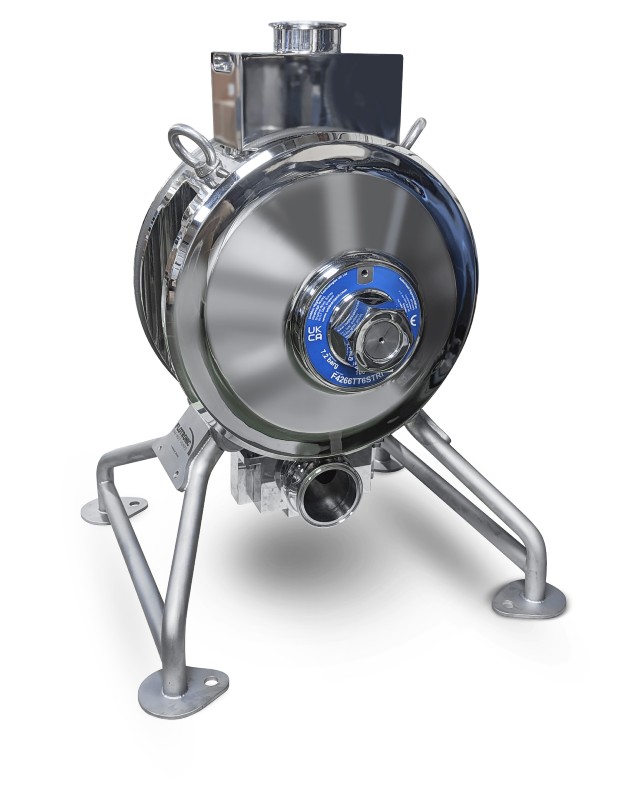
AODD pumps such as the Flotronic AODD+ unit are known for transferring a range of viscous fluids efficiently and with accurate flow control. Image courtesy of Unibloc Hygienic Technologies.
Sauce, Dressing and Condiment Manufacturing
Particulate-laden products such as salsa, pasta sauce, chunky dressings and frozen meals require equipment designed to gently transport solids. Lobe pumps maintain the integrity of products containing discrete items such as diced tomatoes, herb pieces, vegetable chunks, meat and poultry pieces. The clearances between rotors and housing accommodate particles up to 40 mm, depending on pump size.
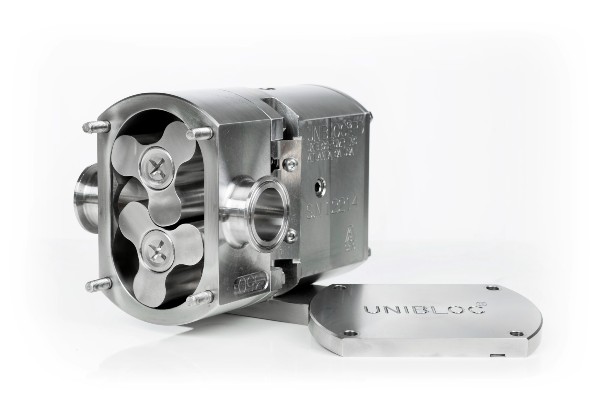
Lobe pumps impart little shear to maintain product integrity, even at high flow rates. Shown here is a Unibloc QuickStrip pump that contains design features that cut maintenance times. Image courtesy of Unibloc Hygienic Technologies.
Extremely High Viscosity Products
For products with very high viscosities such as mayonnaise or thick dressings exceeding 50,000 centipoise, screw pumps deliver consistent performance. Their design generates a smooth, continuous flow without pulsation, which can separate emulsions. Low internal velocities preserve shear-sensitive ingredients including eggs, stabilizers and emulsifying agents.
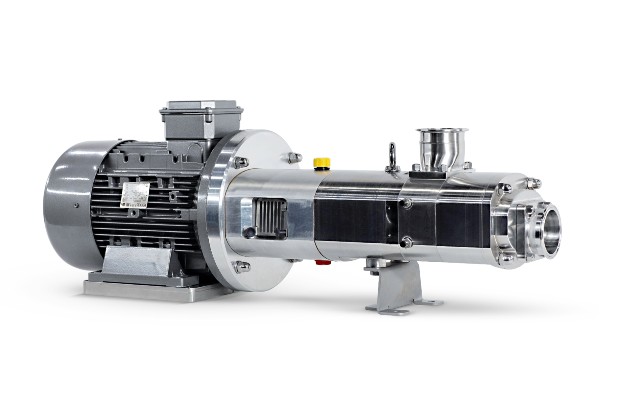
Screw pumps deliver smooth, nearly pulsation-free flow for high-viscosity products, even for long pipe runs. Shown here is a Unibloc Twin Screw pump. Image courtesy of Unibloc Hygienic Technologies.
Maintenance, Accessibility and Cost Implications
Equipment reliability extends beyond mean time between failures. The speed and skill level required for cleaning, inspection and component replacement directly impact production scheduling and labor costs.
Pump manufacturers today have worked to reduce part counts and simplify pump maintenance and sanitation cycles with a variety of design improvements. A variety of design improvements have led to improved pump reliability and sanitation simplicity, such as:
- Front-loading mechanical seal designs allow seal inspection without disconnecting piping or removing the pump from the process line
- Reduced part counts simplify inventory management and minimize components that could fail
- Tool-free disassembly enables faster maintenance cycles with less specialized training required
CIP and COP Effectiveness
Sanitation protocol compatibility is an essential requirement in food processing. Clean-in-place (CIP) system success depends on achieving turbulent flow throughout all wetted surfaces. The internal geometry of the pump significantly affects this outcome.
Critical design elements for effective CIP include:
- Smooth cavities without dead legs, crevices or pockets where product can accumulate
- Polished surfaces that resist bacterial adhesion and facilitate cleaning solution contact
- Minimal gasket intersections that reduce potential contamination points
- Isolated bearing assemblies that prevent lubricant contamination of product zones
- Fully drainable chambers that eliminate standing product after production cycles
Lobe and gear pumps with hygienic design elements with polished surfaces, minimal gasket intersections and isolated bearing assemblies integrate effectively with automated CIP sequences. Their simple internal geometry allows validation of cleaning effectiveness through routine verification procedures.
When manual clean-out-of-place (COP) becomes necessary, ease of disassembly becomes paramount. Designs require only minutes for complete teardown, reduce labor cost and production interruption. Pumps with tool-free disassembly capability and reduced component counts simplify both cleaning and subsequent reassembly. Without the need for tools, there is less chance of scratching, denting and deforming interior pump surfaces, which not only extends pump life but also minimizes crevices that can harbor bacteria. Tool use during cleaning and maintenance is the most common source of pump damage.
Performance Characteristics Under Operating Stress
Real-world processing conditions rarely match ideal design specifications. Centrifugal pumps show pronounced sensitivity to operational variables. Impeller designs optimized for specific duty points experience rapid efficiency degradation when operating conditions shift. Cavitation risks increase when inlet conditions change, potentially causing mechanical damage.
Positive displacement technologies maintain performance stability across broader operating windows:
- Gear pumps continue delivering accurate flow rates as product viscosity varies between batches
- Screw pumps accommodate temperature-related viscosity changes without flow fluctuation
- Lobe pumps maintain gentle handling characteristics across wide viscosity ranges
- AODD pumps provide self-priming capability and can run dry for extended periods without damage
Dry-running tolerance varies significantly between technologies. AODD pumps operate safely without product flow for extended periods, protecting against upstream supply interruptions. Centrifugal and some progressive cavity designs risk rapid overheating and catastrophic failure even under short dry-running conditions.
Economic Considerations Beyond Initial Capital
Equipment acquisition costs represent only a fraction of total ownership expenses. Operating costs, maintenance requirements and production losses from downtime substantially impact financial outcomes.
Initial capital outlay varies considerably. Centrifugal pumps typically require the lowest upfront investment, while lobe, gear, AODD and screw pumps command premium pricing justified by their specific capabilities. Energy efficiency calculations must account for operational profiles. Positive displacement pumps maintain consistent efficiency across their operating range, whereas centrifugal pumps exhibit dramatic efficiency variations with flow rate and head pressure.
Making Informed Technology Decisions
Effective pump selection requires systematic evaluation of product characteristics, process requirements, facility constraints and long-term operational considerations. Engineers who approach specification decisions with comprehensive criteria consistently achieve better outcomes than those defaulting to familiar technologies.
Essential evaluation criteria include:
- Product viscosity range and temperature-dependent viscosity changes
- Particulate content, size and fragility requirements
- Shear sensitivity of product formulations and ingredients
- Ease of maintenance and cleaning
- Chemical compatibility with cleaning agents and sanitizers
- Flow rate accuracy requirements for dosing or metering applications
- Pressure capabilities needed for downstream processing equipment
- Available installation space and utility requirements
No single pump technology optimally serves all food processing applications. When engineers match technology capabilities to specific application requirements rather than applying one-size-fits-all approaches, they create processing systems that deliver consistent performance, support rigorous sanitation standards and provide favorable economic returns.
Looking for a reprint of this article?
From high-res PDFs to custom plaques, order your copy today!