Redefining Quality: Has the Industry Lost Sight of What Actually Matters?
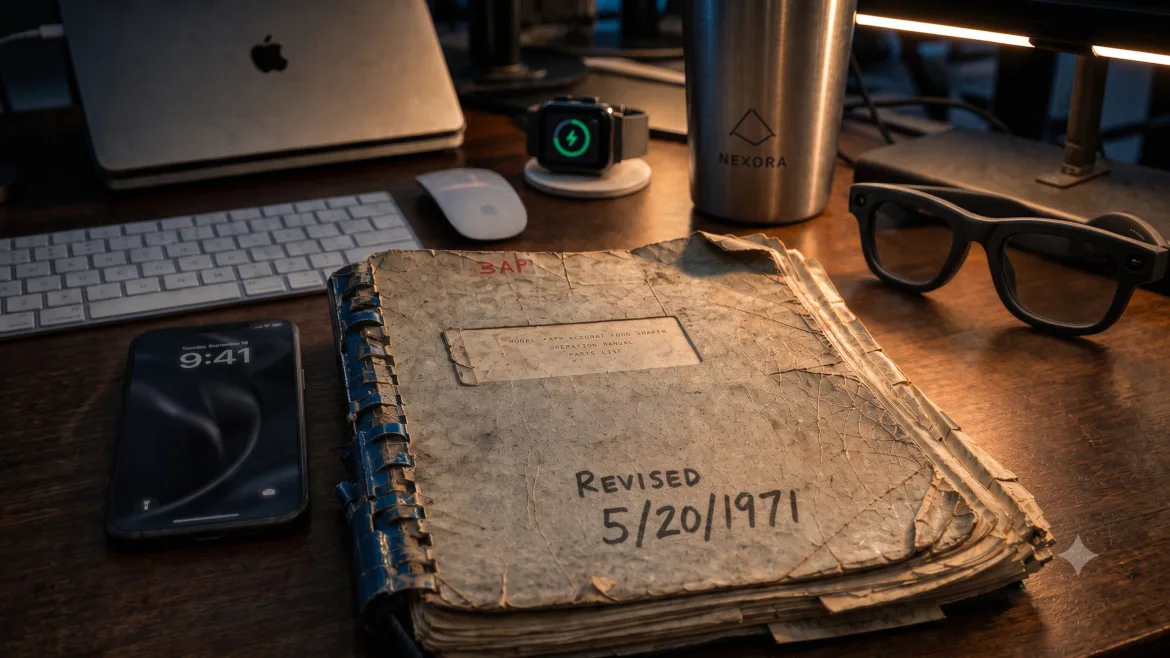
A manual that still matters decades later usually points to equipment designed the right way
When I started at EnSight as a young man, the seasoned veterans left no room for interpretation on the definition of quality. It meant consistency and reliability, using the best materials and components, with no shortcuts in fabrication. That was the industry mantra, and it sat at the center of every decision and most conversations. Now, 37 years later, quality is still the foundation of manufacturing, but as technology and automation have become more integrated, the definition has shifted. It is worth asking whether that change has improved the way we think about quality, or simply changed the way we talk about it.
A Fair Question Worth Asking
Quality was never a word used to describe how a machine looked on the production line. Quality meant hitting spec on shift one, shift two, and shift three, day after day, year after year, without excuses. Predictable. Consistent. Proven. That is still the only definition that matters on a production line, even if it is not the one getting talked about most.
Automation and new technology have brought positive change to this industry, and that deserves credit. But it is worth asking honestly, without pointing fingers at anyone's intentions, whether some of that innovation has drifted toward polish and features rather than improving the fundamental job the equipment is built to do. A sleek finish, attractive branding, and a flashy software loaded control panel are enticing on a spec sheet, but the real world impact may not be as appealing. The question is whether those added features are truly improving production overall or simply boosting a single metric. In my experience, the mantra of “Do it once, do it right” is still the best measuring stick for whether a design choice earns its place on a machine, or just decorates it.
The Hidden Cost of Complexity
Here is the part that does not get talked about enough. Every added sensor, screen, and system is not just a feature. It is a new point where something can fail, and a new skill a technician has to master to fix it. A machine with three moving parts and a machine with thirty do not just differ in cost to build. They differ enormously in the cost to keep running. A simple mechanical issue used to mean an hour with a wrench and a service manual. Now it can mean waiting on a specialist who understands the software layer sitting on top of the mechanics, because the fix is not just physical anymore. It is diagnostic. That is added risk sitting quietly on every line that has adopted it, whether anyone has accounted for it or not.
That risk is not theoretical. It shows up as longer average repair times, more specialized labor required per fix, and equipment that gets swapped out in years instead of the decades it could have lasted. When you add up the maintenance burden against the efficiency gains those features actually deliver on the floor, a lot of that complexity turns out to be a net drag on production, not a net gain.
Simplicity Is the Smart Play, Not the Simple One
Simplicity often gets mistaken for a lack of value, innovation, or ambition, as if it is what you settle for when you could not design or afford something more advanced. I would say they have it backwards. Removing unnecessary complexity from a machine takes more engineering, discipline, and skill, not less. It requires a skilled hand to step back, understand the whole picture, ask what could go wrong, and work the problem out of the design before it ever reaches the plant floor. That is the harder work. Products with extra features may be touted as more efficient or more advanced, but those additions can quietly mask weaknesses in the core design. Those weaknesses usually become apparent at the most critical times of a production run, long after the sales rep has left.
Take a bushing versus a bearing. The brass bushing we use at EnSight, with proper maintenance, are planned for a five year service life. A bearing, by comparison, converts that sliding friction in bushings into lower rolling friction and is considered a step forward in terms of operation, but often come with a planned service life of only one year. What looks like a footnote on a spec sheet actually changes the entire maintenance conversation. When components are selected to support an “ultra low friction” claim on a sales brochure over holistically improving quality, the preventive maintenance schedule is the one that pays the price.
What Easy Maintenance Actually Buys a Plant
Another test of good design is not how a machine performs on day one. It is how much labor it demands to keep performing on day one thousand. The difference between a five year bushing and a one year bearing may not seem significant in isolation, but when you run the numbers across a year and across every piece of equipment in the plant, the gap is not small. The compounding impact can be the difference between a maintenance program a plant can actually sustain and one that is perpetually playing catch up, falling further behind every time a complex fix eats a whole shift instead of an hour.
That is why maintenance friendly design matters. If a machine can be serviced without tearing half the unit apart, the work gets done. If it takes a specialist, a long diagnostic process, and more time than the plant can comfortably give, the service gets delayed. In this business, delayed service usually turns into shortened life.
Why This Matters More Right Now
The industry is consolidating. Economic pressure is thinning out demand, and fewer plants are being asked to run at peak efficiency with less room for error. In this environment, downtime is not an inconvenience. It is a death sentence for a production schedule, and competitors are always waiting for their opportunity to gain ground. Planned service time is budgeted and manageable. Unplanned downtime ripples through the whole business: missed orders, strained customer relationships, overtime nobody wanted to pay for. The more complex the equipment, the longer that downtime tends to stretch, because diagnosing a modern failure usually takes longer than fixing an old fashioned one.
Layer the labor shortage on top of that, and the stakes get higher still. Manufacturing has over 622,000 unfilled jobs in the US right now, and food processing is carrying more than its share of that gap. Deloitte projects the sector could need close to 3.8 million new workers by 2033 if the trend continues. Three out of every four food manufacturers already say they are struggling to find the people they need, a number that has climbed sharply from where it stood just a couple years ago. That is not a gap closing anytime soon.
Here is where it hits the plant floor directly. Technicians coming up today do not always carry the same deep technical background the last generation did, and there simply are not as many maintenance techs to go around. Complex equipment demands specialized knowledge that is getting harder to find, right at the moment the industry can least afford that gap. Equipment that is difficult to service tends to break down faster, and not always because techs are cutting corners, but because the labor is just not there to keep up with the complicated PM schedule. A machine that does not demand a specialist to diagnose a basic issue has a far better shot at getting its full preventive maintenance process completed by the crew on shift rather than requiring the specialized A team, who is inevitably on vacation when they are needed most.
What This Means for Buying Decisions
The next time a spec sheet crosses your desk, it is worth asking a different set of questions than the ones the sales rep is probably prepared for. How many failure points does this design actually introduce? What is the real service life on the wear components, not the marketed one? How much specialized labor does keeping this running actually require, and does the plant realistically have that expertise on staff or on call? Those questions will not show up in a brochure, but they are the ones that decide whether a machine is still running steady in ten years or sitting unusable because it is waiting on a part, or a specialist, nobody has.
The Bottom Line
Quality was never about the flash. It is about whether the machine does what it is supposed to do, every time, without asking more of your people or your maintenance budget than they have to give. Every layer of unnecessary complexity is a quiet tax on production, paid in longer repairs, scarcer expertise, and downtime that did not need to happen. I take a great deal of pride as I see this approach to quality in action at EnSight. The future holds both promise and challenge but through all the changes there is a common truth. The plants that treat simplicity as the smarter engineering choice, not the lesser one, are the ones that will still be running steady long after the equipment dressed up to impress has gone quiet.
Looking for a reprint of this article?
From high-res PDFs to custom plaques, order your copy today!