Key Preventive Maintenance Considerations for Expansion Joints in Food Processing Plants
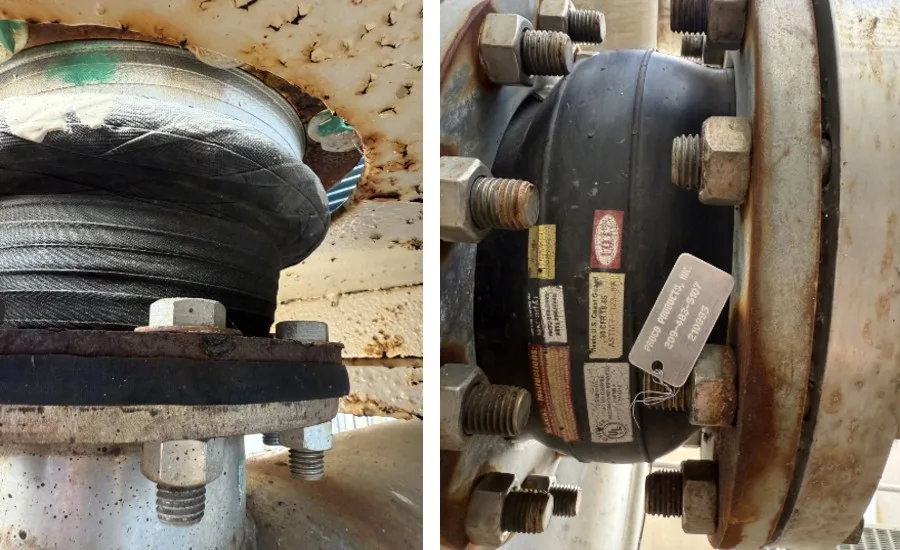
The expansion joint on the left shows overexpansion, while the expansion joint on the right shows visual wear and a 1-inch lateral offset.
Expansion joints absorb thermal movement, isolate vibration and accommodate misalignment in piping systems. They are installed at connections between equipment and piping, at transitions between dissimilar materials, and wherever the system requires controlled flexibility. Because they are flexible by design, they degrade differently than rigid pipe components and require a maintenance approach suited to that distinction.
A failed expansion joint can release hazardous media, damage adjacent equipment and trigger unplanned shutdowns. In applications involving abrasive slurries, high-cycle vibration or extreme temperature swings, the window between early degradation and functional failure narrows. A preventive maintenance program with scheduled professional survey inspections that document protocols and provide clear criteria for replacement will reduce failure events.
Understanding Failure Modes
Effective maintenance starts with understanding what causes expansion joints to fail so that operators know where and what to look for during maintenance rounds. The predominant failure modes fall into three categories: material degradation, installation-driven stress and operational overload.
Material degradation
Rubber bellows are subject to aging, ozone attack, UV exposure and chemical attack from the conveyed medium or external environment. Cracking, hardening or surface checking of the elastomer are early-stage indicators that can be identified visually. Delamination (the separation of the elastomer from the reinforcement fabric) is a more advanced condition that compromises pressure-bearing capacity.
Metal parts can suffer from stress corrosion cracking, pitting corrosion and fatigue cracking at the convolution roots. These failure modes are often less visible to the naked eye and may require expert inspection.
Installation-driven stress
A significant proportion of premature expansion joint failures originates at installation. Joints installed under excessive pre-stretch or pre-compression, flanges with significant angular or lateral offset, or bolting patterns that impose uneven loading all contribute to shortened service life. In some cases, joints are used to force misaligned pipe runs into alignment. This puts constant stress on the joint and dramatically accelerates wear.
Expansion joints are rated for specific movement in axial, lateral and angular directions. When the installed geometry forces a joint to operate at or beyond these rated limits, fatigue accumulates quickly. Control rods, limit rods and gimbal hardware can be used to contain joint movement within design limits; their absence or improper adjustment is a common root cause of premature failure.

Operational overload
Pressure surges, water hammer and vibration amplitudes that exceed design values all impose transient loads that joints may not be rated to withstand. System changes such as new pump installations, changes in flow rate and altered fluid chemistry can change the loading environment without triggering a review of expansion joint suitability.
Inspection Intervals and Assessment Protocol
Inspection frequency should be proportional to the severity of the operating environment. The following framework applies to most industrial installations.
Maintenance rounds should include a quarterly visual inspection of each expansion joint. The objective is to detect obvious changes: visible distortion, flange weeping, abnormal displacement or changes to control hardware. Inspectors should note any change in installed length, angular position or the condition of protective covers relative to the prior round. These checks do not require measurement — they establish a baseline for identifying change between formal condition assessments.
A full condition assessment should be conducted annually by a service provider. Some manufacturers provide this service for free. It should include measuring overall installed length at four circumferential points, examining the body for cracking or delamination, and verifying flange alignment. Metal attachments require examination for corrosion, deformation and liner condition. Findings should be documented and retained to build a service history that supports remaining-life estimates and replacement budgeting.
For higher risk environments with abrasive media, shorter intervals may be appropriate where:
- Abrasive media is conveyed (mining slurries, fly ash, sand)
- High-cycle vibration is present from reciprocating equipment
- Thermal cycling is frequent, or the temperature range is wide
- Fluid chemistry approaches the limits of the elastomer's rated compatibility
Rubber joints in standard industrial service typically achieve a service life of five to seven years. Actual life depends on the quality of the product, installation and operating history.
Preparing for an Expansion Joint Survey
For facilities with over 40 rubber or PTFE of expansion joints, particularly process industries, semiconductor facilities and steel mills, a professional survey provides the most reliable baseline for maintenance planning.
Before conducting a survey, assemble all available documentation: piping and instrument diagrams, equipment data sheets, original installation records and prior inspection reports. Confirm the number, location and service of each joint. Develop a consistent numbering or tagging scheme if one does not already exist.
Remove insulation or protective jacketing covering expansion joints to ensure full access and proper inspection. Insulating a rubber expansion joint is inadvisable because trapped moisture has nowhere to escape, accelerating the degradation of the rubber compound over time.
A completed survey should produce three actionable deliverables: a prioritized replacement list, a recommended spares inventory (matched to specific locations), and an updated inspection schedule. The spares inventory is especially important for facilities where joint sizes are non-standard or where lead times for custom fabrication could extend downtime during an unplanned failure.
Common Inspection Findings
The following conditions appear regularly in expansion joint assessments and warrant specific responses.
Excessive lateral offset
Lateral displacement beyond the joint's rated capability is often a result of pipe misalignment that was not corrected at installation. The appropriate corrective action is to address the alignment before replacing the joint — reinstalling a new joint in the same geometry will reproduce the failure. Where permanent alignment correction is not practical, a tied expansion joint or gimbal arrangement may be the more appropriate specification.
Cracking and tearing at the flange
Cracking near the flange bead indicates fatigue or chemical attack. Contributing factors include over-torqued bolting, irregular flange face surfaces and elastomer-fluid incompatibility. Bolting should be torqued to the joint manufacturer's specification, typically lower than standard pipe flange torque values, and applied in a cross-pattern to distribute load evenly. Joints showing flange-area cracking should be scheduled for replacement.
Cover damage and delamination
Surface cuts and checking are sometimes dismissed as cosmetic. Cover damage exposes the reinforcement carcass to environmental attack, accelerating degradation. Delamination indicates a bond failure, often due to chemical incompatibility or heat aging, and warrants immediate replacement. In systems where external abrasion or UV exposure is a factor, protective covers or wraps can extend life between replacements.
Overextension
Joints found significantly elongated or compressed relative to their neutral catalog length are operating outside their design range. Where control rods or limit hardware are absent, system forces can displace joints beyond rated travel. The correct response is to install appropriately sized control hardware and address the source of excess movement, which may include thermal growth calculations, pressure thrust analysis or evaluation of anchor and guide spacing.
Field Experience
A recent survey conducted by Proco Products for a potato processing plant in Idaho found that the majority of more than 230 rubber expansion joints were serviceable but identified several that required reorientation, replacement or closer monitoring. The survey covered 12 pump locations across the facility's sugar flume, water return, blanching, quenching and box-cutter systems.
Several joints showed installation or fit issues that could lead to premature failure. These included, for example, a bolt impinging on the joint's arch (recommended reorientation), missing full-faced mating flanges on multiple pumps (recommended spacer installation to ensure a complete seal), and a joint slightly over its standard overall length (flagged for monitoring). More serious conditions included a joint compressed beyond half its allowable range, another overextended by roughly half an inch with associated excessive system movement (recommended control rods to stabilize), and a single-arch joint installed where vibration-dampening duty exceeded its design tolerance (recommended replacement with a different joint style).
The most urgent items were three joints recommended for immediate replacement: one with a deteriorated bottom flange, one showing a developing bulge and one with significant flange rotting and cracking that posed an active leak risk. The report documented overall condition, measurements for replacement sizing and specific concerns at each location, generating a store maintenance list to guide future component sourcing.
Replacement and Procurement Planning
Size verification should be performed against the as-installed dimension, not the original catalog specification. Settlement, bolt load and pressure elongation can cause installed joints to differ from nominal values. Measuring actual face-to-face length at four circumferential points during the survey establishes the correct replacement dimension and avoids fitting problems at installation.
For non-standard sizes, procuring a standard joint with a dedicated spacer is often faster and less costly than custom fabrication, provided the configuration is verified for the service pressure and movement requirements. Material compatibility should be confirmed against current operating parameters, not the original design basis. Fluid chemistry, temperature range and any abrasive content should all be reviewed and accounted for in the manufacturer's elastomer selection guide before specifying a replacement.
Expansion joints are designed to fail first to prevent damage to more expensive or critical piping and equipment, but the goal is to avoid failure entirely. Knowing what to look for in your facility, along with what to expect from an expert survey, will ensure you have a strong preventive maintenance and repair program, helping your facility avoid failure events.
Looking for a reprint of this article?
From high-res PDFs to custom plaques, order your copy today!