Food Engineering logo
search
cart
facebook twitter linkedin youtube
  • Sign In
  • Create Account
  • Sign Out
  • My Account
Food Engineering logo
  • NEWS
    • Latest Headlines
    • Manufacturing News
    • People & Industry News
    • Plant Openings
    • Recalls
    • Regulatory Watch
    • Supplier News
  • PRODUCTS
    • New Plant Products
    • New Retail Products
  • TOPICS
    • Alternative Protein
    • Automation
    • Cannabis
    • Cleaning | Sanitation
    • Fabulous Food Plants
    • Food Safety
    • Maintenance Strategies
    • OEE
    • Packaging
    • Sustainability
    • More
  • EXCLUSIVES
    • Plant Construction Survey
    • Plant of the Year
    • Sustainable Plant of the Year
    • State of Food Manufacturing
    • Top 100 Food & Beverage Companies
  • MEDIA
    • Podcasts
    • Videos
    • Webinars
    • White Papers
  • FOOD MASTER
  • EVENTS
    • Food Automation & Manufacturing Symposium and Expo
    • Industry Events
  • RESOURCES
    • Newsletter
    • Custom Content & Marketing Services
    • FE Store
    • Government Links
    • Industry Associations
    • Market Research
    • Classified Ads
  • EMAGAZINE
    • eMagazine
    • Archive Issue
    • Advertise
  • SIGN UP!
Food SafetyManufacturing News

Manufacturing News

Food Fraud: You purchased what?

Is your burger really 100 percent beef? Is your virgin olive oil really virgin? Only your analytical instrumentation knows for sure.

June 7, 2013

Is your burger really 100 percent beef? Is your virgin olive oil really virgin? Only your analytical instrumentation knows for sure.

As a result of the recent UK horsemeat scandal, consumers and processors are very much aware they may not be getting what they paid for.

A well-attended conference session at BNP Media’s 2013 Food Safety Summit, Food Fraud/Economically Motivated Adulteration, brought counterfeit food issues
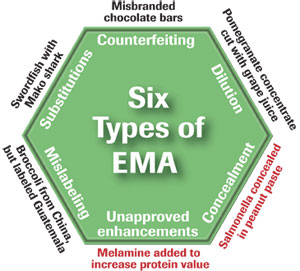
  EMA
    Not all types of EMA are injurious to human health. The basic motive is to make as much money as possible, while operating secretly as long as possible. But some problems are bound to crop up, such as melamine in pet food and baby formula and Salmonella in peanut paste.

to the forefront. John Spink, director of the food fraud initiative at Michigan State University (MSU) warned the audience that “counterfeiters attend anti-counterfeit conferences.” What better place for bad guys to learn how to manipulate the system?

Neil Stiber, FDA director, risk management staff, began the session with defining economically motivated adulteration (EMA) as the fraudulent, intentional substitution or addition of a substance in a product for the purpose of increasing the apparent value of the product or reducing the cost of its production, i.e., for economic gain.

EMA includes dilution of products with increased quantities of an already present substance (e.g., increasing inactive ingredients of a drug) to the extent such a drug-related dilution poses a known or possible health risk to consumers. EMA also includes the addition or substitution of substances to mask dilution.

EMA, according Stiber, costs the global food and consumer products industry $10 to $15 billion per year. One incident can cost a company 2-15 percent of its yearly revenues.

Spink suggests there are plenty of aspects of EMA/food fraud to worry about that could result in recalls. Since the purpose of EMA is to make money, the “bad guys” aren’t necessarily trying to make people sick, says Spink. In fact, they just want to keep operating in the background and making money, hoping they won’t get caught or cause a recall. Spink points to the recent horsemeat scandal and a few others that have been in the news:

• Peanut Corporation of America selling known contaminated product

• Pure olive oil diluted with other oils

• Melamine in pet food and infant formula

• Over-icing product with unsanitary water

• Unauthorized, unsanitary repackaging (up-labeling or origin laundering).

Fortunately, government and industry groups are addressing EMA problems, and there is help for processors that would like to get involved in combating food fraud. Jason Bashura, senior defense analyst for FDA’s Food Defense and Emergency Coordination Staff, described FDA’s interactions with the National Center for Food Protection and Defense (NCFPD, www.ncfpd.umn.edu). The goals of this joint effort are to identify foods at elevated risk of EMA; identify ingredients that are most susceptible to EMA so insufficient analytical methodologies can be addressed; conduct ongoing surveillance of various data sources that provide prior indication of EMA potential; and approach prevention and mitigation as needed specifically for each potential food or ingredient.

NCFPD has compiled documented incidents of EMA since 1980 into an online, searchable database hosted on www.foodshield.org. Food scientists from around the globe evaluated the monographs in the US Pharmacopeial Food Chemicals Codex for susceptibility to EMA. The results of these evaluations can be found at foodshield.org. In addition, NCFPD has developed a methodology for monitoring food imports for anomalies that could signal an increased risk for EMA. Finally, NCFPD is developing case studies for EMA-prone products to evaluate various data sources for scanning and understanding anomalies in food supply chains. 

KEYWORDS: food defense food fraud FSMA testing

Share This Story

Looking for a reprint of this article?
From high-res PDFs to custom plaques, order your copy today!


Recommended Content

JOIN TODAY
to unlock your recommendations.

Already have an account? Sign In

  • 2025 Top 100 Food and Beverage Companies

    FOOD ENGINEERING’s 2025 Top 100 Food and Beverage Companies

    While sales were largely down under dynamic economic and...
    Top 100 Food & Beverage Companies
    By: Alyse Thompson-Richards
  • Bottling machine

    How Optical and X-Ray Inspection Supports Bottling Safety and Quality

    By transitioning from legacy single-technology systems to...
    Food Safety
    By: Dan McKee
  • Bread baking in oven

    The State of Food Manufacturing in 2025

    Food and beverage manufacturers are investing in...
    Manufacturing News
    By: Alyse Thompson-Richards
Manage My Account
  • eMagazine
  • Newsletter
  • Online Registration
  • Manage My Preferences
  • Customer Service

More Videos

Popular Stories

The Campbell's Company logo

Campbell’s Terminates Exec Over Alleged Disparaging Comments

alternative protein products

Alternative Protein in 2025: Key Trends and Technologies

circular packaging material for frozen and chilled food packaging

Sustainable Barrier Coatings Replace PFAS, PE and other Plasticized Materials in Packaging

State of Maufacturing 2025

Events

June 17, 2025

Refrigerated & Frozen Foods’ State of the Cold Chain

On Demand Kelley Rodriguez, Editor in Chief of Refrigerated & Frozen Foods, will be joined in this 60-minute webinar by industry experts to help unpack the latest research.

July 23, 2025

Decarbonizing Process Heat: What You Should Know and Next Steps

On Demand Driven by climate goals, business risk, client interest, and resilience considerations, food and beverage companies are increasingly turning their attention to decarbonizing their production processes.

View All Submit An Event

Products

Recent Advances in Ready-to-Eat Food Technology

Recent Advances in Ready-to-Eat Food Technology

See More Products

CHECK OUT OUR NEW ESSENTIAL TOPICS

Alternative ProteinAutomationCleaning/SanitationFabulous Food Plants

Food SafetyMaintenance StrategiesOEE

PackagingSustainability

Related Articles

  • Food Safety: What did you learn this summer?

    See More
  • What GFSI can do for you

    See More
  • FDA inspection

    What you need to know before an FDA visit

    See More

Events

View AllSubmit An Event
  • July 23, 2025

    Decarbonizing Process Heat: What You Should Know and Next Steps

    Driven by climate goals, business risk, client interest, and resilience considerations, food and beverage companies are increasingly turning their attention to decarbonizing their production processes.
  • July 23, 2025

    Decarbonizing Process Heat: What You Should Know and Next Steps

    On Demand Driven by climate goals, business risk, client interest, and resilience considerations, food and beverage companies are increasingly turning their attention to decarbonizing their production processes.
View AllSubmit An Event
×

Elevate your expertise in food engineering with unparalleled insights and connections.

Get the latest industry updates tailored your way.

JOIN TODAY!
  • RESOURCES
    • Advertise
    • Contact Us
    • Food Master
    • Store
    • Want More
  • SIGN UP TODAY
    • Create Account
    • eMagazine
    • Newsletter
    • Customer Service
    • Manage Preferences
  • SERVICES
    • Marketing Services
    • Reprints
    • Market Research
    • List Rental
    • Survey/Respondent Access
  • STAY CONNECTED
    • LinkedIn
    • Facebook
    • YouTube
    • X (Twitter)
  • PRIVACY
    • PRIVACY POLICY
    • TERMS & CONDITIONS
    • DO NOT SELL MY PERSONAL INFORMATION
    • PRIVACY REQUEST
    • ACCESSIBILITY

Copyright ©2025. All Rights Reserved BNP Media.

Design, CMS, Hosting & Web Development :: ePublishing