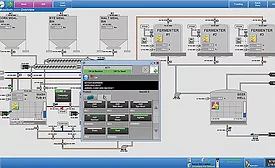
Do what makes sense when installing automation in your facility, considering your budget and business goals. Understanding your application can help you fine-tune your equipment purchase.
While the trend for large manufacturers is to automate a new plant in its entirety, small and medium-sized food and beverage processors rarely have the funds to automate their plants, turning them into lights-out facilities. Even some tier-one processors may find areas in certain operations where it may not make sense to over-automate.
Five facilities are recognized for projects or programs that improve environmentally friendly efforts in food and beverage product manufacturing operations.
On April 15 of this year, PMMI’s OpX Leadership Network presented the 2014 Sustainability Excellence in Manufacturing Awards (SEMA) during Food Engineering’s Food Automation & Manufacturing Conference in Clearwater Beach, FL.
Conveyors and the belts that run on them, whether they are polymer, metal, hybrid or fiber, connect raw material reception, processing, packaging, palletizing, accumulation, final delivery and a myriad of other things.
In this video, Gerald Lessard, Vice President & Chief Operating Officer of West Liberty Foods, discusses the major challenges of retaining technicians and how the FIT Program can help enhance plant productivity as well as keep technicians in the food and beverage industry throughout their careers.
Global warming is heavily debated in some circles, but governing bodies worldwide have declared it a reality, regardless of personal belief. For the past 30 years, regulatory agencies around the world have been working to reduce greenhouse gas emissions, beginning with the 1987 Montreal Protocol, which was the first globally supported legislation to reduce ozone-depleting substances.
For the last 20 years, 3-A SSI and EHEDG have been working together to create a synergistic set of hygienic design, testing and implementation standards for process equipment.
No one ever said 3-A Sanitary Standards Inc. (3-A SSI) and the European Hygienic Engineering and Design Group (EHEDG) guidelines were supposed to be compatible or directly interchangeable in an “apples to apples” sense. In fact, they were conceived at different times, in different parts of the world and with different needs in mind.
It shouldn’t be news that bad work designs can spell major problems for employers in terms of lost production time, workers’ compensation claims and injuries. All of these take deep cuts out of the bottom line. But poor design can hurt you where you least expect it such as in turnover rates, damage to your brand and bad rankings in best place to work surveys.
You add up the mass of raw materials your facility consumes each day, look at the products it’s made, and the numbers just don’t balance—until you look at skids of rework and a dumpster topped off with the day’s malformed products and/or damaged packages.
Whether your plant is located in a drought-stricken area or where water is plentiful, building a wastewater treatment center on site may be cost effective for several reasons.
With the Sun Belt states experiencing serious droughts and the cost of processing wastewater escalating in many municipalities, conserving and reusing water at food and beverage processing facilities just makes plain business sense.
As consumers want a bigger variety of healthier choices that come in a plethora of sizes, manufacturers are offering fillers that are flexible while producing optimal output.
Blame social media, changing tastes and needs or just the “Have it your way” attitude inspired by Burger King’s decades-long slogan, but modern consumers are demanding