Making Cloud-Based Maintenance & EAM More Resilient
Recent outages among internet cloud providers have shown that maintenance and enterprise asset management (EAM) systems need to have a fallback — and fortunately most automation suppliers are ready.
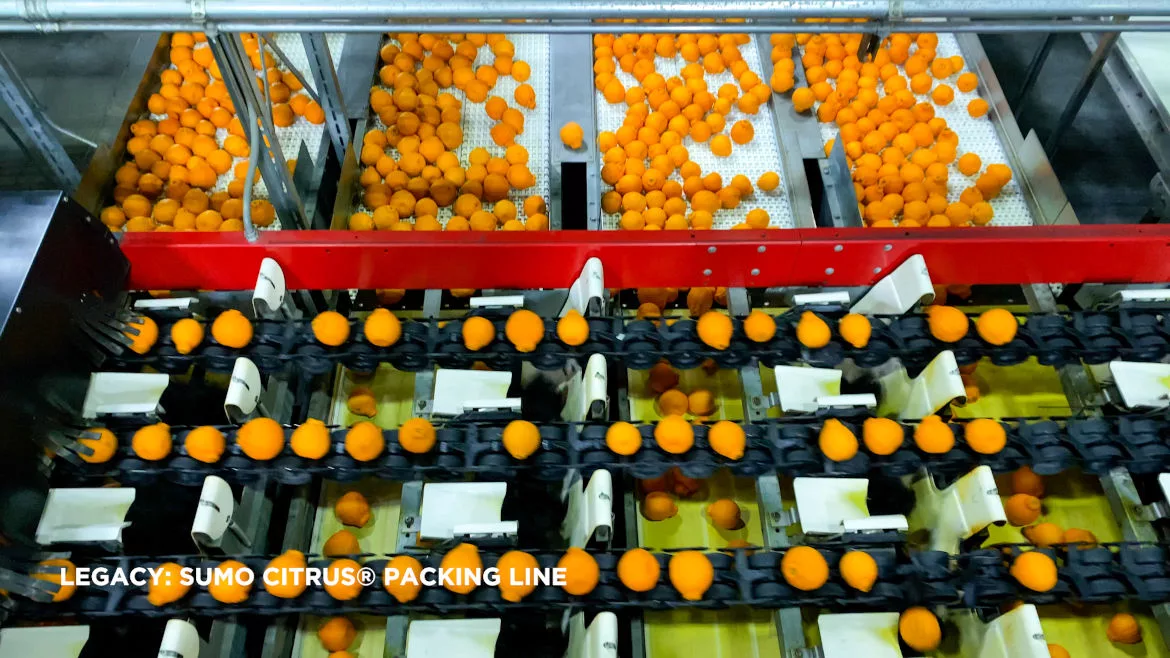
Suntreat, a leading citrus grower and packer of its Sumo Citrus brand, is replacing its paper-based maintenance system with a cloud-based enterprise asset management (EAM) from Ultimo, an IFS company. The system will be installed first at its legacy facility in Dinuba, California.
While food companies are relying on remote (cloud-based) support for maintenance and asset health monitoring or enterprise asset management (EAM), what happens when these cloud services break (lose connectivity) due to a communications failure like the one that AWS (Amazon Web Services) suffered recently — where communication was out anywhere from some minutes to a day or more?
In this article, we look at backup methods that automation/maintenance companies provide for their end users should a cloud service or internet service provider (ISP) communications fail. Though the applications presented are proprietary to the specific respondents, the underlying technologies tend to be similar and will be important considerations as you think about and search for the appropriate tools for your applications.
Looking Back
In fall 2025, there were outages with some large cloud service providers that of course made headlines, says Jason Pennington, Endress+Hauser (E+H) USA director of digital solutions.
“Today, most of the world is running cloud-first systems for reasons of scalability, response and recovery, and ease of administration,” Pennington says. “It’s difficult to make a singular decision that covers the entire enterprise; for example, in manufacturing, hybrid architectures leverage traditional PLC/DCS and SCADA. Historians allow critical systems and data to be processed in real time and synchronized later once connectivity is established. Business and operational continuity becomes more expensive with hybrid architectures, but the benefits of continuing operation cannot be undervalued.”
Hidden Vulnerabilities Exposed by Cloud Outages
Charles Lim, head of digital security solutions at Yokogawa East Asia, lists five vulnerabilities that are exposed when a web service — or “cloud” — goes down. They include production disruptions (including maintenance and EAM), inability to monitor critical quality and safety parameters, supply chain blind spots, cybersecurity risks and loss of operator confidence.
Many food and beverage manufacturers depend on a cloud-based manufacturing execution system (MES), quality management platforms, maintenance, ERP and scheduling tools. If these systems become unreachable:
- Operators may lose access to essential batch instructions.
- Automated production lines can stop functioning due to missing cloud-hosted recipe data.
- Maintenance workflows and alerts may be disrupted, increasing operational risk.
Cloud outages often force companies to implement emergency workarounds, such as manual overrides or unsecured local access. These actions can raise exposure to unauthorized system access, data integrity problems and safety lapses caused by rushed or improvised responses.
Lim says that even short-lived outages can erode trust in digital systems. Operators may begin to rely on manual, parallel processes, leading to inconsistencies and slowing the pace of digital transformation.
How F&B Businesses Can Protect Themselves: Best Practices for Cloud Resilience
1. Adopt hybrid cloud architectures: Retain critical, real-time control functions on-premises — while leveraging the cloud for analytics and long-term optimization. This ensures plant operations continue even during prolonged cloud outages.
2. Implement local edge computing. Edge devices can:
- Cache vital recipes, production schedules and quality parameters locally.
- Continue executing control logic during cloud downtime.
- Automatically synchronize data with the cloud once connectivity is restored.
This approach removes the dependency on constant cloud availability.
3. Build redundant network paths. Using multiple internet carriers and SD-WAN technology helps maintain stable connectivity, even if one provider fails.
4. Maintain an offline-ready operating model. Critical systems should be capable of:
- Operating autonomously without cloud access.
- Logging data locally.
- Reconciling changes when the system reconnects.
Regular testing of offline capabilities is essential to ensure readiness.
5. Strengthen OT cybersecurity. During outages, operational technology (OT) environments are especially vulnerable. Strengthening OT networks, implementing role-based access controls, and securing remote access minimizes the risk of exploitation during disruptions.
6. Use digital twins and simulation tools locally. Having local simulation capabilities allows operators to plan, troubleshoot and maintain plant operations, even if cloud-based engineering tools are unavailable.
— Charles Lim, head of digital security solutions, Yokogawa East Asia
Get the “Edge”
Before the days of cloud computing and “edge servers,” most on-premises servers were simply named according to function, for example, SCADA, MES server, local file servers, historian, “private cloud,” maintenance or EAM host server and ERP (which might have included several common maintenance functions).
Unlike cloud servers, which operate in data centers anywhere in the world, edge servers operate at far more locations or “points of presence” (PoPs) where data is produced and consumed by users and devices. The physical location of an edge server is typically close to the systems or applications creating the data that is being stored/used by the edge server. At the “edge” of the network, these servers are usually responsible for relaying the data to the cloud for further processing. This arrangement is usually known as a hybrid solution.
However, E+H’s Pennington makes a case for cloud-exclusive systems. “Cloud exclusive environments serve many benefits, such as ease of sharing data between applications without the need for time consuming or error prone export/import activities. Keeping data on-premises or on-the-edge is not necessarily 100% without cloud. For example, some enterprise-specific AI tools are highly preferred over public cloud services or AI engines. The main safeguards for leveraging AI tools and protecting data also need to be reinforced and observed through company-specific lenses to ensure the suggestions and results continuously improve, are valid contextually and deliver increasing value while maintaining security.”
Endress+Hauser provides Netilion as its primary cloud service. “With Netilion, users have automatic asset management enrollment and product updates in our Library and Analytics services,” Pennington says. “With live connections, we can continuously monitor asset health according to the Namur NE107 framework; e.g., distinguishing between failures, a need for maintenance and out-of-spec operation.”
“Netilion Connect is an embedded service within our platform that can securely share master data and perform basic functions like work order creation in maintenance systems based on asset health status,” Pennington adds. “For example, Netilion has a standardized connector to the CMMS System FiiX, by Rockwell Automation.”
Automation Suppliers Have the Edge
Festo has a variety of cloud-based and hybrid solutions that facilitate predictive maintenance, condition monitoring, and asset management, says Jonas Schimmele, business driver digital business. “The Festo AX (Automation Experience) platform is our way to enable AI-based analytics for maintenance and performance optimization. Smartenance, a cloud-based digital maintenance manager (CMMS), is what we offer to help maintain operational continuity and efficiency even when there is a failure in cloud communication.”
Smartenance brings together various resilience strategies and is equipped with a mobile app that enables operators to perform maintenance tasks, access documents and view videos right at the machine even if there is no continuous cloud connection. The offline mode allows the execution and recording of tasks locally with the data being updated once the connection is restored. This ensures that necessary maintenance activities can continue at the local level even if there is a temporary cloud outage. Data is stored locally and synced once connection is restored.

“At HMS Networks, we offer the Red Lion FlexEdge™ Intelligent Edge Automation platform powered by Crimson® software,” says Courtney Peel, strategic product manager, insights. “This powerful IIoT device gives food and beverage customers a flexible industrial solution with advanced network security on the edge with local control and visualization, cloud connectors with intelligent buffering, and connectivity to Ewon Talk2m cloud for secure remote monitoring. This hybrid local-plus-cloud approach protects users from data loss associated with unplanned outages that can disrupt remote diagnostics, halt predictive maintenance and compromise visibility into critical assets — and can lead to production delays, quality risks and compliance challenges.”
FlexEdge devices log data and run critical control logic at the edge, so production processes continue uninterrupted. Operators can access real-time dashboards and historical logs locally through the system webserver. Crimson also uses MQTT cloud connectors with data buffering for efficient, secure data exchange with cloud platforms. When connectivity is lost — whether due to an ISP issue or a cloud outage — data is buffered locally. FlexEdge provides the necessary features to meet the stringent cybersecurity needs of food and beverage applications while derisking data loss and offering real-time alarms and events with local and virtual displays for KPI monitoring to enable real-time insights.
Explore More Essential Content


Planning a Resilient CMMS/EAM: Start Simply and Work Up
E+H’s Pennington: “Generally, we recommend mapping where each user is and where they want to progress to. We suggest starting with key assets and not trying to immediately engage the entire plant operation in a single implementation. In this way, users can experience and learn iteratively, as opposed to expending extensive efforts to set up, execute and maintain architectures before being proven in use.”
To be resilient from unplanned outages and connectivity issues, food processors should plan their digital transformations around a hybrid architecture, combining the benefits of cloud scalability with the reliability of local control, data buffering and real-time data visualization, Peel says. Critical considerations for a resilient hybrid architecture include: MQTT cloud connectors with intelligent data buffering; local control and visualization on the edge so production processes continue uninterrupted in the event of latency or lost connectivity; hybrid cloud/edge for real-time control locally and cloud for advanced analytics and remote support.
Processors need to implement a hybrid system that merges the adaptability of the cloud with the strength of the local plant, Schimmele says. Festo’s Smartenance and AX platforms are designed to support operations that can be done offline; thus, the maintenance teams may have access to the schedules, record the incidents and handle the tasks even if there is a cloud service interruption.
In order to keep the business running without interruptions, Schimmele suggests:
- Edge computing for local data processing and condition monitoring.
- Mobile-first tools for decentralized access.
- Redundant connectivity paths (e.g., dual ISPs, 4G/5G failover).
- AI-driven predictive maintenance via Festo AX, deployable on-premises or in the cloud.
- Secure local authentication and time-stamped data logging for compliance.
This approach ensures that maintenance operations remain autonomous, traceable and compliant, even in distributed environments or during connectivity disruptions.
When the Cloud Goes Down…
Since running large maintenance applications and even controls in the cloud can provide a multitude of advantages — especially with AI powering them — the question to ask is what’s still functional should cloud-based services go down? Hybrid architectures do a pretty good job of keeping local operations running normally.
According to Lim, Yokogawa’s distributed control systems (DCS), local SCADA platforms and modular automation solutions ensure that critical production and safety systems remain fully functional, even without cloud connectivity. The key advantage is that real-time control remains onsite and deterministic, regardless of how long the cloud outage lasts. Yokogawa’s edge controllers and data acquisition platforms enable local execution of control logic, local storage and buffering of production and quality data and continuous operation of essential workflows.
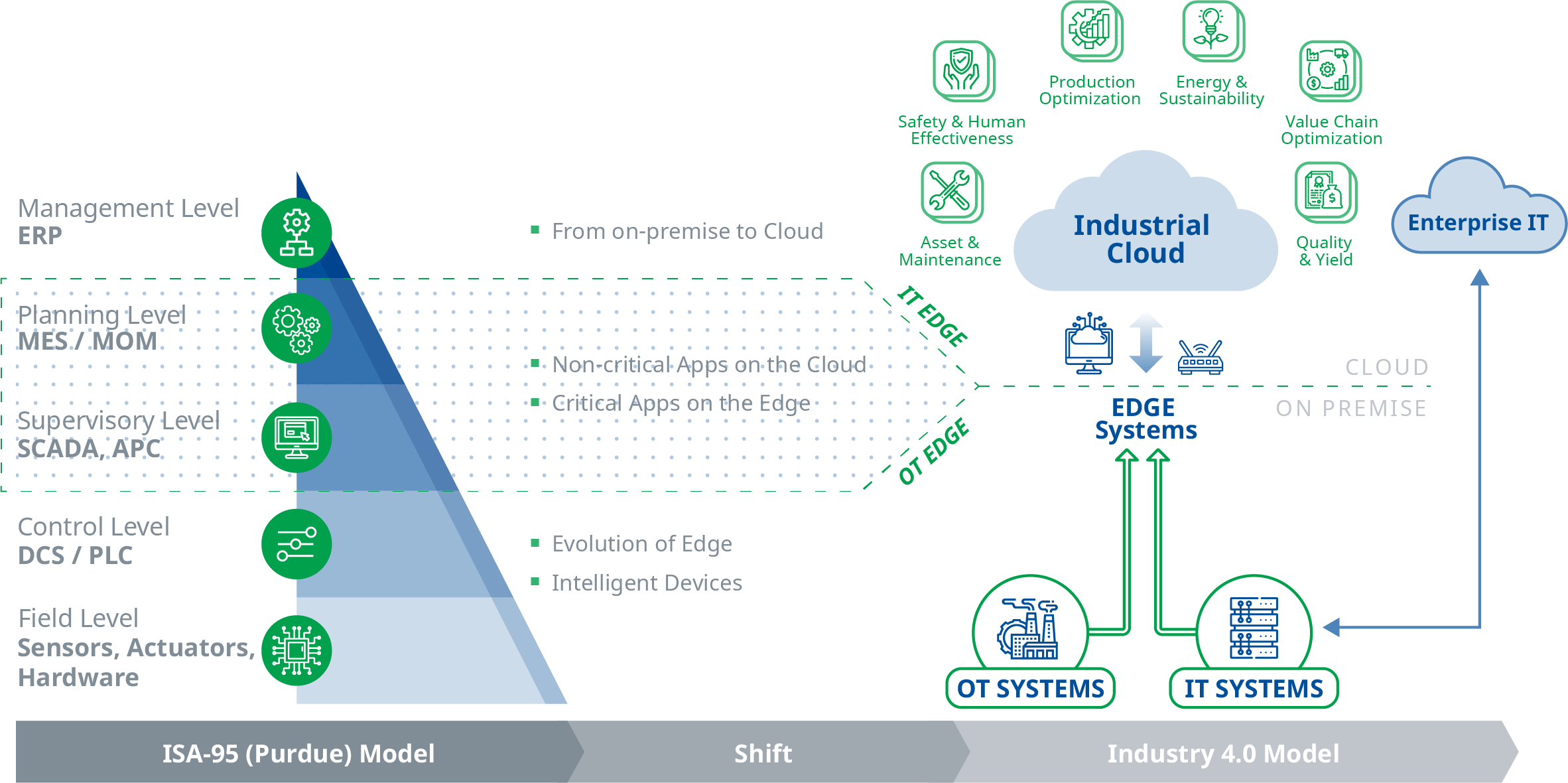
In addition, while full-scale cloud AI models may not be able to run locally due to compute and storage constraints, edge-based analytics can handle critical KPIs and rule-based diagnostics, says HMS Networks’ Peel. This ensures real-time insights for essential maintenance tasks without cloud dependency.
Food processors should choose edge devices with robust local logic execution for control logic and basic analytics on the edge. Cloud connectors that buffer data by storing it locally until connectivity resumes should also be implemented. Local dashboards should be designed to provide operators and plant managers with real-time and historical trend views on local virtual HMIs or smart TVs, Peel adds. Other considerations include edge-based predictive rules for anomaly detection and threshold alerts, local AI lite models deployed on the edge for critical asset health checks often in an integrated container environment, using redundant connectivity to reduce single point of failure like cellular failover with a secondary ISP, and hybrid storage with local storage for compliance and operational continuity.
Not having cloud functionality doesn’t mean AI can’t be used. Artificial intelligence-powered maintenance insights may be done locally with Festo AX, which allows on-premises deployment, Schimmele says. Food and beverage processors, thus, can continue to get predictive maintenance alerts and anomaly detection even during a prolonged cloud outage. Alternatively, Smartenance provides offline capabilities through mobile applications, whereby technicians can access schedules, record incidents and carry out documentation locally. All information is securely saved and synchronized when the connection is restored.
Cloud installation is usually a customer-initiated action through the Smartenance web portal, and Festo supports the integration, especially for the advanced setup like SAP connectivity through the AX Smartenance SAP Connector, Schimmele adds.
Multiple Locations and Headquarters
Geographic distribution adds layers of complexity to cloud-based maintenance. For instance, when the HQ acts as a central node for data aggregation and decision-making, the loss of connectivity can have a ripple effect. If, for example, the HQ in Chicago disconnects from the rest of the network, it can hamper centralized analytics, reporting and coordination.
According to Schimmele, Festo fights this problem with Smartenance and Festo AX, which allow a decentralized operation. By installing offline-capable mobile apps, local data caching and edge-based AI via Festo AX in each plant, the users ensure that each plant can independently continue maintenance. This guarantees that maintenance tasks, incident logging and condition monitoring can go on uninterrupted, even if the HQ or cloud services are temporarily out of reach.
If the food processor follows the best practice hybrid architecture approach, mission critical maintenance data will be processed on the edge, and the necessary alarms and events will still be triggered locally in the event of a loss of connection to headquarters, says HMS Networks’ Peel. Once the plants come back online, the buffered data will be transmitted through the cloud connectors, and enterprise analytics will resume.
For example, a FlexEdge device at each of the plant locations in the U.S. and Canada can send data to the company’s cloud and SCADA system used by headquarters, while still running local control, alarms and events, Peel adds. The data feeds into the enterprise dashboards while local dashboards provide real-time KPIs and data insights for operators and local plant management.
If the connection to the enterprise cloud is interrupted, the data is buffered at the edge and there is no change in local monitoring, control or visualization; therefore, there is no impact or application interruption, Peel says. Once the plant is connected to cloud again, the buffered data is sent to the cloud, and the enterprise cloud connectivity is restored. A hybrid solution allows the plants to maintain their applications autonomously from the cloud while the cloud captures the data from the individual applications to feed into enterprise analytics and larger scale AI models.
Solving the Outage Problem
While having cloud-based tools lend themselves to more powerful analytical functionality in monitoring maintenance activities, assets and processes, having a fallback system on site is key to smooth operation while a cloud service may be out. Electrical outages? That’s another story.
Suntreat Selects Cloud-based Ultimo to Digitize Maintenance and Boost Asset Visibility
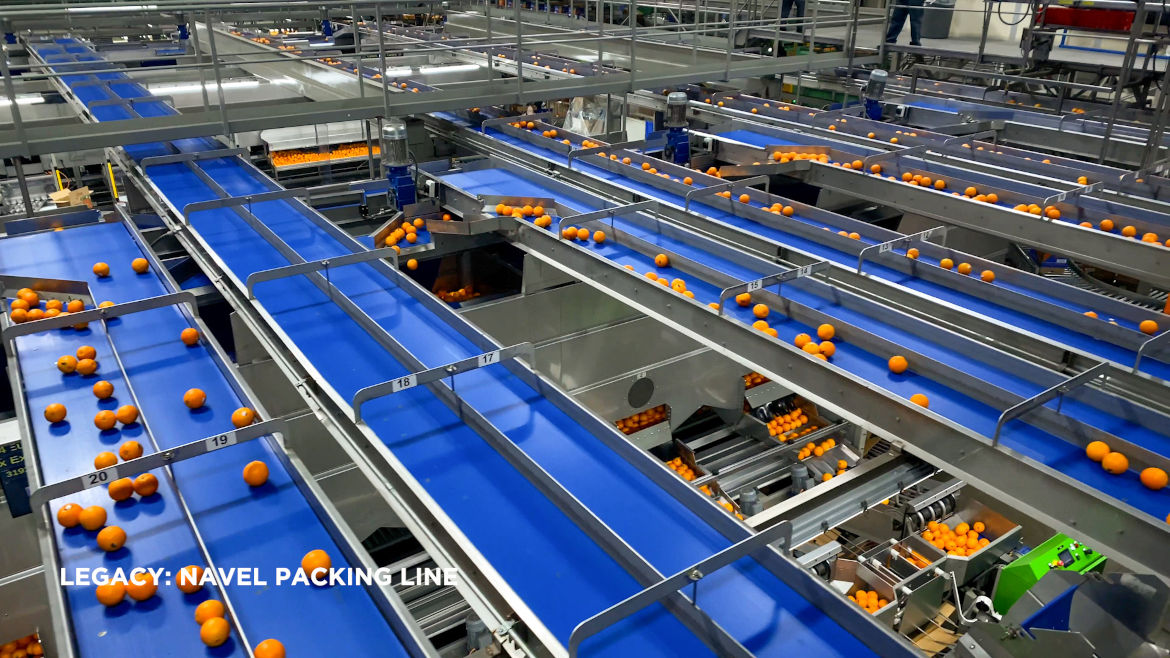
Suntreat®, a leading citrus grower and packer best known for its premium Sumo Citrus brand, is replacing paper-based maintenance processes with an enterprise asset management (EAM) system from Ultimo, an IFS company. As part of a digital transformation program for the maintenance and management of its physical assets, the manufacturer is using Ultimo EAM solutions to track work, share insights across sites and manage materials efficiently. The Ultimo software enables real-time auditability, centralized asset visibility and support future expansion.
Part of the AC Food Family, Suntreat handles citrus for approximately 150 grower families on over 9,000 acres, and supplies millions of cartons of fruit every year. The company is committed to producing food not just sustainably, but regeneratively. With operating brands such as Sumo Citrus and I’m Pink Cara Cara, Suntreat grows and packs a variety of citrus, both popular high-volume and specialties. Ultimo’s EAM integrates seamlessly with Suntreat’s current enterprise resource planning (ERP) system, Famous Software, which is tailored for the fresh produce supply chain.
From farm to freezer, including nurseries, packing and cold storage, the rapidly modernizing leadership team at Suntreat is focused on digital transformation.
“Selecting Ultimo marks a major milestone for us,” says Kevin Watson, VP of operations at Suntreat. “We needed more than just a software tool — we needed a flexible, scalable platform and a partner who understands how to help us evolve as a business in every stage of our asset management journey. Ultimo’s intuitive interface, proven industry track record and ability to integrate with our existing ERP system made it the clear choice to digitize our maintenance processes, bring real-time visibility across our teams and support our long-term growth.”
Suntreat is implementing the Premium Edition of Ultimo EAM software with a suite of specialized modules tailored to their maintenance, health and safety and operations teams, including: Asset Management, EHS Incidents, Lockout/Tagout, Work Permits, Self-Service, and Power BI dashboards — all delivered through the cloud. The first phase of implementation began at Suntreat’s legacy site in Dinuba, California, supporting a broader strategy to roll out across additional locations in the future. The company’s industrials assets include forklifts, loading equipment, sorting and grading equipment, irrigation systems, tractors, harvesters, refrigeration systems and cold storage and freezer units.
“We’re thrilled to partner with Suntreat as they embark on their digital transformation,” says Candi Robison, VP Americas at Ultimo. “Able to provide robust support for their operations, we’re proud that Ultimo will play a central role in helping Suntreat to improve its maintenance safety, efficiency and asset reliability. This partnership reflects the transformative impact modern EAM solutions can have in the food and beverage sector.”
Looking for a reprint of this article?
From high-res PDFs to custom plaques, order your copy today!